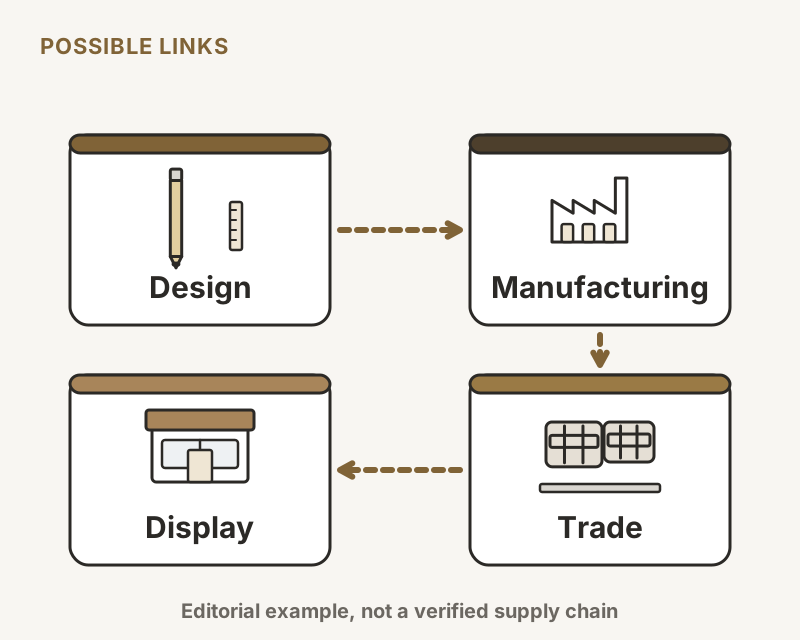
Context and practical distinctions
A manufacturing city beyond one product category
The public records linked in this guide describe ceramics history, exhibition settings and furniture-related activity. Read the ceramics account and Longjiang report as accounts of particular sectors and places, rather than as a current industry census. They do not establish what any particular company makes. A regional label cannot answer whether a cabinet, a basin or a fitting was produced at the premises shown to a visitor.
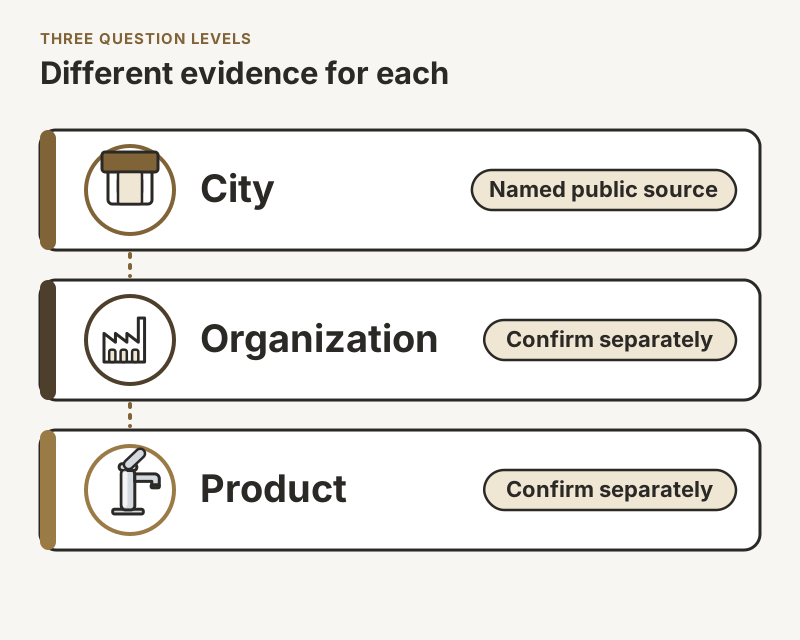
Start with the city, then identify the organization and the specific product. This distinction is useful to a curious reader as well as a buyer: an economy can contain production, design, distribution and exhibition businesses without those activities belonging to the same company.
| Question | Evidence or boundary |
|---|---|
| City or event | Read the named public source within its scope. |
| Individual organization | Confirm the activity and identity separately. |
Ceramics history and the development of exhibition trade
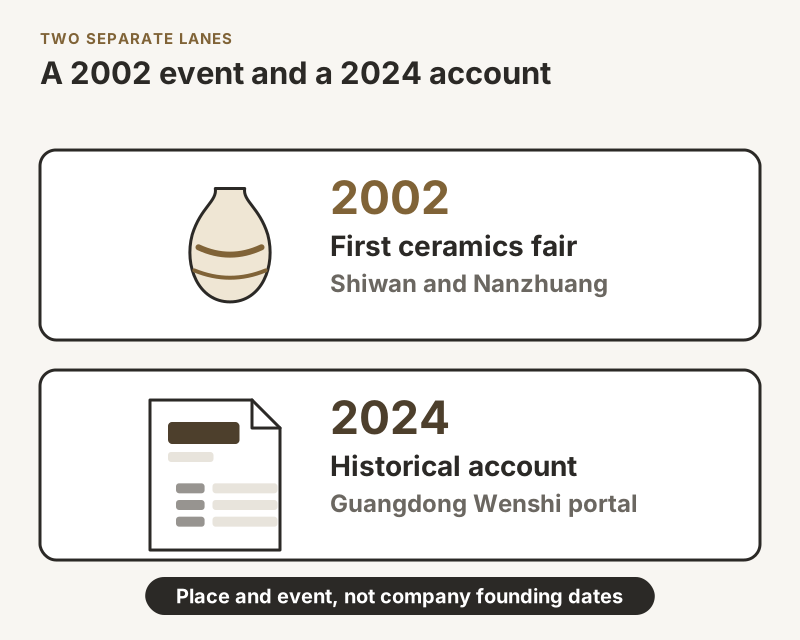
The 2002 first CeramBath event and the 2024 account publication occupy separate historical lanes; the spacing is not an industry growth scale.
Sources: S2: Guangdong Wenshi portal; article credits Guangdong provincial local chronicles office
Original generated SVG editorial artwork; not a photograph or verified factory record.
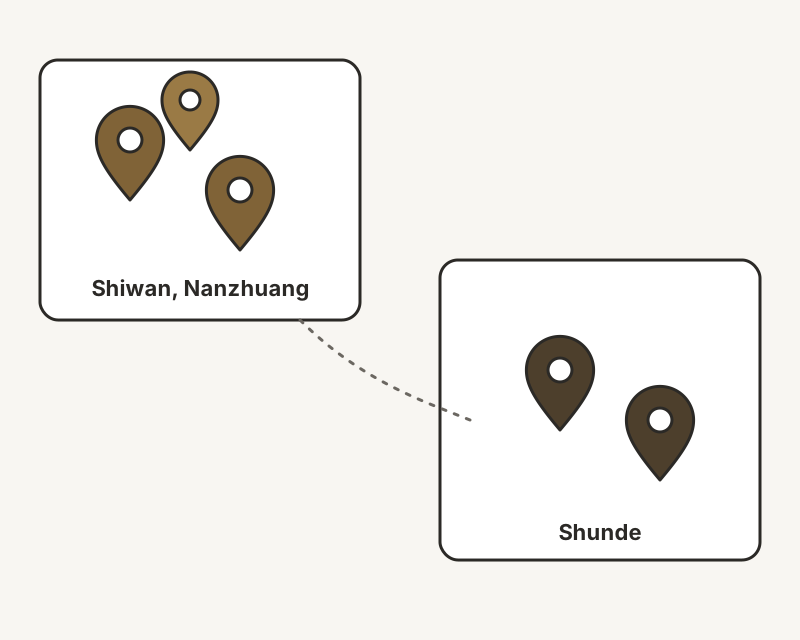
A 2024 historical account on the Guangdong Wenshi portal, credited to the provincial local chronicles office, connects Foshan ceramics with Shiwan and the later development of building and sanitary ceramics. It records the first ceramics fair in Shiwan and Nanzhuang in 2002. Read the historical account. These are historical milestones for a place and an event, rather than founding dates for every business operating there today.
- Identify the subject being discussed.
- Read the date and scope of its source.
- Keep interpretation separate from documented facts.
The historical perspective helps explain why manufacturing and display appear together in accounts of the city. It does not establish that a modern company owns an old kiln, has inherited a particular process or produces every category discussed in that history.
China Ceramics City: permanent and temporary displays
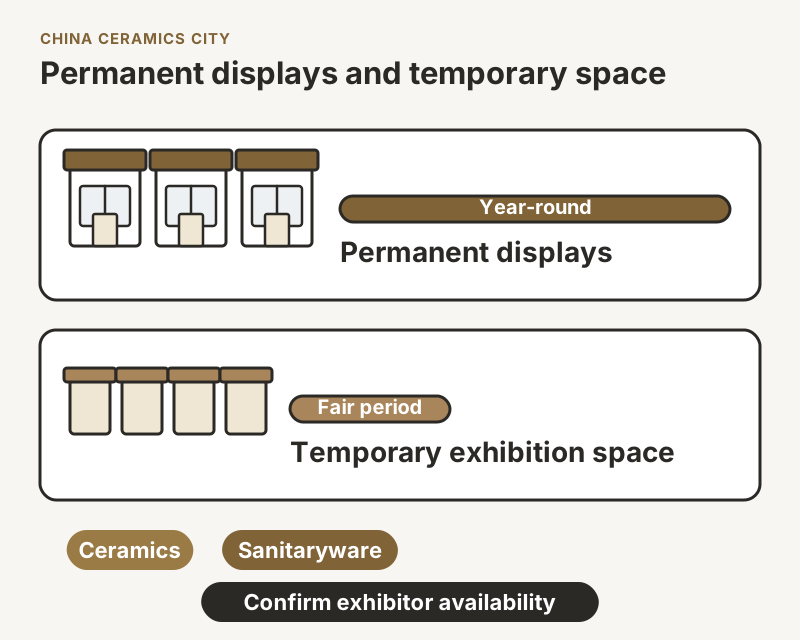
Organizer S3 distinguishes permanent year-round displays and temporary fair-period booths. Band lengths are qualitative, not opening-hour measurements; confirm exhibitor availability.
Sources: S3: CeramBath organizer
Original generated SVG editorial artwork; not a photograph or verified factory record.
The organizer describes China Ceramics City as having permanent displays alongside temporary exhibition space, with categories that include ceramics and sanitaryware. Check the CCC venue page. The two display formats answer different questions about when a visitor can expect to see a particular exhibitor; current availability still needs confirmation with that exhibitor.
| Display format | Source scope |
|---|---|
| Permanent | Organizer-described permanent displays; confirm exhibitor availability. CCC venue |
| Temporary | Organizer-described fair-period exhibition space. CCC venue |
A display setting helps people examine appearance, compare samples and discuss a range. It does not by itself show where that range is manufactured. Treat the venue description as information about the venue, rather than as verification of each exhibitor’s business model.
The headquarters venue is a showroom setting
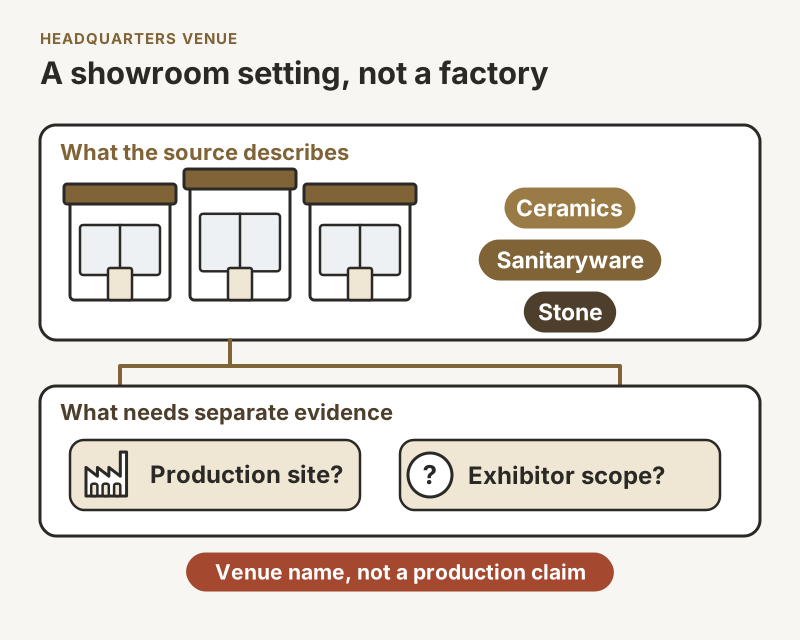
Source S4 describes showroom buildings and categories. The lower branches mark limits of inference, not facilities confirmed for WNS.
Sources: S4: CeramBath organizer
Original generated SVG editorial artwork; not a photograph or verified factory record.
The organizer describes China Ceramics & Sanitaryware Industry Headquarters as a collection of showroom buildings featuring categories including ceramics, sanitaryware and stone. Read the headquarters venue description. The word headquarters belongs to the venue name. It should not be interpreted as a statement that every displayed product is manufactured inside those buildings.
| What the source describes | What needs separate evidence |
|---|---|
| Showroom buildings | Whether a particular displayed product is made at a particular production site. |
| Displayed categories | The actual scope of an individual exhibitor. |
This is a useful example of how a place name can describe a commercial setting without describing a production process. Here, the source identifies buildings, displays and product categories. Questions about a specific production site require separate information.
Huaxia has a different exhibition emphasis
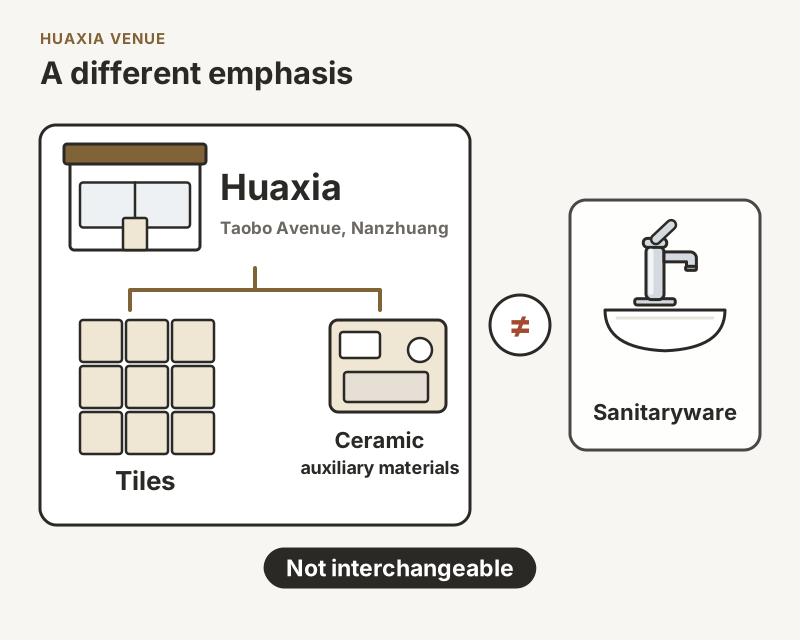
Organizer S5 lists tile varieties and ceramic auxiliary materials. The hierarchy groups those source categories to guide display interests; it does not represent material properties, product samples or an exhaustive current exhibitor inventory.
Sources: S5: CeramBath organizer
Original generated SVG editorial artwork; not a photograph or verified factory record.
The Huaxia venue page places the exhibition center on Taobo Avenue in Nanzhuang and describes an emphasis on tiles and ceramic auxiliary materials. Read the Huaxia venue page. It should not be presented as an interchangeable sanitaryware showroom simply because it appears within the same fair’s venue information.
Scope of the information
A useful city guide distinguishes the subjects displayed at each location. That allows a reader to understand the exhibition ecosystem without treating an event’s entire category list as available at every building, or treating exhibitors from different places as all manufacturing locally.
- Use the source for its stated subject.
- Do not infer company capability from the setting.
Lecong and Longjiang illustrate different roles
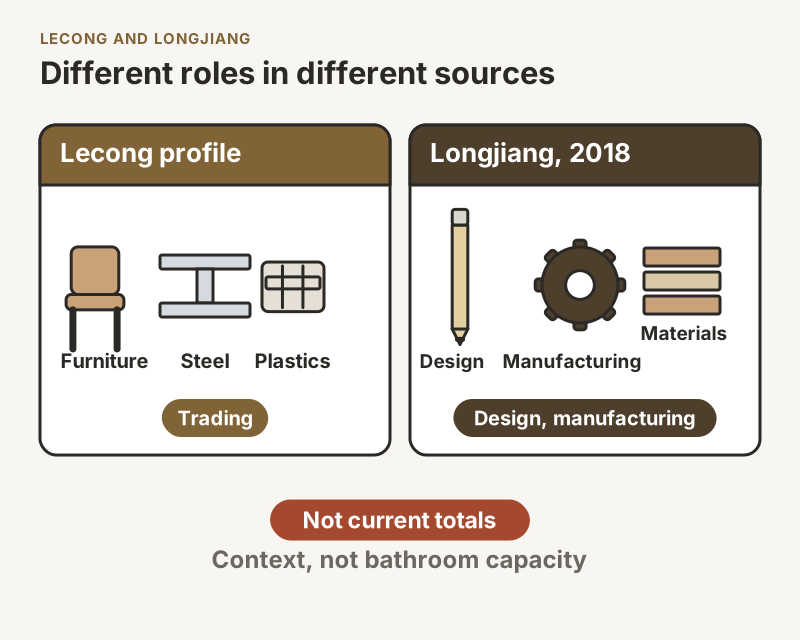
Compare the stated subject and dating of S6 and S7, not current scale, market share or sanitaryware capacity.
Sources: S6: Shunde government-domain town-profile service S7: Shunde District Human Resources Public Service Center
Original generated SVG editorial artwork; not a photograph or verified factory record.
A Lecong profile on the Shunde employment-service website discusses furniture, steel and plastics trading. Its mixed historical figures are not used here as current totals. Read the Lecong profile. A separate 2018 Longjiang account discusses furniture design, manufacturing and materials. Read the dated Longjiang account. The Lecong profile and the 2018 Longjiang account illustrate different kinds of commercial and industrial activity within the wider city.
A practical distinction
These furniture examples are context, not evidence that a bathroom supplier can supply steel, plastics or all furniture categories. Nor do they prove current production capacity. The date and sector of each source matter as much as the name of the town.
Keep dated context and current confirmation clearly separate.
Manufacturing, design, trade and display are distinct
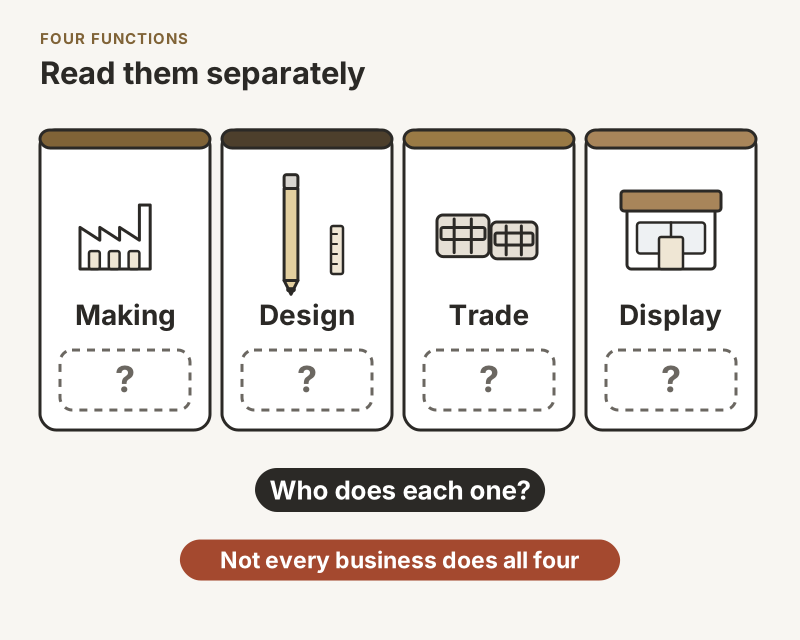
A responsibility-allocation worksheet asks who performs each task. Roles may overlap; no party or WNS responsibility is prefilled.
Original generated SVG editorial artwork; not a photograph or verified factory record.
The records in this guide discuss different activities: making goods, developing designs, trading materials and presenting products. Our interpretation is to read those functions separately, rather than assuming that all of them are performed by every business. This is an explanatory framework, not an official classification of individual companies.
| Question | Evidence or boundary |
|---|---|
| Activity | A manufacturer may coordinate purchased components, while a trading or coordination business may provide useful selection and communication services. Neither label is an automatic quality verdict. To learn about an individual organization, examine its stated scope and the evidence for the activity being discussed. |
| Unconfirmed statement | Keep it as a question rather than a conclusion. |
Read dates and statistical categories carefully
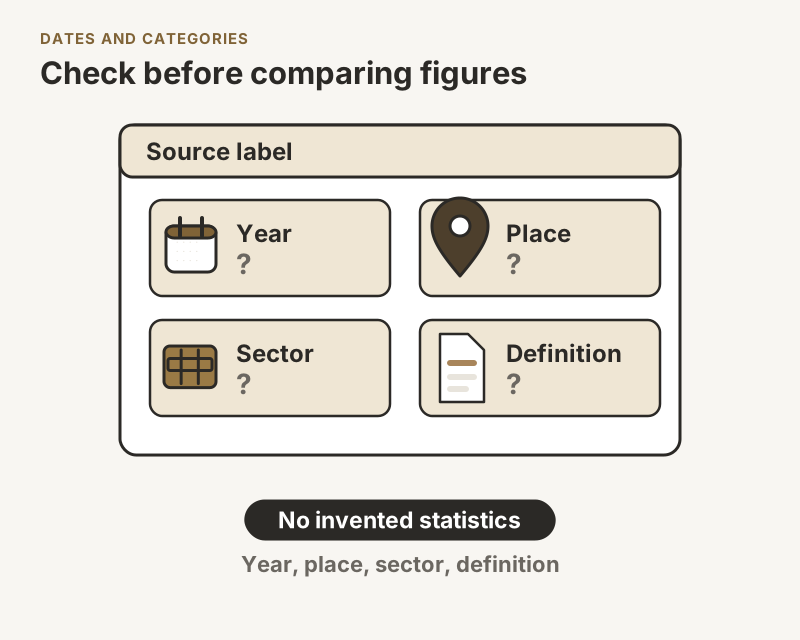
An illustrative source label groups time, geography, subject and definition within one record. No invented statistic is supplied; the diagram shows what to check before comparing figures.
Original generated SVG editorial artwork; not a photograph or verified factory record.
Historical information can explain how an area developed, while a venue page can explain what an organizer currently advertises. Neither should silently become a current production census. When reading a percentage or a ranking, identify its year, geography, sector and definition before comparing it with another figure.
- Check the date. Confirm the edition or time period.
- Check the scope. Identify the place, activity and source.
What remains open
This guide intentionally omits output totals, rankings, exhibition-area figures and industry shares. Omitting an inapplicable number preserves a clearer explanation.
What this ecosystem tells us, and what it leaves open
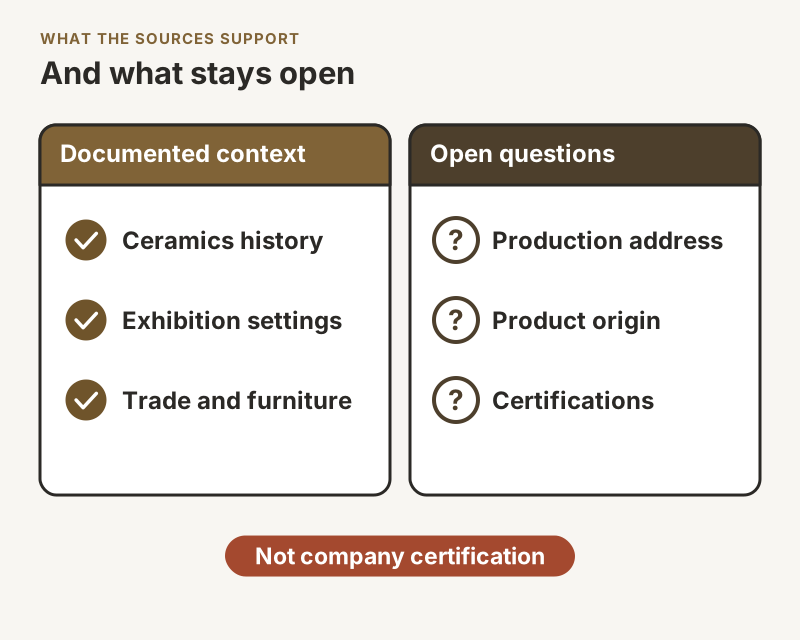
Separate a supported answer from an unanswered question; neither branch treats regional context as company certification.
Original generated SVG editorial artwork; not a photograph or verified factory record.
The sources support a picture of a manufacturing city with historical ceramics activity, several exhibition settings and examples of specialized trade and furniture activity. They do not establish a single uniform supply chain for every bathroom product, or a capability statement for WNS Global.
| Question | Evidence or boundary |
|---|---|
| Documented context | Retain source, date and subject. |
| Open question | Record what still needs confirmation. |
Keep the conclusion within the evidence
- No unsupported ranking or output statistic.
- No company capability inferred from regional context.
Questions about a business’s production address, product origin, equipment, certifications and order responsibilities remain company-specific. Readers can explore the official sources without taking a purchasing step. For event planning, use the organizer’s current introduction and calendar rather than treating this evergreen article as a schedule.