From rating to request
What does the magnification number on a mirror mean?
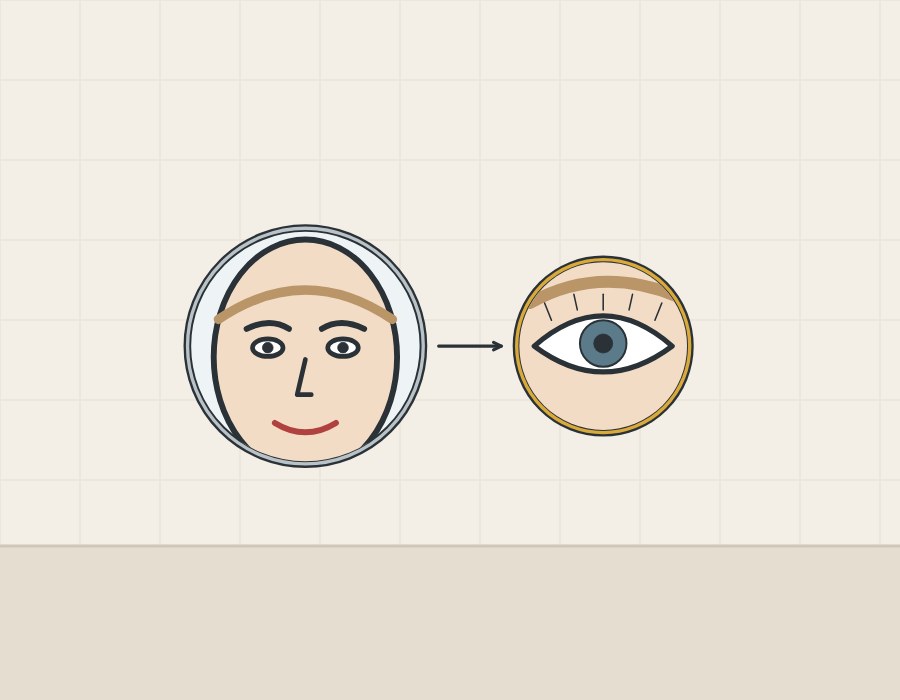
The number says how much larger the mirror makes an object look. Baci Mirrors’ magnification guide rates a plain flat mirror at 1X and one that makes an object three times larger at 3X.
Baci names 3X, 5X, 7X and 10X as the most common ratings for make-up and shaving mirrors. Two things control the result, it says: the curve of the glass, which is fixed, and the user’s distance, which is not.
No standard defining how a rating is measured was found for this guide. Treat a rating as the maker’s own figure.
| Term | What it means |
|---|---|
| 1X | Baci: a plain flat mirror. |
| Curvature | The curve of the glass; fixed, per Baci. |
| User distance | Variable; it changes the image, per Baci. |
| Focal distance | Baci: half the radius of the curved surface. |
| Detail window | On simplehuman’s Trio, a 10x area on the same side as the 1x view. |
How does distance change what the user sees?
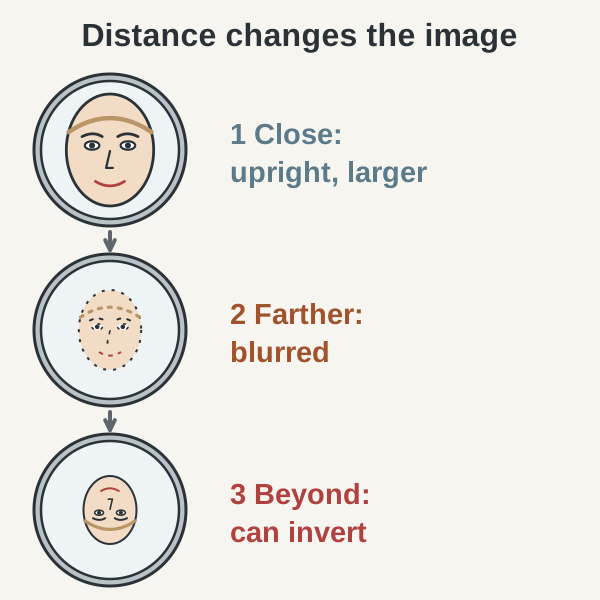
Distance decides whether the image is upright, blurred or upside down. The sequence follows Zadro’s viewing-distance article and Baci’s guide.
- The user stands close, inside the maker’s stated viewing distance.
- Zadro says the image is then upright and magnified.
- Baci says that moving back makes the image larger, up to a point.
- Zadro says that farther away the image turns blurry or distorted.
- Beyond that range, Zadro says, the reflection can become inverted.
- Zadro’s selection article says to move the face closer to the mirror.
The cause is the curved surface, which Zadro says bends and focuses reflected light. Baci’s guide defines the focal distance as half the radius of that curve.
Which view suits which task?
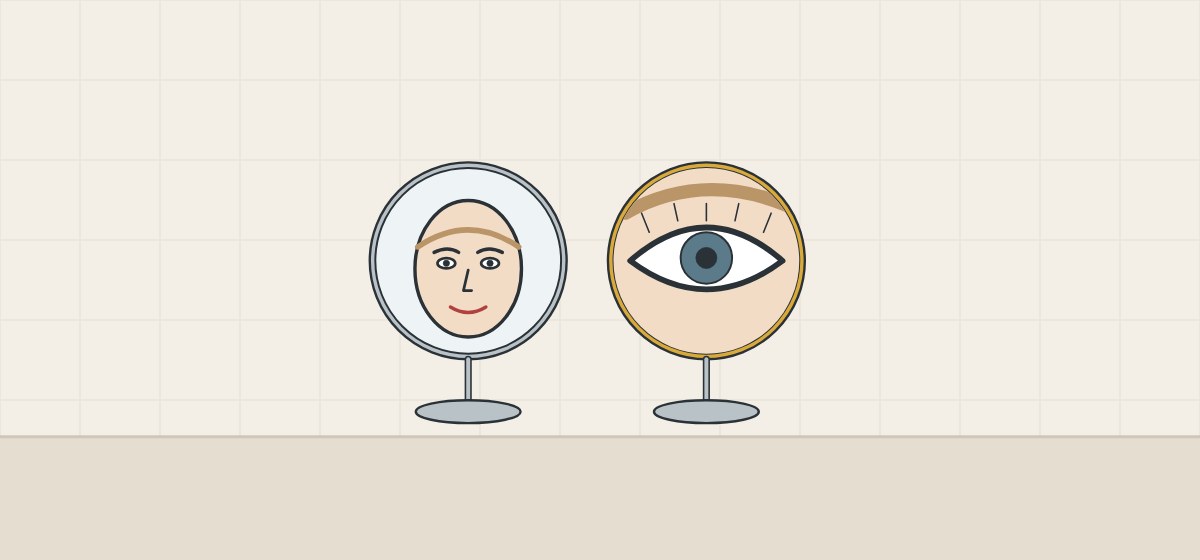
Simplehuman gives 5x to the full face and Zadro gives 1X to the entire face; each source in the table names close or detailed work for a higher power. Zadro prefaces its list “for most people”.
| Source | View | Stated use |
|---|---|---|
| simplehuman Trio | 5x side | Full-face clarity |
| simplehuman Trio | 10x window | Hyper detail |
| Zadro, selection article | 1X | Viewing the entire face |
| Zadro | 10X | Detailed makeup, skincare, tweezing |
| Baci | 3X or 5X | Works very well for most users |
| Baci | 7X | Declining vision or very detailed work |
| Jerdon, 10x article | 10x | Brows, false lashes, eye makeup, skincare |
Zadro and Baci do not treat the highest number as the best choice. Zadro keeps 15X and 20X for very detailed grooming tasks, and Baci places 10X in pocket compacts and other small-diameter mirrors.
How do named mirrors arrange their views?
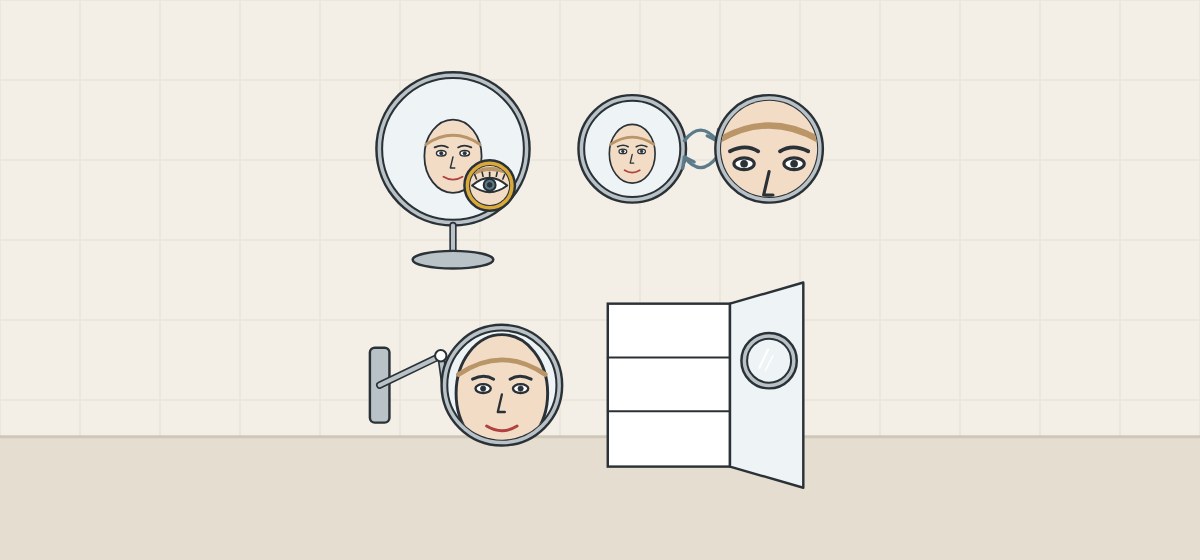
Named products combine views in different ways. Each row is that maker’s own description.
| Layout | Named example | What the maker states |
|---|---|---|
| Two sides plus a window | simplehuman Sensor Mirror Trio | 5x on one side; 1x and a 10x window on the other. |
| 1X and one higher power | Zadro Lexington | 10X on one side, 1X on the other. |
| 1X and one higher power | Jerdon HL75 | Listed as 8X-1X. |
| Two magnified sides | emco prime LED | Mirrored on both sides: 3x and 7x. |
| One power on a swivel arm | KEUCO iLook_move | 5x; round or square; with or without LED lighting. |
| Inside a cabinet door | Kohler Verdera K-99007 | A built-in magnifying mirror that adjusts vertically. |
A product name is not a view specification. The Kohler text retrieved for this guide gave no magnification figure, and the simplehuman pages gave no size for the 10x window, so ask for both.
How close does the user have to be?
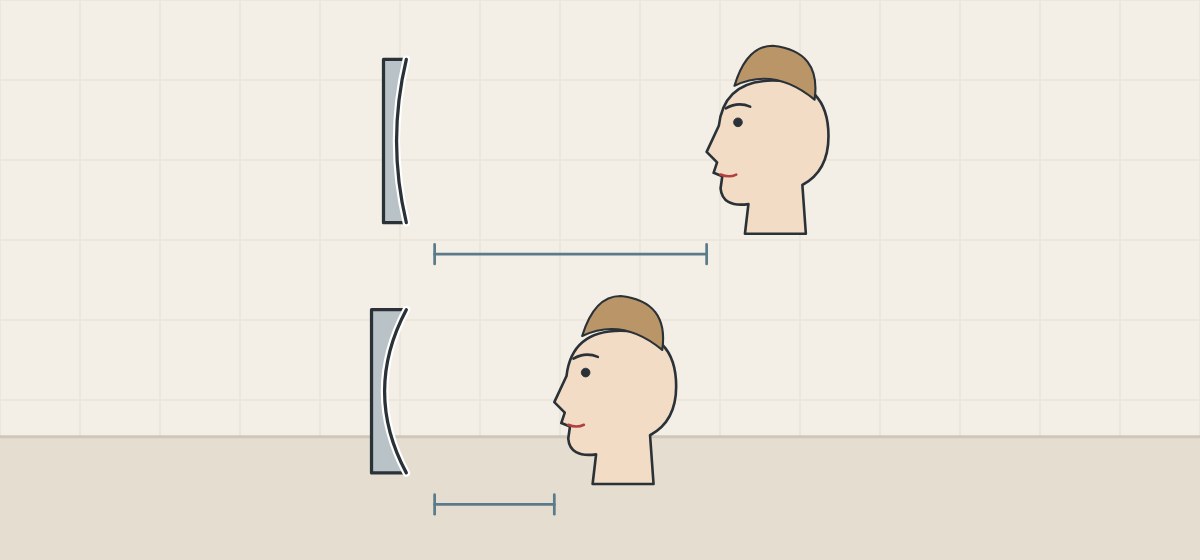
Closer as the power rises, according to Zadro. The figures are the makers’ own, not a general rule:
Zadro, 5X
Zadro’s distance table gives 6 to 8 inches.
Zadro, 10X
The same table gives 4 to 6 inches; Zadro’s selection article says most 10X mirrors are designed for approximately that.
Zadro, 15X and 20X
The table gives 3 to 5 inches for 15X and 2 to 4 inches for 20X.
Jerdon, 10x
Jerdon’s 10x article calls about 5 to 6 inches ideal.
- The maker’s stated viewing distance for each view
- Where the user will sit or stand
- How far the mirror can come towards the user
What decides whether the user can get that close?
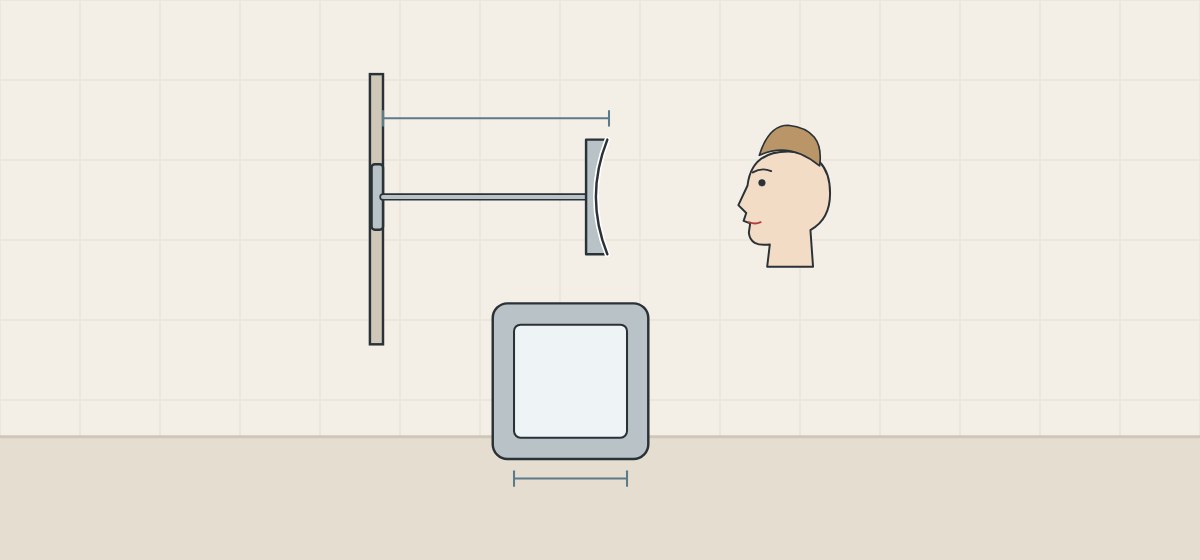
Arm reach, reflective size and adjustment decide it. Three points from named products:
Arm reach
Zadro lists a 20-inch extended arm on its Lexington; Jerdon lists a 13.5-inch arm on the HL75.
Reflective size
The Lexington’s head is 10 by 10 inches but its reflective surface is 7.5 by 7.5 inches. emco gives its prime LED mirror a 202 mm diameter without saying whether that is the reflective area. Zadro says a surface that is too small can make everyday tasks frustrating.
Adjustment
KEUCO says the iLook_move arm adjusts height, sideways position and inclination. Simplehuman lists an 8-inch size with manual flip and a 10-inch size with automatic flip; on the 10-inch Trio Max it says a double-tap on the touch bar flips the mirror.
Optical quality is a further line: Baci says a poorer quality mirror may show distortion or waviness.
What must the specification keep separate from magnification?
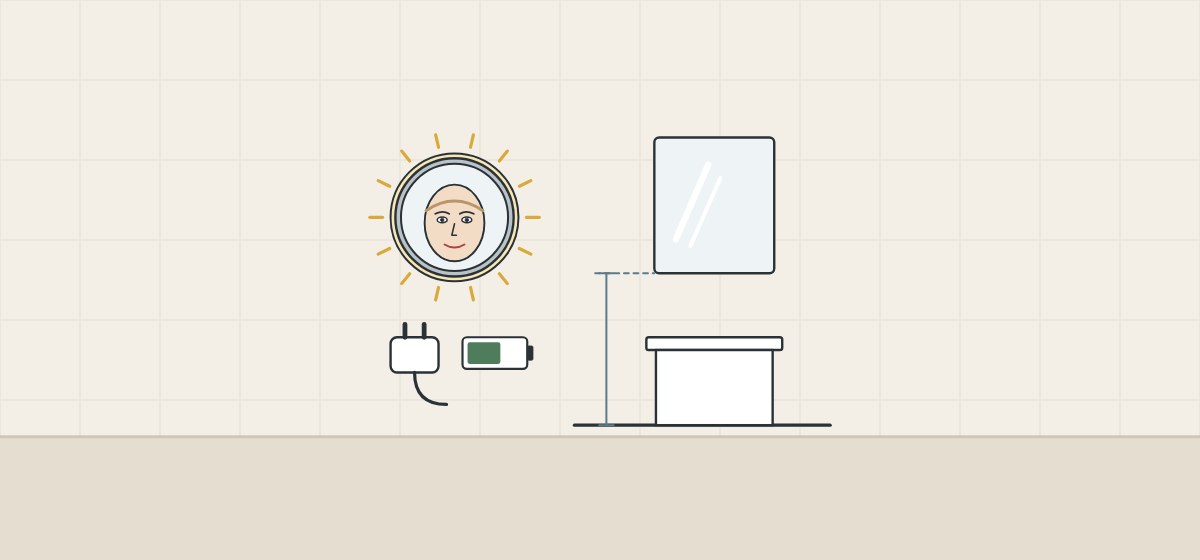
Light, power connection and mounting height are separate lines. The rows are the named sources’ own statements.
| Source | What it states |
|---|---|
| simplehuman Trio | 95 CRI and 100 to 800 lux; the 8-inch model charges by USB-C, one charge lasting 5 weeks. |
| emco prime LED | 3,000 K and 6,000 K light, dimmable by sensor switch; direct connection. |
| Jerdon HL75 | 3,000 K LED around the frame; plug-in and direct-wire versions. |
| Zadro, selection article | Lights above a mirror create shadows under the eyes, nose and chin. |
| ADA Standards 603.3 | Bottom edge of the reflecting surface: 40 in maximum above the floor over a lavatory or countertop, 35 in elsewhere. |
How should a buyer specify a magnifying mirror?
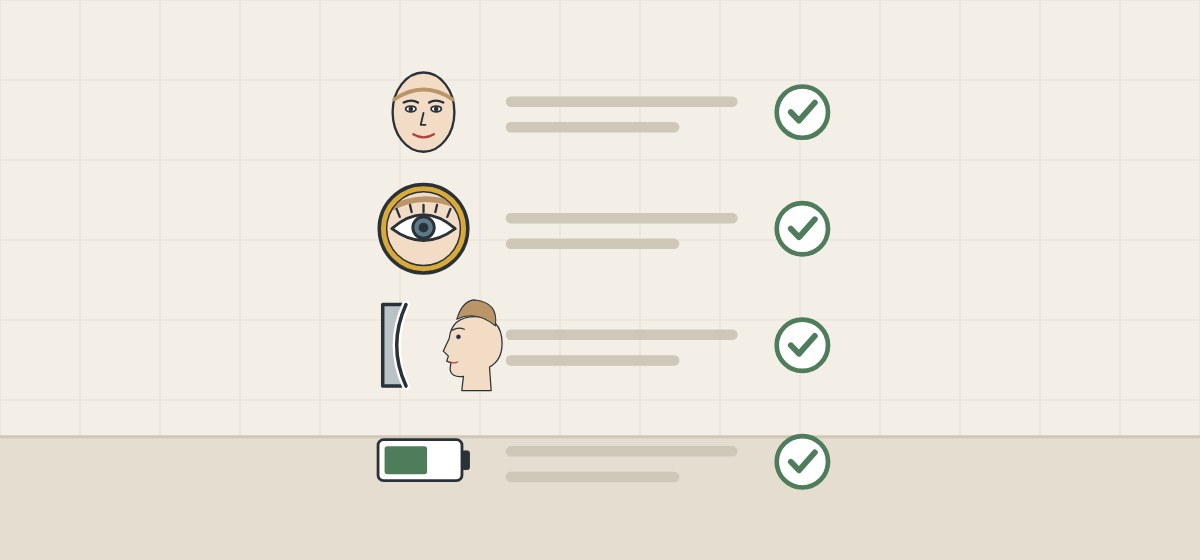
Start from the tasks and end with a sample tried in position. These steps are procurement guidance.
- List the tasks. Separate whole-face tasks from close work on one area.
- Name each view. Give a magnification for each task, including 1X if needed.
- Choose the layout. Reversible, inset window, one power on an arm, or inside a cabinet.
- Ask for each reflective size. The reflective surface, not the head, and any window size.
- Ask for the viewing distance. The maker’s figure for each view, and the arm reach.
- Keep light and power separate. Lit or unlit, color, dimming and connection type.
- Try a sample in position. Record where the user stood, so later samples are judged alike.
When accessibility is a project requirement
Choosing a view does not establish accessibility compliance or suitability for every user. Section 603.3 as published sets mirror heights and does not name magnifying mirrors; confirm with the project’s accessibility consultant or the authority having jurisdiction how it applies.
What should you send and ask before a quotation?
Send the tasks and the planned position, then ask for the figures that describe each view.
| Question | Why it matters |
|---|---|
| Which magnifications, and on which side? | Layouts differ: two sides, a window or one power. |
| What is the reflective size of each view? | A head size is not a reflective size. |
| What viewing distance does the maker state? | Zadro says higher powers need a closer face. |
| How far does the arm reach? | The user must be able to get that close. |
| How does the user switch views? | By hand or by control, depending on model. |
| Is the mirror lit, and how is it powered? | Plug-in, direct-wire and rechargeable differ. |
Include with your request
- Whole-face and detail tasks
- Planned position and mounting surface
- Lit or unlit, and available power
- Quantity per room type
WNS Global confirms any offered mirror, its views and commercial terms separately in writing. This guide does not state that WNS Global products have any magnification, layout, lighting or rating named above.