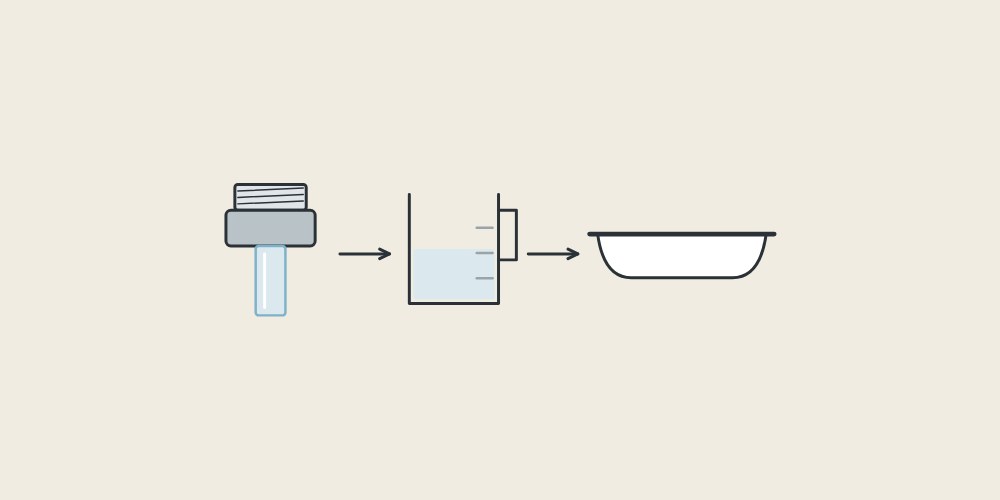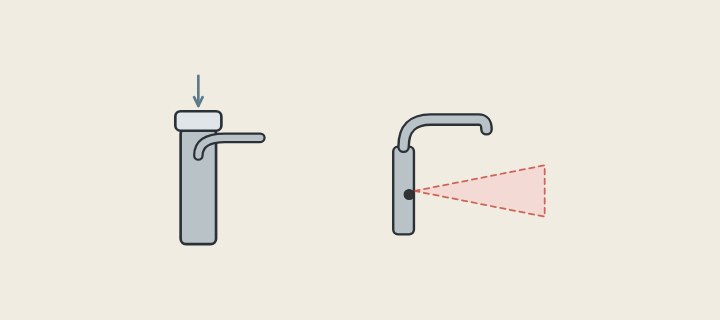


From stream type to part identity
What is the difference between an aerated and a laminar stream?
An aerated stream contains air; a laminar stream does not. Neoperl says an aerator adds air to the water to make a soft stream, and calls the laminar stream turbulence-free and crystal-clear.
The EPA’s WaterSense at Work guide says standard aerators inject air and give a larger, whiter stream, while laminar flow devices give a crystal-clear one.
A photo of a faucet cannot show the stream. Ask for the outlet maker’s name for it.
| Term | What the source says |
|---|---|
| Aerated stream | Neoperl: air is added to the water; soft stream. |
| Laminar stream | Neoperl: turbulence-free flow; looks crystal-clear. |
| Spray stream | EPA: a miniature shower pattern. |
| Multi-stream | Neoperl: two switchable stream types in one aerator. |
| Accessory | EPA specification: a part the user can readily add, remove or replace, without which the fitting still works. |
How does an aerator change the stream?
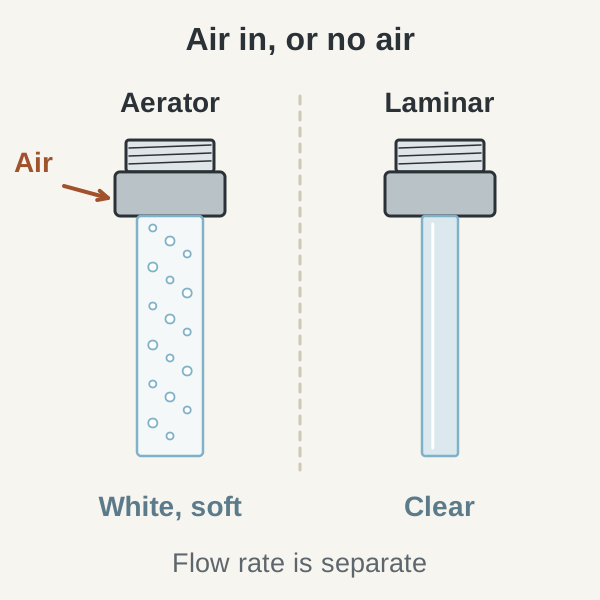
An aerator mixes air into the stream; a laminar flow device does not. The steps follow the EPA’s and the makers’ descriptions, not the inside of any part.
- Water reaches the outlet at the end of the spout.
- A standard aerator injects air into the water stream.
- The aerated stream leaves larger, whiter and soft to the touch.
- A laminar flow device does not inject air into the water.
- The laminar stream leaves clear.
- A spray aerator gives a miniature shower pattern instead.
The laminar step follows the EPA, which says laminar flow faucets do not inject air into the water. Neoperl says its hygiene aerators are designed not to draw in air.
Does the stream type set the flow rate?

No: in the makers’ lists below, laminar outlets appear at several flow rates, and so do aerators. The figures are the makers’ own.
| Maker and part | Listed as | Stated flow |
|---|---|---|
| T&S Brass parts list | Aerator | 2.2, 1.5, 1.2, 1.0 and 0.5 gpm |
| T&S Brass parts list | Non-aerated spray device | 0.5 and 0.35 gpm |
| T&S Brass parts list | Laminar device or outlet | 2.2, 1.5, 1.2 and 1.0 gpm |
| Chicago Faucets E36JKABCP | Laminar, non-aerating | 1.5 gpm |
| Chicago Faucets E72JKABCP | Laminar, non-aerating | 0.5 gpm |
| Delta RP19897 | Laminar flow spray outlet | 2.2 gpm at 60 psi |
“Low flow” is not another word for laminar. Write stream type and flow as two lines.
Which flow limits apply to lavatory faucets?

The limit depends on the use and on who sets it. The figures are as the EPA reports them; confirm with the local authority.
| Source | Applies to | Figure |
|---|---|---|
| DOE standard, adopted 1998 | Private-use lavatory faucets | Maximum 2.2 gpm at 60 psi |
| ASME/CSA standard | Non-metering public-use lavatory faucets | Maximum 0.5 gpm at 60 psi |
| Energy Policy Act of 1992 | Metering faucets in public restrooms | Maximum 0.25 gallons per cycle |
| WaterSense, Version 1.0 | Private-use lavatory faucets and accessories | Maximum 1.5 gpm at 60 psi; minimum 0.8 gpm at 20 psi |
The WaterSense specification counts hotel guest rooms and hospital rooms as private use; it excludes metering, public-use lavatory and residential kitchen faucets. CSA Group gives the scope of ASME A112.18.1/CSA B125.1 (2024) as plumbing supply fittings and accessories located between the supply stop and the terminal fitting, inclusive.
How do flow restrictors and regulators differ?
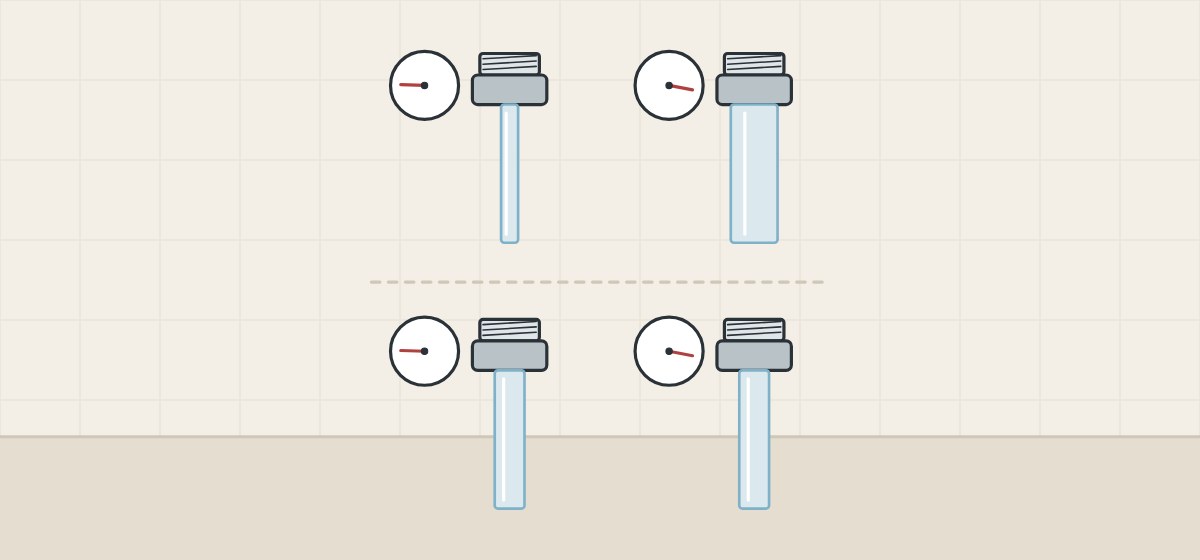
A restrictor lets flow follow the supply pressure; a flow regulator holds it nearly constant, as Neoperl explains on its water-saving technologies page.
Flow restrictor
Neoperl says the flow is set by the bore size and the applied pressure, so it rises and falls with pressure.
Flow regulator
Neoperl says its PCA technology gives a nearly constant flow rate across a wide pressure range. Chicago Faucets uses the term pressure compensating for both laminar outlets above.
Stated pressure range
T&S Brass gives 20 to 125 psi for its B-0199-21-VRF laminar outlet. Neoperl says its PCA Dual Core reaches nominal flow from as little as 0.7 bar.
Low pressure
The EPA says the WaterSense minimum flow helps user satisfaction where water pressure is low, and advises testing that system pressure is between 20 and 80 psi.
- Flow figure and its pressure
- Restrictor or regulator
- Pressure range of the part
- Supply pressure at the site
What thread and housing does the outlet use?

Neoperl describes two builds, an insert in a threaded housing or a single threaded part, and each maker lists its own threads.
Housing, insert and washer
Neoperl’s aerators with housing have three components and several insert sizes, from Tom Thumb to Tubfiller.
Housing threads
Neoperl lists metric threads such as female M22×1 and male M24×1, and US threads such as female 55/64″-27 and male 15/16″-27. Its vandal-proof option needs a special key.
Integrated thread
Neoperl’s integrated-thread aerators are one plastic part with a male thread and no housing. Each thread size has its own service key; two models can be replaced using only a coin.
Other makers’ lists
T&S Brass lists 55/64-27UN female, 13/16-27UN male and 3/8″ NPSM male threads, among others. Chicago Faucets states a 13/16″-24 female inlet; Delta states 15/16″-27 male on RP19897.
Kohler’s support page sorts aerators into three types: threaded, with visible threads; keyed, with a smooth exterior; and a stream breaker recessed in an oval spout opening.
What do public bodies say about aerators in healthcare?

The EPA tells medical facilities to consider their own needs, and the CDC’s 2003 text reports no consensus on disinfecting or removing aerators in general use. A clear stream is an appearance, not a certificate.
| Source | What it says |
|---|---|
| EPA, WaterSense at Work | Medical facilities may want laminar flow devices instead of aerators; the EPA says these inject no air, so the risk of bacterial contamination is lower. |
| CDC guideline, 2003 | No consensus on disinfecting or removing faucet aerators; if further clusters occur in high-risk areas, cleaning or removing them may be prudent. |
| CDC recommendations, 2003 | Protective environments and transplant units: in areas with patients at risk, when Legionella is not detectable in unit water, remove, clean and disinfect shower heads and faucet aerators monthly (Category II). |
| CDC recommendations, 2003 | No recommendation on removing aerators in areas for immunocompetent patients. |
| Neoperl | The replacement interval for its hygiene aerators must be set by each facility. |
| FGI and ASHRAE documents | Not read. The CDC’s 2003 text reports that ASHRAE recommends cleaning and monthly disinfection of aerators in high-risk patient-care areas; current ASHRAE and FGI wording was not retrieved. Ask the project’s infection-control team. |
How should a buyer specify the faucet outlet?

Specify the outlet as its own item on the faucet schedule. These steps are procurement guidance.
- Name the stream. Aerated, laminar, spray or switchable.
- State the use. Private or public; the limits differ.
- Give the flow with its pressure. The EPA’s maximum flow figures, for example, are stated at 60 psi.
- Ask how flow is controlled. Restrictor or flow regulator.
- Record the part identity. Maker, part number, thread, insert size and any key.
- Try it with the basin. Run the outlet over the chosen basin.
- Plan the service. Who cleans or replaces the outlet, and with which tool.
Keep the approved part for service
The EPA advises inspecting aerators for scale and checking that they remain installed at the intended flow. A similar-looking replacement can change the stream or flow, so staff need the part number, not just “clear stream”.
What should you send and ask before a quotation?

A complete request asks about stream, flow and part identity separately.
| Question | Why it matters |
|---|---|
| Which stream type does the outlet give? | Streams differ in look and feel. |
| What is the flow, and at what pressure? | The same stream type is sold at several flows. |
| Restrictor or flow regulator? | A restrictor’s flow follows the pressure. |
| Who makes the outlet, and which part? | Needed for a like-for-like replacement. |
| Which thread, size and key? | Each maker lists its own threads. |
| Which markings and listings apply? | Check a label claim against the certifier’s record. |
Include with your request
- Location, code and private or public use
- Stream type and required flow
- Site supply pressure
- Basin model or drawing
- Any healthcare requirement
WNS Global confirms any offered faucet, outlet part and commercial terms separately in writing. This guide does not state that WNS Global products use any outlet, flow rate, thread, label or listing named above.