From start to stop
What is the difference between a self-closing and a sensor faucet?
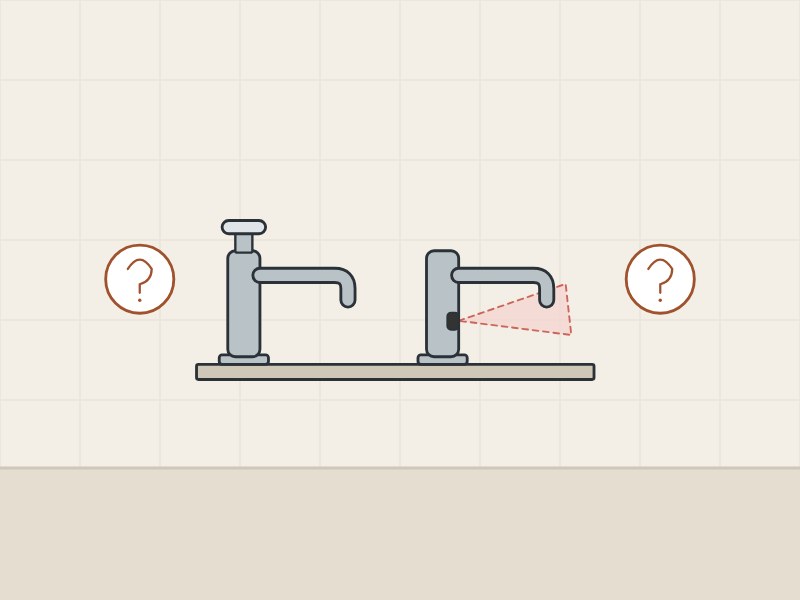
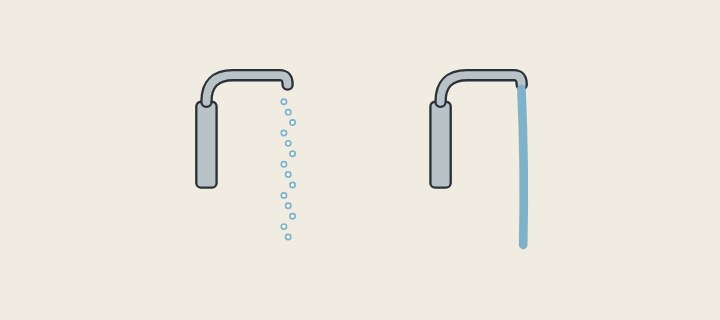
The difference is what starts the water and what stops it. The EPA’s WaterSense at Work guide says a metering faucet, once activated by the user, dispenses water for a preset time before shutting off.
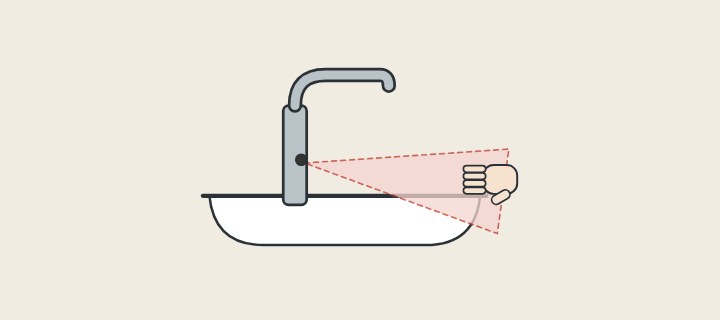
The same guide describes self-closing faucets as operated with a spring-loaded knob or a sensor, shutting off when the user releases the knob or withdraws their hands.
Other sources name things differently. DELABIE calls its push-button TEMPOMIX 2 a time flow mixer, and the published scope of ASME A112.18.1-2024/CSA B125.1:24 lists “metering and self-closing supply fittings”.
| Term | Used by | What it describes |
|---|---|---|
| Metering faucet | EPA | User activates it; water runs a preset time. |
| Self-closing faucet | EPA | Knob or sensor; shuts on release or when hands leave. |
| Sensing mode | Zurn | Valve shuts after hands are removed. |
| Metering mode | Zurn, Chicago Faucets | Sensor start, then a set run. |
What happens between start and stop?
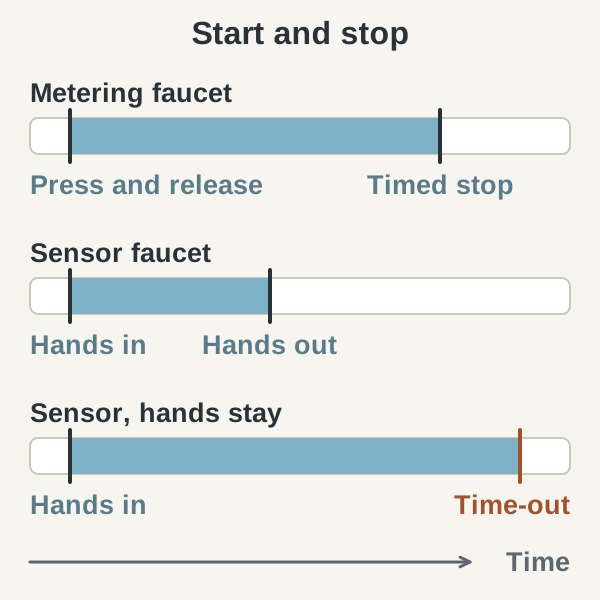
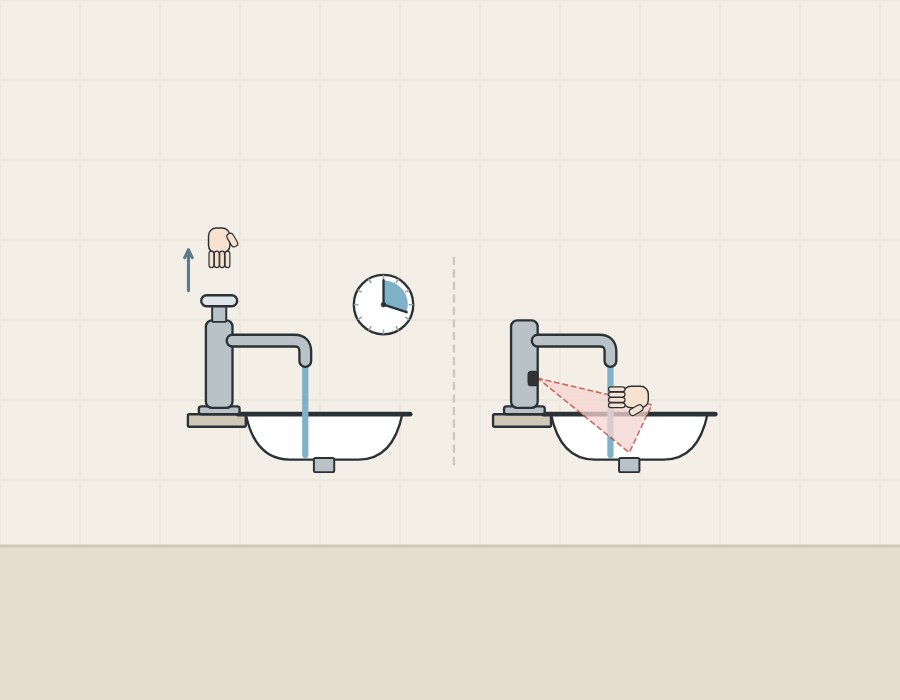
Both types follow a short sequence. The steps combine DELABIE’s description of its TEMPOMIX 2 with Zurn’s description of its AquaSense Z6913-XL and Z6915-XL: two examples, not rules.
- Metering: the user presses the push-button.
- On the TEMPOMIX 2, water flows only once the button is released.
- Water runs for the stated time flow, about 7 seconds on that model, then stops.
- Sensor: hands are detected and water runs.
- In Zurn’s sensing mode, the valve shuts off after hands are removed.
- If hands are not removed, the time-out delay turns the faucet off.
DELABIE calls the release behaviour an anti-blocking system. Its TEMPOMATIC 4 electronic faucet page lists an anti-blocking security, with no detail in the text retrieved.
How long does a metering faucet run, and can it be adjusted?
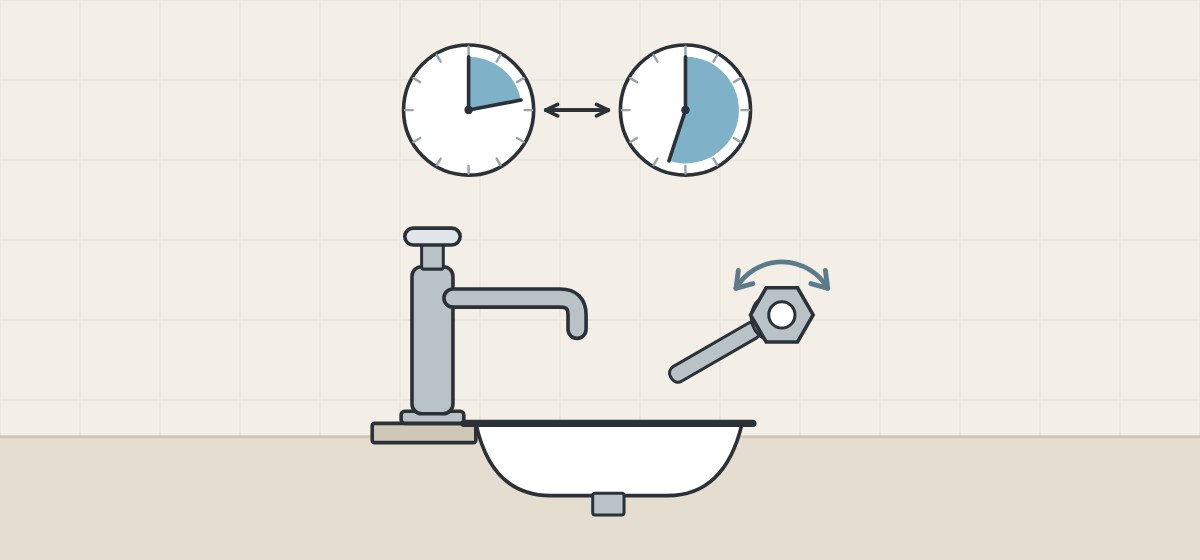
The run time is a maker’s figure for a named product, and some makers state that it can be changed.
| Named product | Run time stated | Adjustment stated |
|---|---|---|
| DELABIE TEMPOMIX 2 | About 7 seconds | None in the text retrieved |
| Chicago Faucets MVP metering cartridge | 2 to 25 seconds; range may vary | Timing nut, water supply left on |
| Symmons SCOT, on the SLS-7000 page | Not given | Wash cycle time adjustable |
The ADA Standards set a floor of their own: section 606.4 requires hand-operated metering faucets to remain open for 10 seconds minimum. Compare the offered run time with that figure where the rule applies; the run times in the table are makers’ figures, not statements about that rule.
How much water may a metering faucet use per cycle?

Per the EPA, the Energy Policy Act of 1992 addresses metering faucets in public restrooms and sets a maximum of 0.25 gallons per cycle: a limit per cycle, not per minute.
| Source | Figure | Applies to |
|---|---|---|
| EPAct 1992, as the EPA reports | 0.25 gallons per cycle maximum | Metering faucets in public restrooms |
| ASME A112.18.1/CSA B125.1, as the EPA reports | 0.5 gpm maximum at 60 psi | Non-metering public-use lavatory faucets |
| Symmons SLS-7000 | 0.5 gpm aerator; 0.25 gallons per cycle maximum | That model, per its maker |
| WaterSense label | No labeling criteria | Public lavatory and metering faucets |
A stop that happens by itself is not a saving figure or a hygiene rating. The EPA says appropriately programmed sensors may or may not provide additional savings, depending on use patterns before installation, and advises checking and adjusting sensors so that faucets do not run longer than necessary.
How does a sensor faucet decide when to stop?
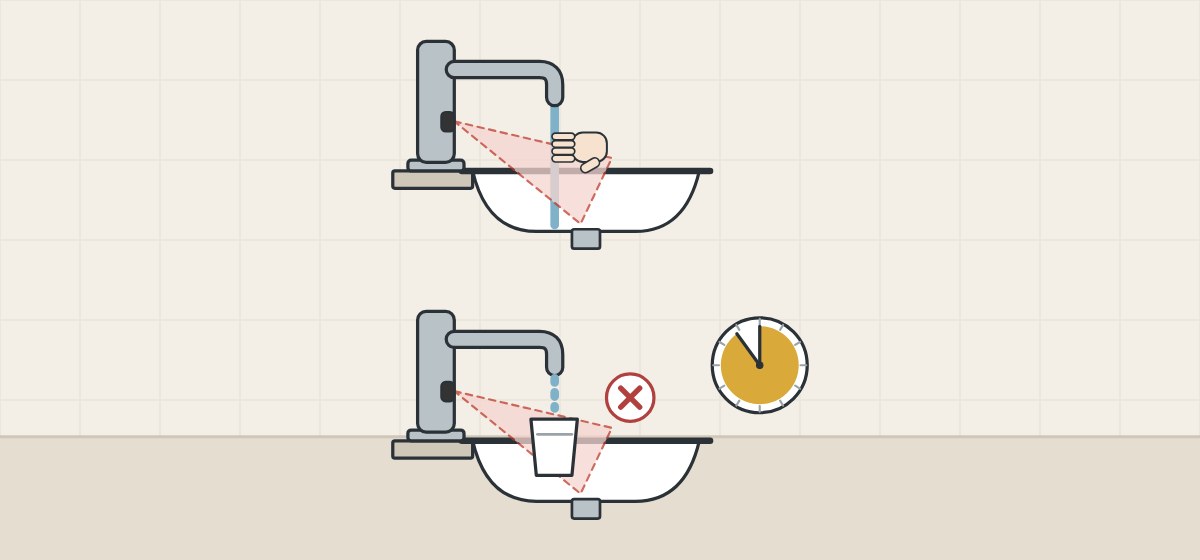
A sensor faucet stops according to the mode it is set to, and named models offer more than one:
Stop when hands leave
Zurn’s sensing mode shuts the valve after hands are removed. Chicago Faucets’ HyTronic guide describes its default normal mode only by the start (the faucet is activated if it senses a hand), and Sloan says the sensor position on its BASYS faucets allows on-demand flow; neither text retrieved states the stop.
Time-out
In Zurn’s manual the standard flow time is 30 seconds, with settings of 5, 10, 15 and 60 seconds. A further option, which Zurn names Less Time-out, stops flow after 20 minutes.
Metering mode
In Zurn’s metering mode, water runs for the set time once hands are detected. HyTronic’s metering mode shuts off after 10 seconds regardless of hand presence; the maker’s FAQ gives 3 to 180 seconds of activation for HyTronic used as an electronic metering faucet.
Scrub mode
HyTronic’s scrub modes shut off 60 or 180 seconds after the last hand presence is detected.
- Operating mode as delivered
- Time-out value and its options
- Set run time, if metering mode is used
What can the faucet do between uses, and how are settings changed?
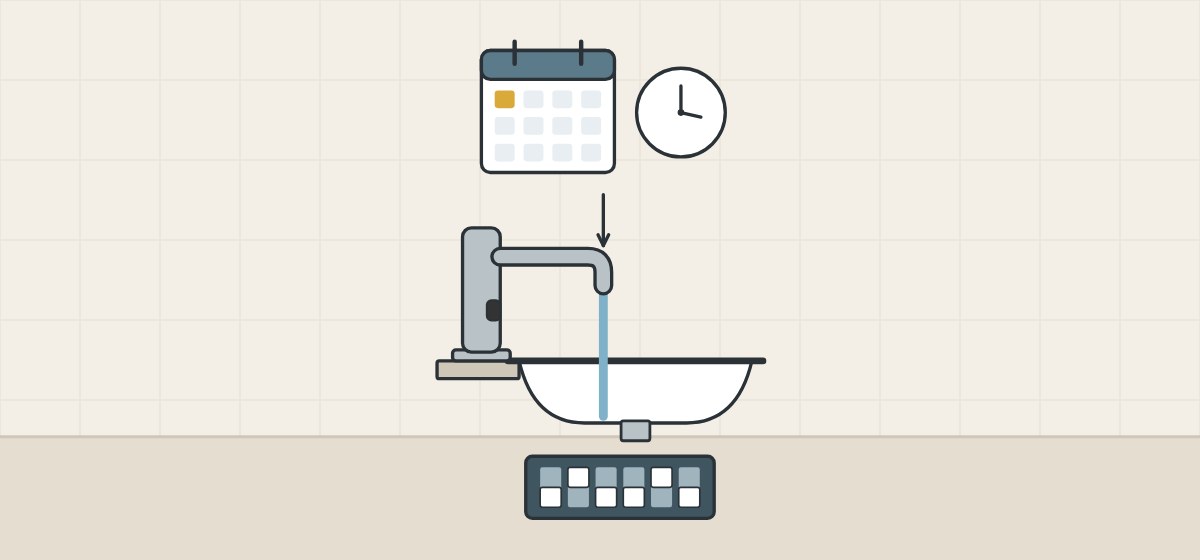
Some sensor faucets run water with no user present:
Duty flush
DELABIE lists a duty flush on the TEMPOMATIC 4, ref. 443400: about 60 seconds every 24 hours after the last use.
Purge
Zurn’s purge is disabled in the standard configuration. It can be set to 12, 24 or 48 hours, and the purge flow lasts 2 minutes.
Line purge
Sloan says all BASYS models include a line purge function; the text retrieved gives no interval.
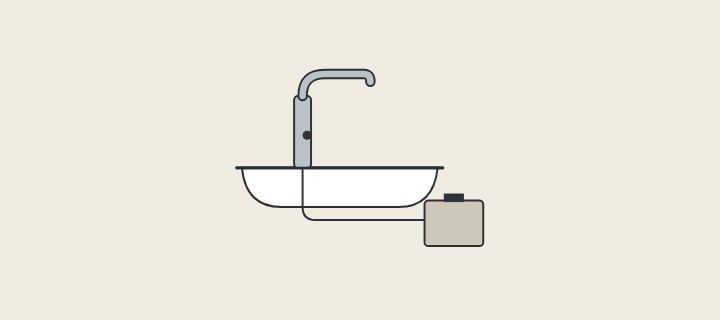
Zurn’s manual says the switches are visible once the battery tray is removed. Chicago Faucets describes manual setting through the sensor or with its Commander handheld unit.
Which rules and standards touch the activation?

Accessibility rules address the activation directly; the product standard covers the fitting. Confirm with the local authority which apply.
| Source | What it says |
|---|---|
| ADA Standards, 606.4 | Faucet controls comply with 309; hand-operated metering faucets remain open 10 seconds minimum. |
| ADA Standards, 309.4 | Operable with one hand; no tight grasping, pinching or twisting of the wrist; 5 pounds maximum force. |
| ASME A112.18.1-2024/CSA B125.1:24 | Published scope lists metering and self-closing supply fittings; clause text not read. |
| Symmons, on the SCOT | Calls it fully compliant with ADA regulations: the maker’s statement. |
How should a buyer specify the activation?
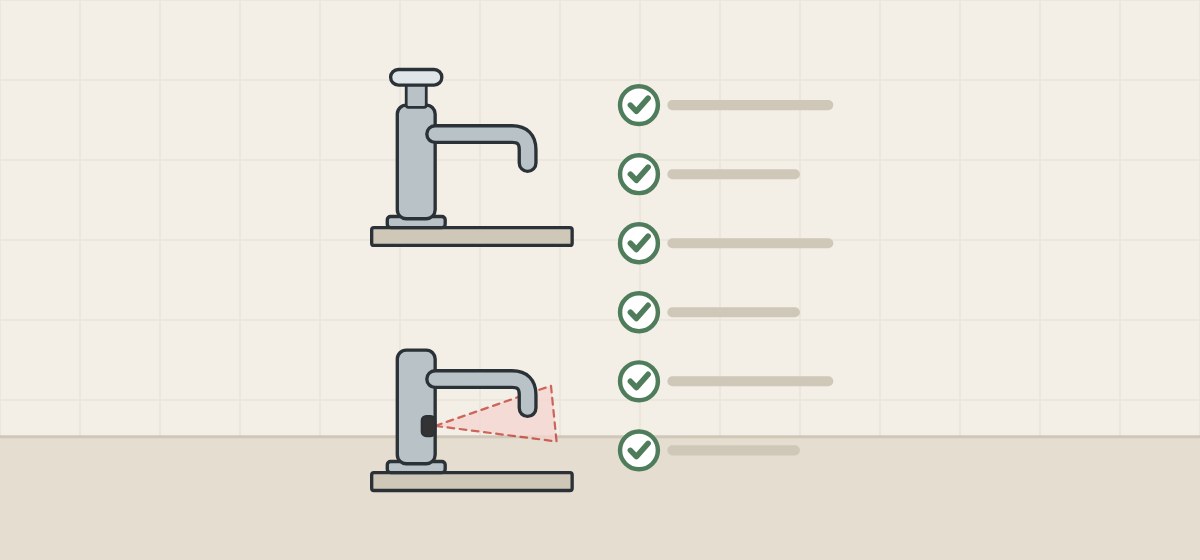
State the sequence first and the parts second. These steps are procurement guidance.
- Name the start. Push-button, lever or sensor detection.
- Name the stop. Timed run, hands leaving, or a time-out.
- Fix the run time. Give the value and say whether it can be adjusted on site.
- State flow and cycle volume. Run time and flow rate together decide the water per cycle.
- List idle functions. Flush or purge interval, duration and delivered setting.
- Check the rules. Accessibility run time and per-cycle limit, where they apply.
Watch the sample run
Ask to see the offered model go through its sequence: approach, press or reach, hold, release, walk away, and leave an object in the basin. Compare what happens with the data sheet. Power supply and service access are a separate check.
What should you send and ask before a quotation?

Describe the interaction, not only the faucet.
| Question | Why it matters |
|---|---|
| What starts and stops the water, and after how long? | Run times and time-outs are model figures. |
| Is the run time adjustable, and how? | One maker publishes a timing nut. |
| Does water flow while the button is held? | One maker’s anti-blocking system waits for release. |
| Which idle flush is set at delivery? | One maker’s purge is disabled as standard. |
| Is the complete control set included? | Quotations for an automatic faucet may not cover the same parts. |
Include with your request
- Project location and building type
- Who uses and who maintains the washroom
- Required start and stop
- Run time or time-out wanted
- Rules to meet, quantity and basin model
WNS Global confirms any offered faucet, its activation sequence and commercial terms separately in writing. This guide does not state that WNS Global products have the run times, modes, flush functions, ratings or listings named above, or that WNS Global supplies the named brands.