From power option to service route
What power options do sensor faucets use?
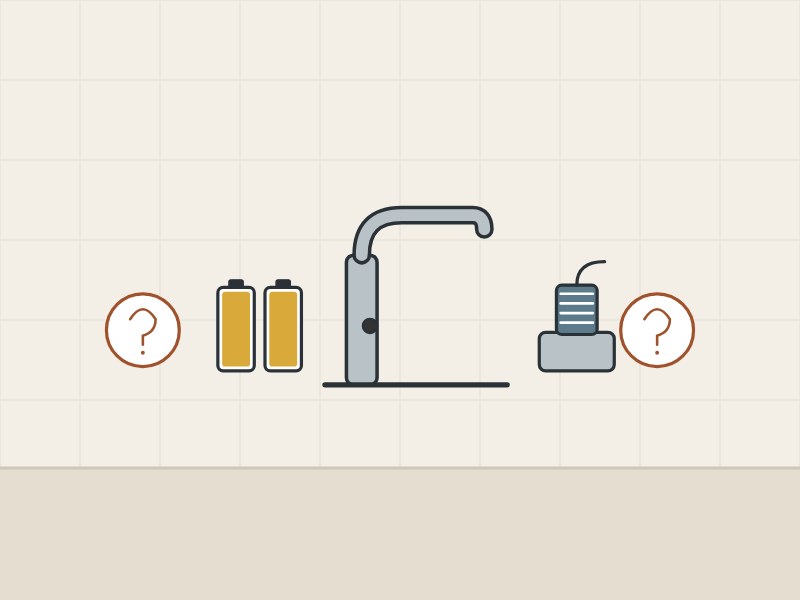
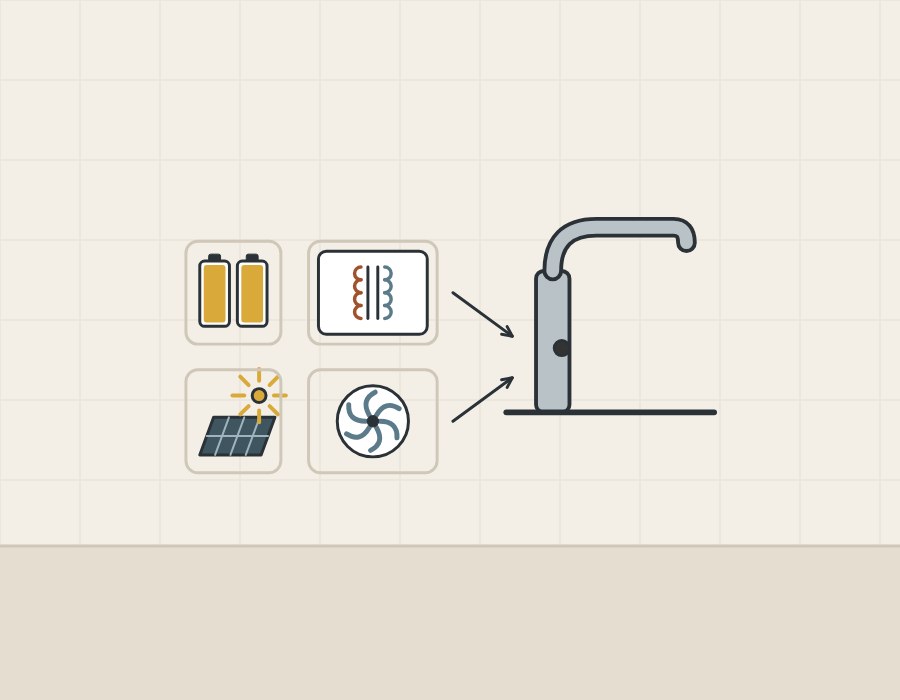
Sensor faucets are sold with battery, hardwired, solar or turbine power, and some with a maker’s long-life option.
Makers treat the option as a version of the product. Chicago Faucets lists one HyTronic faucet in AC, AC with emergency backup, DC, DC with a long-term system and self-sustaining versions.
| Power option | What named makers say |
|---|---|
| Battery | Sloan BASYS: for retrofits and sites that cannot be hardwired. Delta 590T: four C cells. |
| Hardwired | Sloan: for new construction. Delta 590T: 24 VAC from a Class 2 transformer. |
| Solar | Sloan: harvests artificial and natural light; adds no parts to the water path. |
| Turbine | Sloan: says it performs even at a flow of 0.5 gpm. Geberit: a generator unit. |
| Long-life option | Kohler: a Hybrid energy cell. Chicago Faucets: a Long Term Power System. |
Which parts sit between the supply stop and the spout?
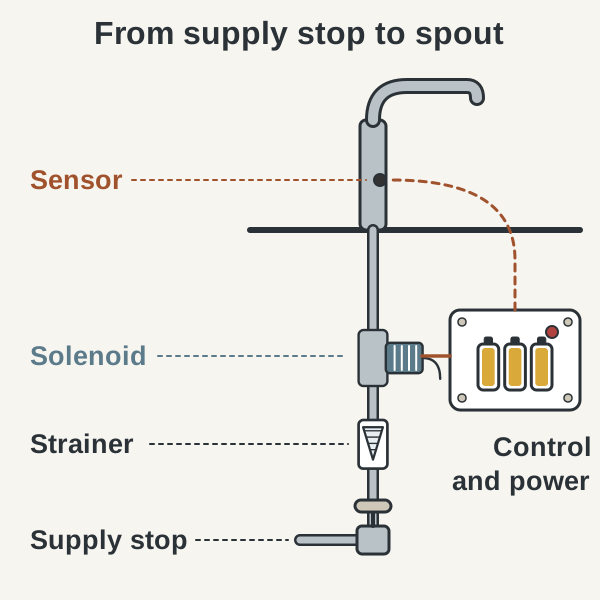
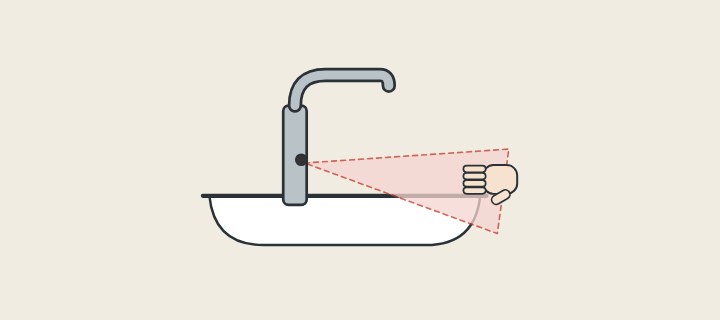
Water passes a strainer and a solenoid valve before it reaches the spout, and a control module opens the valve. The list is a general arrangement, not one product.
- Supply stop: the shut-off valve on the supply.
- Strainer or filter screen: catches debris.
- Solenoid valve: opens and closes the flow.
- Hose or shank up to the spout.
- Control module: drives the solenoid.
- Power source: battery, transformer, solar cell or generator.
- On turbine versions, a generator in the water line; its position differs by maker.
Delta’s 590T specification puts a serviceable filter screen upstream of the valve. TOTO’s parts list for one faucet family shows a controller, solenoid valve unit, generator and filter unit as separate parts.
Where are the battery, module and solenoid on named products?
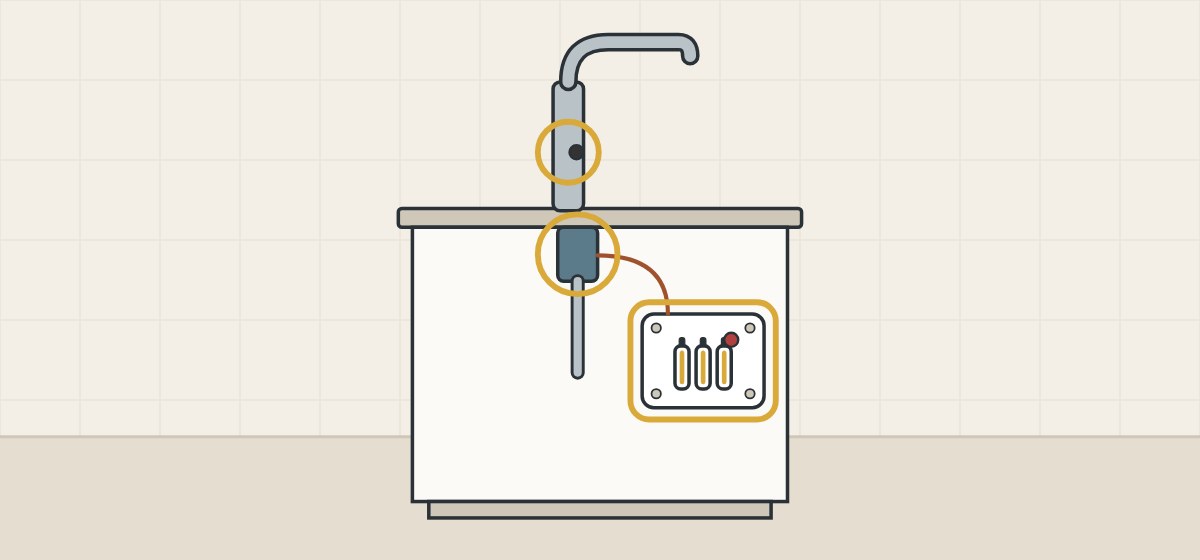
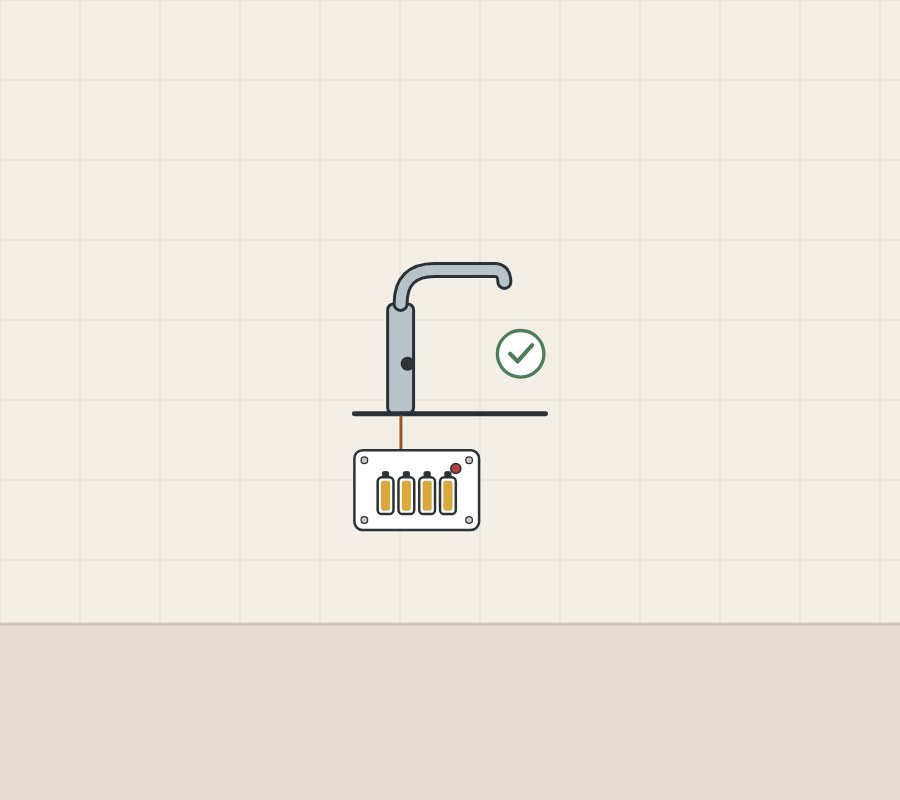
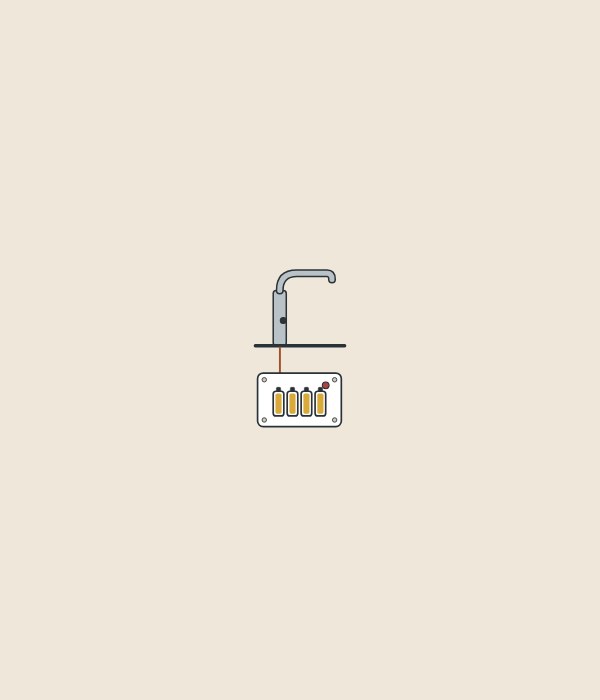
They sit either inside the faucet body above the deck or in a module or box below it.
| Location | Named example | What the maker says |
|---|---|---|
| In the faucet body | Sloan BASYS EFX-280 | Solenoid in a removable carrier with the strainer; one-tool service above the deck. |
| In the faucet body | Chicago Faucets HyTronic | Above-deck electronics; one screw releases the spout to reach the battery. |
| On the faucet shank | Zurn Serio | Electronics module, holding the batteries, tightened to the shank. |
| Wall box under the basin | Delta 590T | Battery box screwed to the wall under the sink, within reach of hose and cable. |
| Wall box under the basin | Kohler electronic sink faucet | Control box below the deck, fixed to the wall. |
| Behind the wall | Geberit washbasin faucets | Function box under the washbasin holds all electronics except the sensor. |
The brand does not settle the layout: Sloan’s faucet range also includes below-deck versions with a watertight box.
What does each service task involve?
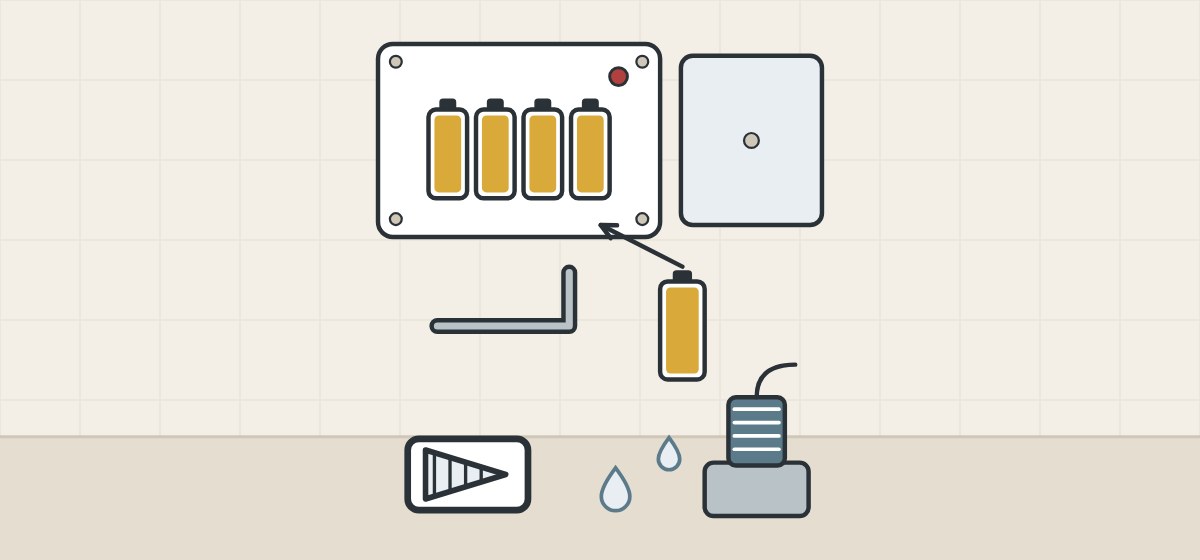
Each task follows the maker’s procedure and depends on where the part sits. Ask for the offered model’s procedure.
| Task | Named example | Maker’s procedure |
|---|---|---|
| Battery change | Chicago Faucets HyTronic | Remove the shut-off screw, lift off the housing, replace the 6 V lithium CR-P2 battery. |
| Battery change | Delta 590T | Surface-mount box: undo two lid screws, fit four C cells. Recessed box: remove the cover. |
| Filter or strainer cleaning | Sloan BASYS | One twist of the solenoid caddy shuts off the water. |
| Filter cleaning | Chicago Faucets HyTronic guide | Close the supply valves; disconnect the hoses to reach the filter. |
| Solenoid check | Zurn AquaSense | Open the solenoid valve and check for debris. |
Chicago Faucets’ FAQ says the HyTronic battery can be changed in a couple of minutes. On a wall box, the same task depends on reaching the box. Ask whether parts are sold separately: Moen’s M-POWER parts list shows a solenoid kit, a filter screen and a battery housing as separate items.
What does a hardwired version need from the site?
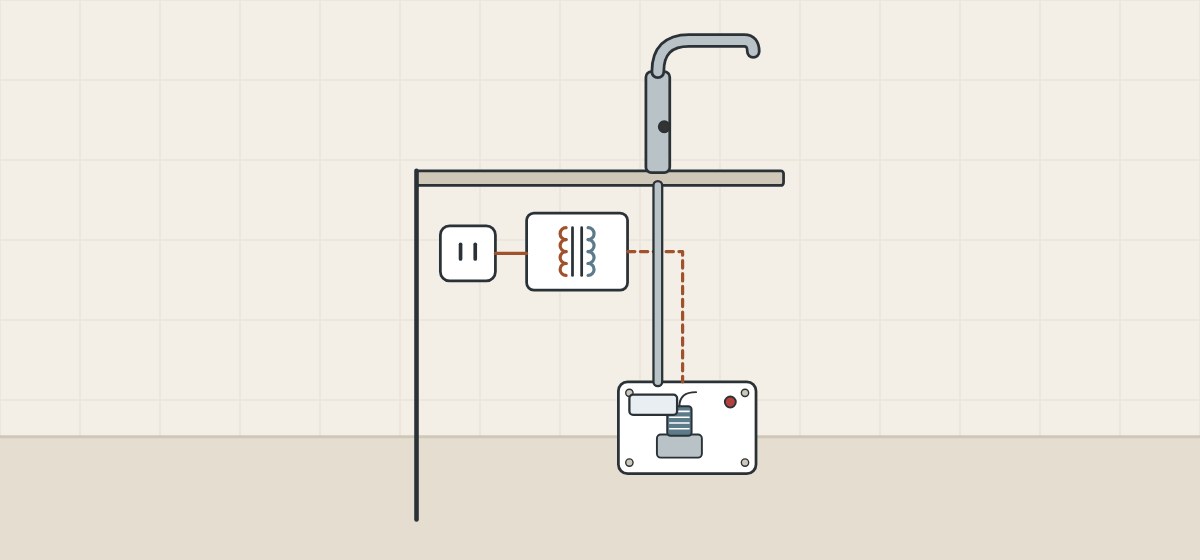
The makers below feed hardwired faucets through a transformer or adapter, so the site has to provide a place and a circuit for it. Three points:
Transformer position
Delta’s 590T instructions call for a Class 2 transformer in a convenient location or a pipe chase, not inside the control box. Zurn offers a plug-in converter or a hardwired 6 V unit for its Serio faucets.
Faucets per transformer
Delta’s specification lists 20 VA, 40 VA and 100 VA transformers for up to 5, 10 and 25 electronic valves. Moen’s parts list has an AC transformer for up to 8 devices.
Battery backup
Sloan says all its hardwired BASYS faucets have backup battery power. Delta sells hardwire with battery backup as a separate model.
- Voltage and connector at the faucet
- Transformer position and supplier
- Faucets per transformer
- Battery backup, included or not
- Trade that makes the connection
Do turbine and solar faucets still need a battery?
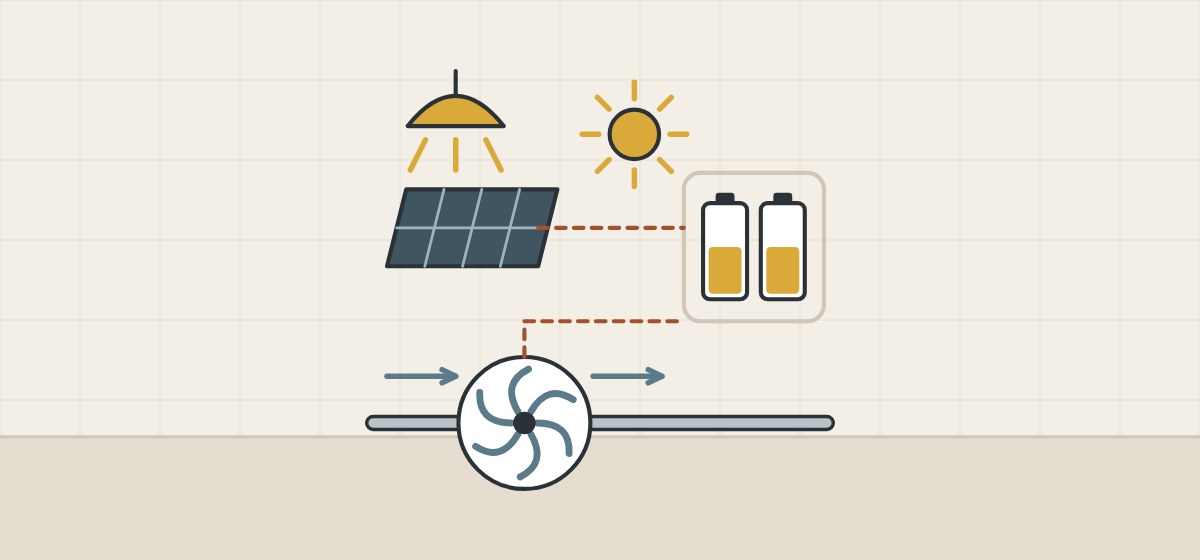
Some do. The makers below pair a turbine or solar cell with a battery on named models, and life figures come with conditions.
Turbine with batteries
Sloan’s turbine-powered BASYS EFX-280 lists four AA alkaline batteries among its features. TOTO’s T28S parts list, which covers ECOPOWER and AC versions, includes a lithium backup battery.
Solar with backup
Sloan’s Optima EAF-275 is solar powered with a 6 VDC lithium battery as backup.
Generator position
Chicago Faucets’ SSPS guide places the generator unit under the sink, fixed to the wall. Zurn’s hydrogenerator attaches to the electronics module, which is tightened to the faucet shank.
Life figures
Chicago Faucets’ FAQ estimates 3 years or 200,000 activations for the HyTronic battery. Kohler’s Hybrid brochure gives at least 875,000 cycles, which it equates to about one use every 20 minutes, round the clock, for 30 years.
TOTO’s EcoPower brochure says its turbine products need no routine battery change. A TOTO specification sheet for a discontinued model gave the backup battery 4 years at 4,000 cycles per month without recharging. Read each figure with its stated use.
How does a sensor faucet show a low battery?
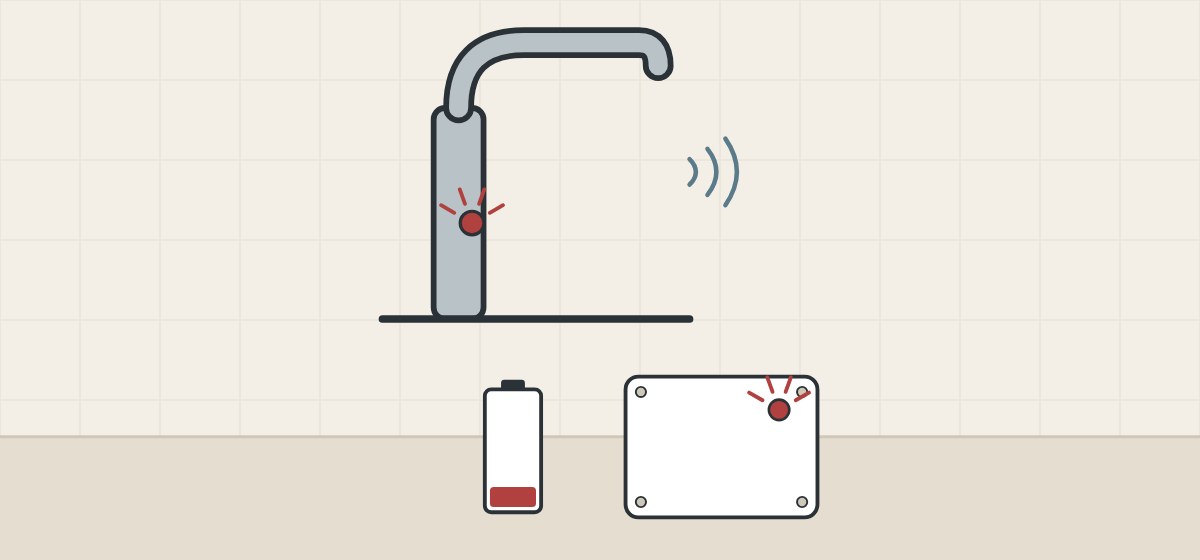
Each maker uses its own signal, by sound or by light, so staff need the one for the installed model. Kohler puts its LED on the control valve assembly cover, not on the spout.
| Product | Signal the maker describes |
|---|---|
| Delta 590T | Two beeps at shut-off with about 1,500 cycles or 2 weeks left. |
| Kohler electronic sink faucet | LED flashes red every 2 seconds when batteries run low. |
| Zurn AquaSense | Flashing red light in the sensor eye. |
| Chicago Faucets HyTronic | An LED lights when the battery is low. |
| Sloan BASYS EFX-280 | Above-deck indicators for battery life and solenoid condition. |
How should a buyer plan power and access in the vanity?
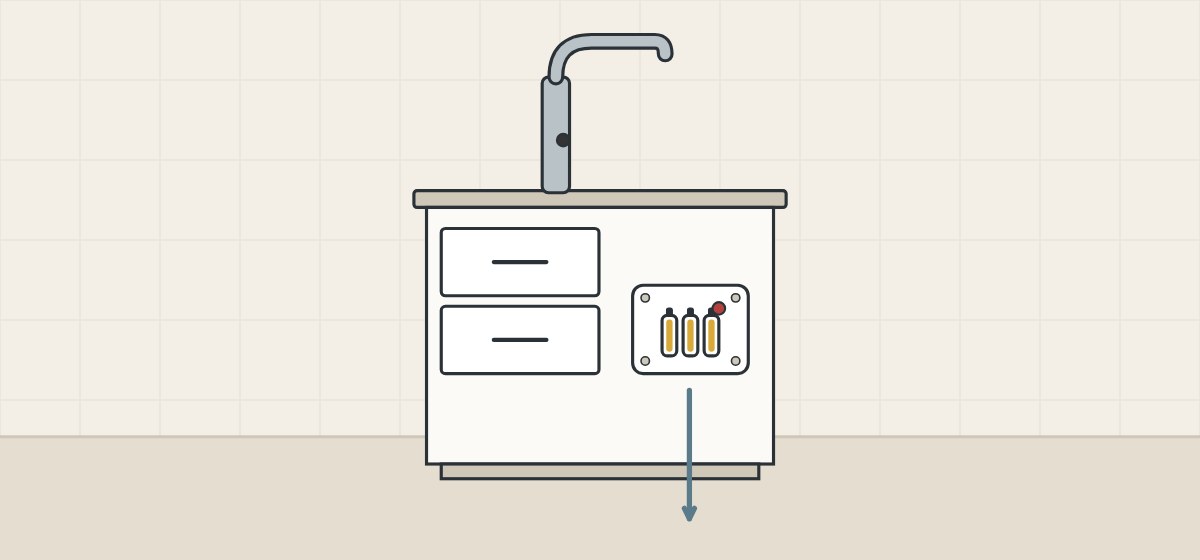
Settle power and access before the spout style, with the faucet, basin and cabinet drawn together. These steps are procurement guidance, not installation instructions.
- Name the power option. As written in the quotation.
- Locate each service part. Battery, module, solenoid and strainer: in the body, a module or a box.
- Draw the box in the cabinet. Against drawers, shelves, the trap and the back panel.
- Check the removal path. Covers, hoses and cables come out with basin and cabinet in place.
- Plan the hardwired supply. Transformer position and trade; confirm with the local authority.
- Get the service procedure. Tasks, tools and the low-battery signal.
- Record part identification. Model, power option and part numbers.
When a claim needs evidence
A sensor does not by itself prove a battery life, a water-saving percentage or a hygiene outcome. If the project relies on one, ask for the maker’s figure and its conditions. Mark an undecided power arrangement as open; do not leave it to the site crew.
What should you send and ask before a quotation?
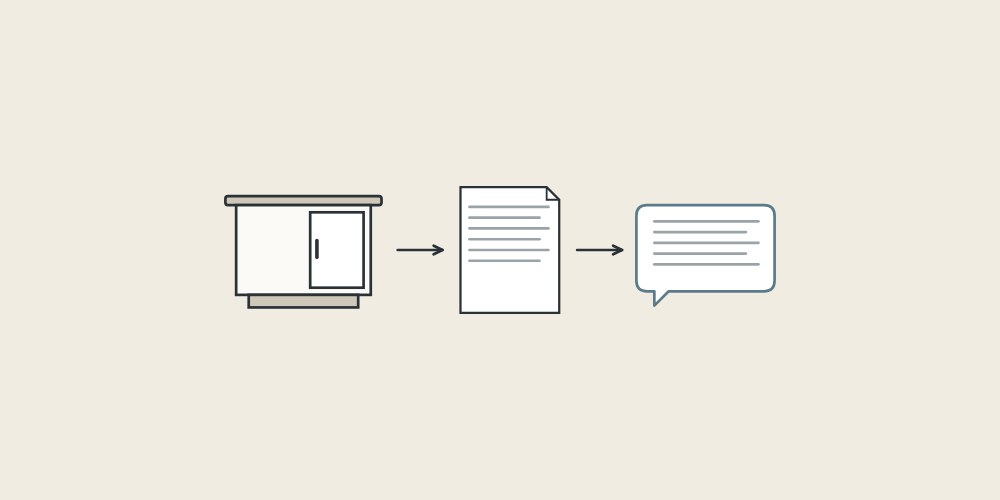
A complete request names the power option and the service route, not only the spout.
| Question | Why it matters |
|---|---|
| Which power option is quoted? | Options are separate versions. |
| Where do the battery and solenoid sit? | Faucet body, shank module or wall box. |
| What must the site supply for hardwired power? | A transformer or adapter needs a place. |
| Does a turbine or solar version hold a battery? | Some named models do. |
| How is the strainer cleaned? | Some procedures need the supply closed. |
| How is a low battery shown? | By beep or LED, at the spout or the box. |
Include with your request
- Basin and cabinet drawing
- Power available at the basin
- Deck or wall mounting
- Type of use and quantity
WNS Global confirms any offered faucet, power option and commercial terms separately in writing. This guide does not state that WNS Global products have any power option, service layout, battery life or rating named above.