From output type to replacement
What does each LED driver type regulate?
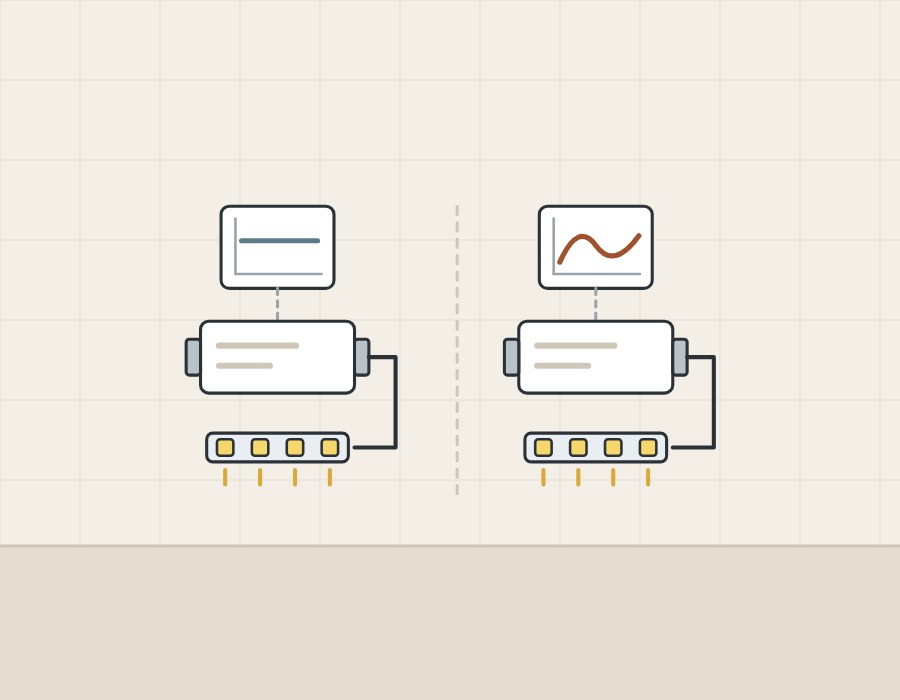
A constant-voltage driver regulates voltage; a constant-current driver regulates current. MEAN WELL’s technical notes give the example of a supply that keeps its output at 5 V while the current varies from 0 to 5 A with the load.
MEAN WELL describes a constant-current LED power supply as one whose output current is held at a fixed value by feedback control. Lutron’s white paper gives 700 mA as an example, supplied to an LED module designed for that current.
MEAN WELL adds that its own constant-current LED power supplies can also work in a constant-voltage region before reaching the constant-current region.
| Term | What it means |
|---|---|
| Constant voltage (C.V.) | Output voltage held at a set value; current varies with the load. |
| Constant current (C.C.) | Output current held at a fixed value by feedback control, in MEAN WELL’s description. |
| Forward voltage (Vf) | The LED voltage; MEAN WELL works with the Vf sum of the LEDs connected in series. |
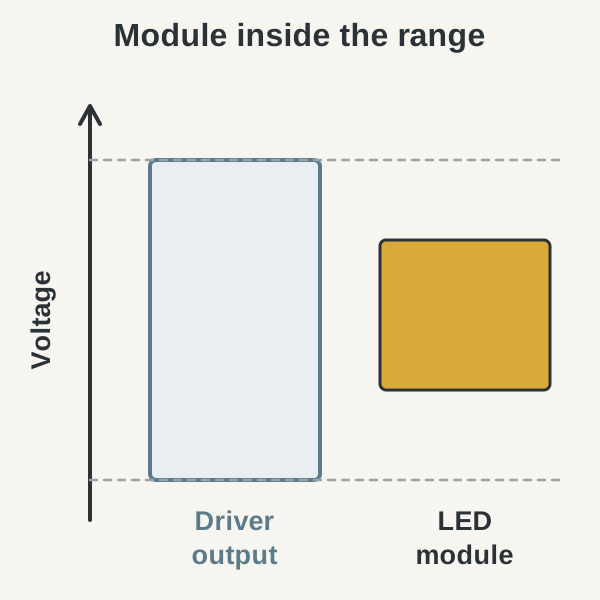
| Output voltage range | The driver’s minimum to maximum output voltage, which Tridonic compares with the LED module’s forward voltage. |
How is an LED driver matched to an LED load?
The LED module’s data sheet values are compared with the driver’s, then the pair is tested. Steps 1 to 5 follow the five-point comparison in Tridonic’s functional description for its own LED drivers; step 6 is the practical test Tridonic requires afterwards. They are design steps, not a field procedure.
- Current: module maximum at or above the driver’s output current plus tolerances.
- Voltage: module forward-voltage range inside the driver’s output voltage range.
- Ripple: module’s permissible low-frequency current ripple at or above the driver’s.
- Peak current: module’s permissible peak above the driver’s maximum output peak.
- Power: module power consumption inside the driver’s output power range.
- Test: a practical test after the data sheet comparison.
Tridonic notes that the forward voltage is temperature dependent and points to the module’s data sheet. MEAN WELL’s technical notes say the LED forward voltage falls as the working temperature rises, which raises the forward current; it gives this as the reason for a current-limiting circuit.
Why is equal wattage not enough to match a driver?
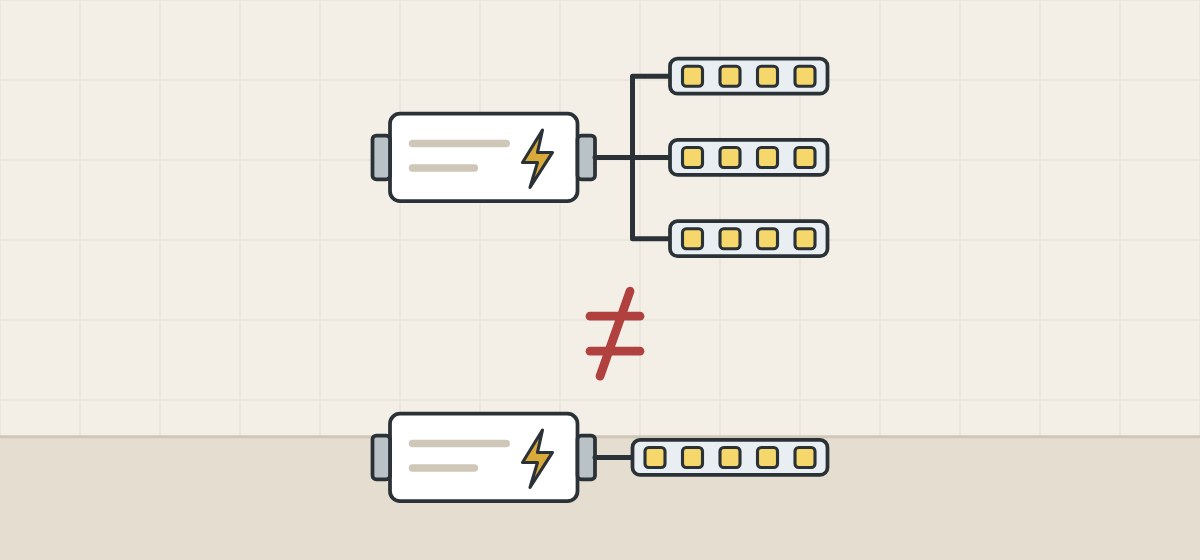
Wattage does not say which quantity the driver holds steady. MEAN WELL’s LPV-60 and LPC-60 data sheets carry the same title, a 60 W single-output switching power supply, yet the outputs differ:
| Field | LPV-60 | LPC-60 |
|---|---|---|
| Design | Constant voltage | Constant current |
| Fixed output | 5, 12, 15, 24, 36 or 48 V by model | 1050, 1400 or 1750 mA by model |
| What varies | Current, from 0 to rated | Voltage, e.g. 9 to 48 V on the 1050 mA model |
| Rated power | 40 W (5 V model) or 60 W | 50.4, 58.8 or 59.5 W by model |
Lutron states that constant-current and constant-voltage drivers are not interchangeable; the electrical requirements and design of the LED load determine which is appropriate.
What happens if the LED load is outside the driver’s range?
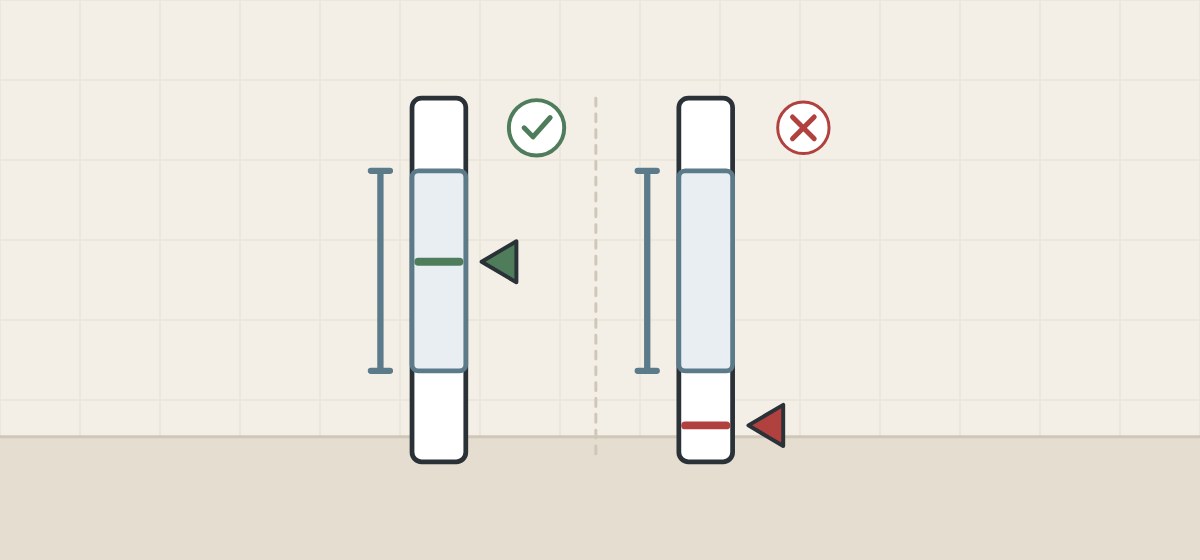
MEAN WELL says its constant-current supply cannot drive the LEDs properly when the LED voltage is below half the rated output voltage; Tridonic gives the voltage range as a check, without naming a consequence. Each speaks for its own drivers:
| Source | What it says |
|---|---|
| MEAN WELL technical notes | If the Vf sum of series LEDs cannot reach 50% of rated output voltage, its constant-current supply enters a “hiccup region” and cannot drive the LEDs properly. |
| MEAN WELL, same notes | The lighting-fixture designer should make sure the Vf sum is high enough to keep the supply in the correct region. |
| Tridonic functional description | Minimum forward voltage at or above the driver’s minimum output voltage; maximum at or below its maximum. |
Each limit is stated for that maker’s own drivers. Ask for the data sheet of the exact model.
Is dimming a separate check from the output type?
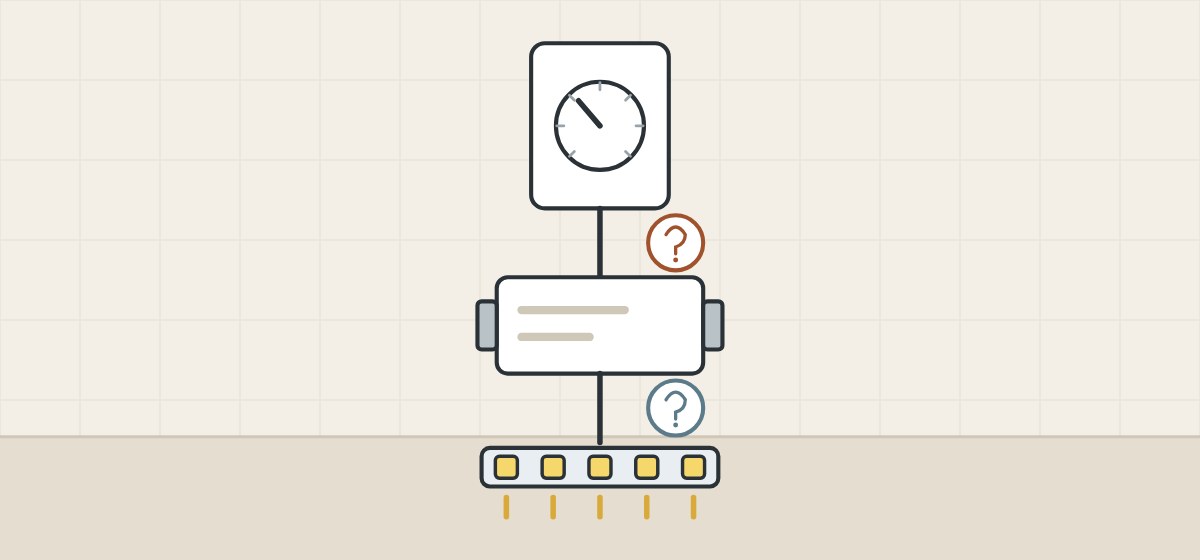
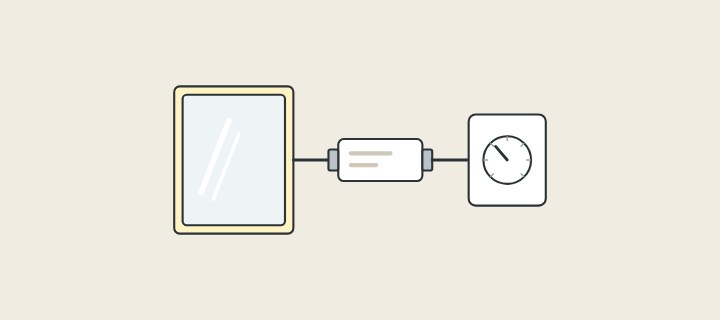
Yes: Lutron says the control type is independent of the driver output type. A matching control does not show that the output type suits the LEDs.
Dimming method
Lutron says constant-current drivers dim by pulse-width modulation (PWM) or constant-current reduction (CCR); constant-voltage drivers only by PWM.
Test the pairing
Lutron says the only way to know for sure that an LED fixture works with a particular dimmer is to test it.
Mirror makers name controls
Electric Mirror’s installation guide recommends one control for 0-10 V dimming and another for forward-phase dimming. Robern’s Vitality instructions recommend one named dimmer and say other dimmers may operate but have not been tested or verified.
Control standard
NEMA SSL 7A covers a forward phase-cut dimmer combined with dimmable LED light engines. It leaves the interface between control gear and LED module undefined: that may be constant voltage, constant current or low-voltage alternating current.
- Driver output type and ratings
- Control type the driver accepts
- Controls the mirror maker names
- Whether the pairing was tested
Which standards and ratings appear on an LED driver?
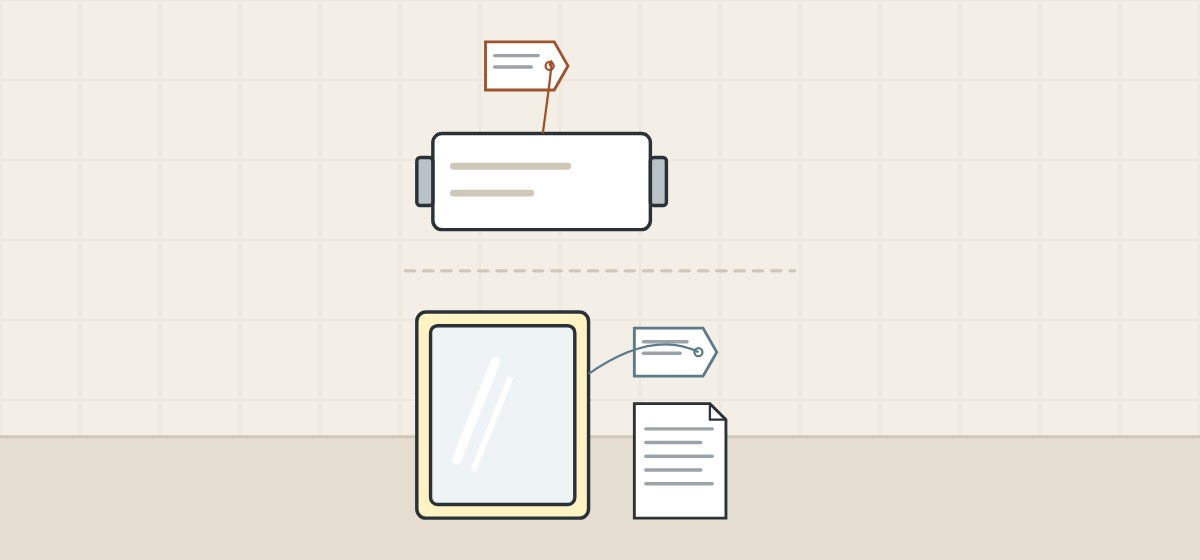
Driver data sheets and mirror documents name standards and ratings, and each belongs to the item it is printed on.
IEC 61347-2-13
The IEC safety standard for electronic controlgear for LED light sources. The abstract of the withdrawn edition 2.1 said controlgear for LED modules is designed to provide constant voltage or current at SELV or higher voltages. Edition 3.0, published in 2024, replaced it.
Ratings on the driver
MEAN WELL’s LPV-60 and LPC-60 sheets each list Class 2 power unit and IP67 encapsulation. Those lines describe that unit only.
Statement on the mirror
Robern states that its Vitality mirror is UL listed for damp locations and conforms to UL 962. That is a statement about the mirror.
Tridonic’s functional description makes the luminaire manufacturer responsible for performing the prescribed tests and for compliance with the relevant standards. Ask separately what the mirror is listed to, and confirm requirements with the local authority.
Who chooses the driver, and who services it?
Lutron says the fixture maker chooses the driver. Electric Mirror reserves servicing of electrical components, and Robern all wiring, for qualified electricians.
| Source | What it says |
|---|---|
| Lutron white paper | The fixture manufacturer chooses the driver type and configuration to match the LED module. |
| Electric Mirror guide | A qualified technician or electrician installs; qualified electricians service electrical components, power disconnected first. |
| Robern Vitality instructions | All wiring should be done by a qualified licensed electrician. |
| Tridonic functional description | Disconnect power to the entire lighting system before working on it. |
| MEAN WELL LPV-60 and LPC-60 sheets | Not intended for LED lighting luminaire applications in the EU and China. |
How should a buyer specify or replace an LED mirror driver?

Start from the LED assembly, then the exact driver model, then the control. These steps are procurement guidance, not electrical instructions.
- Identify the drive type. Ask whether the LED assembly needs constant voltage or constant current.
- Get the LED figures. Rated voltage, or drive current and forward-voltage range.
- Name the exact driver. Maker, model and data sheet, not only a generic label.
- Compare range to load. Output voltage or current range against the LED figures.
- Check dimming separately. Control type accepted and controls the mirror maker names.
- Ask about ratings. The driver’s ratings and the mirror’s own listing.
When only a wattage photo is offered
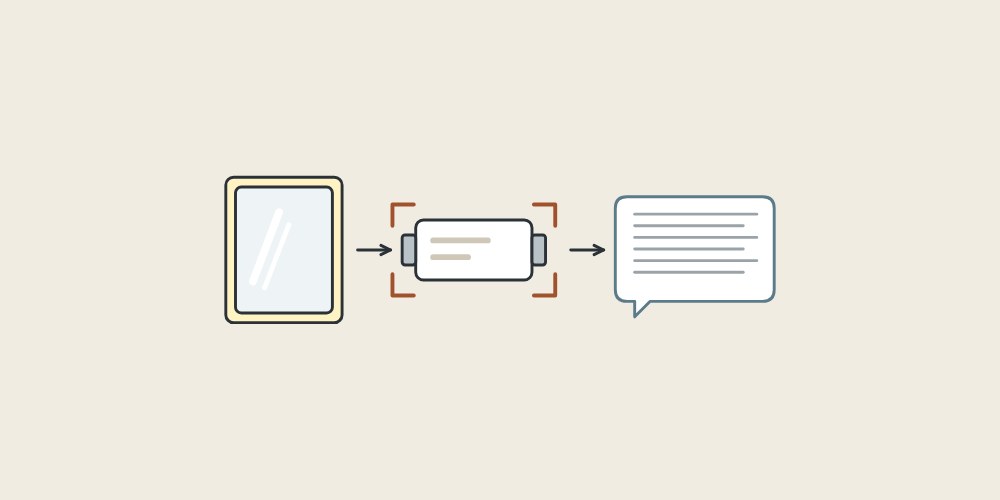
A photo showing only the wattage does not give the output type or range. Ask for a readable photo of the full label and the mirror maker’s replacement instructions. Leave unknown fields open, and have the pairing confirmed by the mirror maker or a qualified electrical reviewer.
What should you send and ask before a quotation?
A complete request names the LED assembly, the driver and the control as three items.
| Question | Why it matters |
|---|---|
| Is the output constant voltage or constant current? | The two types are not interchangeable. |
| What is the driver’s maker and model? | Ranges and limits differ by series. |
| What are the output ratings and range? | The LED load must sit inside them. |
| Which controls does the driver accept? | Control type is independent of output type. |
| Which ratings belong to the driver, which to the mirror? | A driver’s rating is not the mirror’s. |
Include with your request
- Mirror model and size
- Photo of the full driver label, if one exists
- Wall control type, if dimming is wanted
- Like-for-like replacement or redesign
WNS Global confirms any product and terms it offers separately in writing. This guide does not state that WNS Global products have the features, ratings or listings named above.