From slide label to drawer access
What do slide length, full extension and over-travel mean?
Slide length is the slide’s longest dimension when fully closed. Accuride advises using the longest slide the application allows.
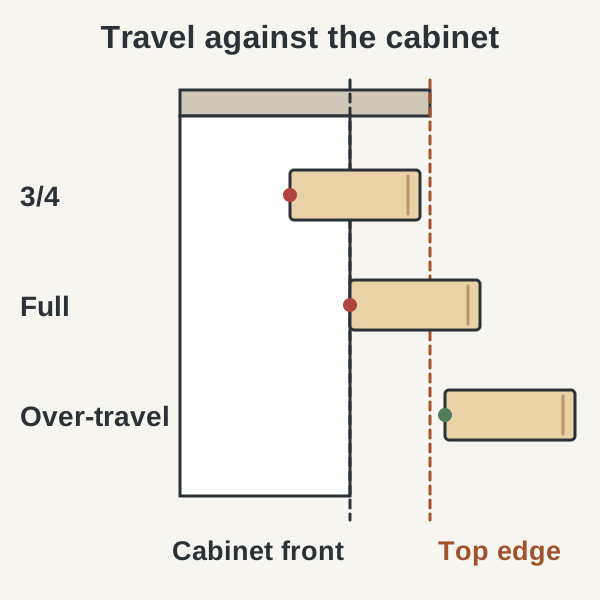
Accuride describes three travel categories. A 3/4-extension slide opens about three-quarters of its length, a full-extension slide opens the same distance as its length, and an over-travel slide opens further. Accuride Europe adds that some slides offer up to 120% extension.
Knape & Vogt ties the terms to the cabinet. Full travel brings the drawer’s back wall level with the cabinet front; its over-travel slides extend 1–2 in. beyond the front of the cabinet frame. Hettich lists partial, full and over-extension runners in its ranges.
| Term | What it tells you |
|---|---|
| Slide length | The closed length of the slide. |
| Travel or extension | How far the drawer moves, often as a percentage of slide length. |
| 3/4 extension | About 75% of slide length; the rear of the drawer may stay covered. |
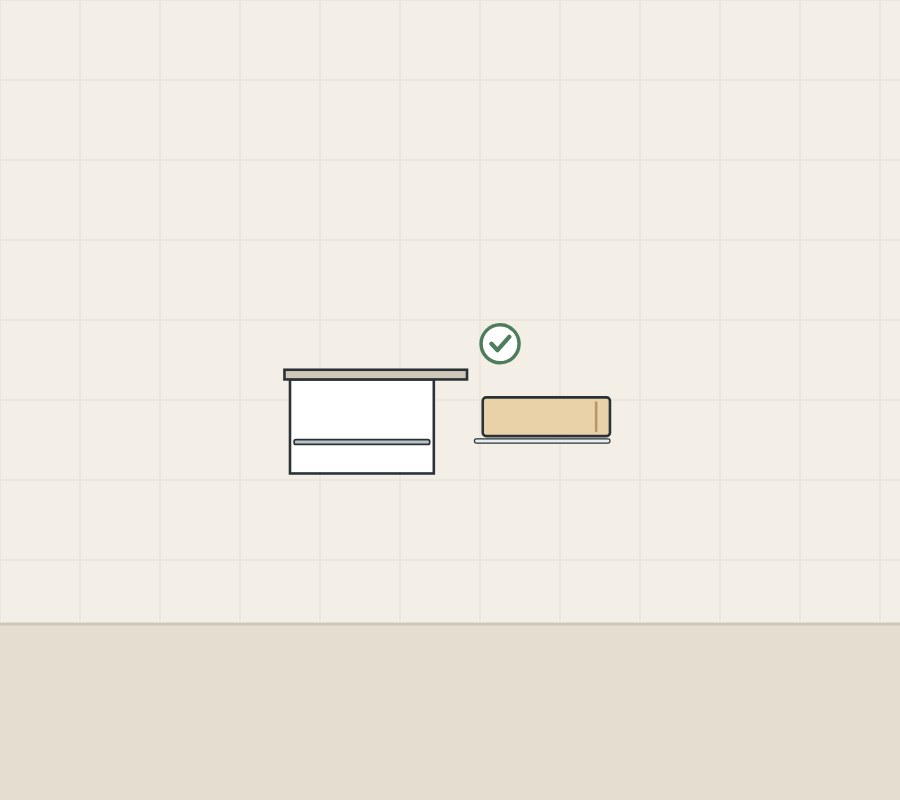
| Full extension | About equal to slide length; by Knape & Vogt’s definition the drawer back comes about level with the cabinet front. |
| Over-travel | Beyond the slide length and past the cabinet front, by a figure the maker states. |
Where is the travel measured from?
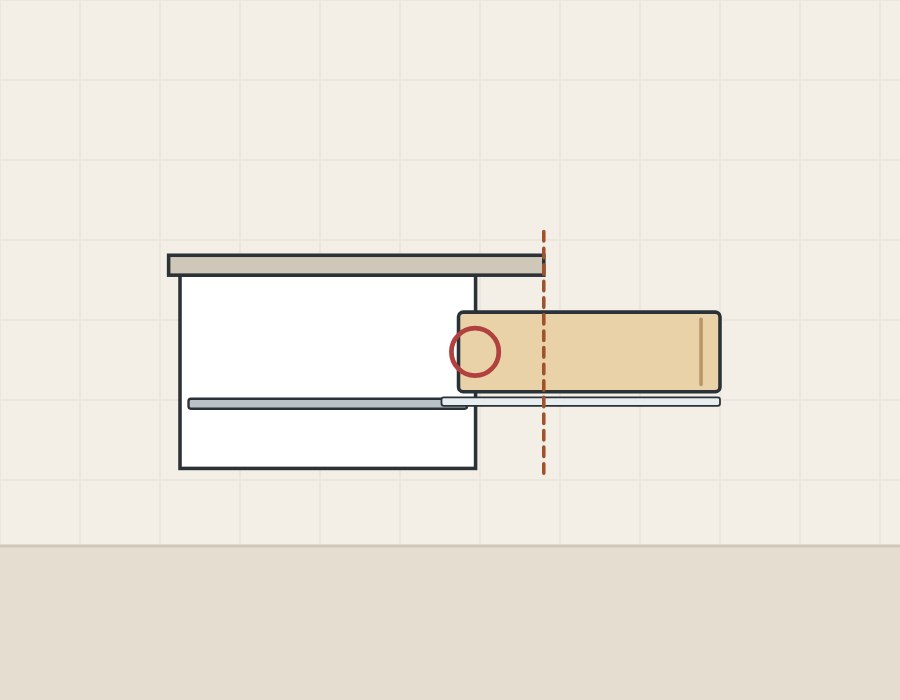
A travel figure is only useful with its reference point. Accuride Europe notes that not every slide has its drawer member flush with the slide front when closed, so a published travel dimension may be measured from behind the front of the slide. It also recommends setting slides back from the front edges, and inset fronts add to that setback. To read travel against a vanity drawing:
- Find the slide length and the travel type on the data sheet.
- Find the travel figure and the point it is measured from.
- Note the setback of the slide from the cabinet front and the drawer front.
- Mark the cabinet front on the side section of the vanity.
- Mark everything that projects over the drawer: top, basin, lip or rail.
- Compare the fully extended drawer back with those projections.
Accuride describes over-travel as suited to drawers that must open beyond the front face of the cabinet for additional access. It does not mention countertops or basins; that comparison has to be made on the actual drawing.
Which parts make up a drawer slide?
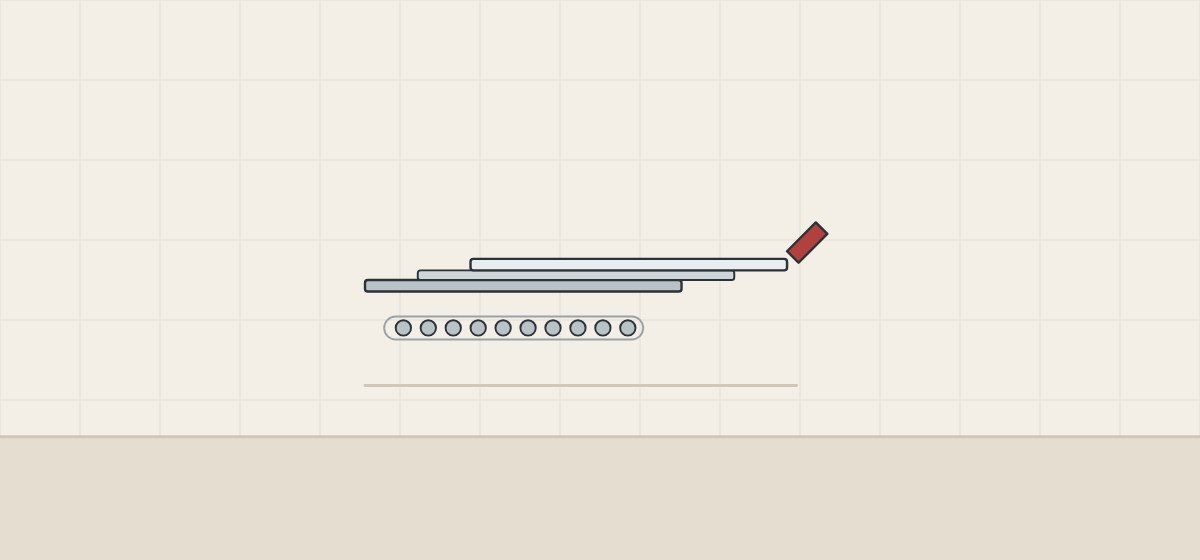
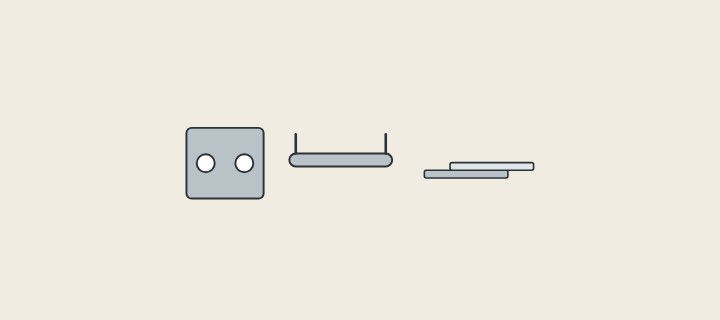
In Accuride’s terminology the cabinet member is stationary, while the intermediate and drawer members move. The parts below affect both travel and service access.
| Part | Role |
|---|---|
| Cabinet member | Fixed to the cabinet side; the stationary part. |
| Intermediate member | Extends the travel; Accuride Europe states 100% extension needs at least three sliding members. |
| Drawer member | Fixed to the drawer and carries it out. |
| Ball bearings or rollers | Accuride slides run on ball bearings in a retainer; Blum concealed runners glide on cylindrical rollers. |
| Disconnect | Releases the drawer for removal; Accuride lists lever, rail, friction and push-latch types. |
| Motion devices | Soft-close or push-to-open, such as Blum’s BLUMOTION and TIP-ON options for its concealed runners. |
Hettich states that its slides have guards against unintended roll-out and removal, and Salice describes a synchronization system that lets a press anywhere on a wide front open its push drawers. These are features of the named products, not of slides in general.
3/4, full or over-travel: what access does each give?
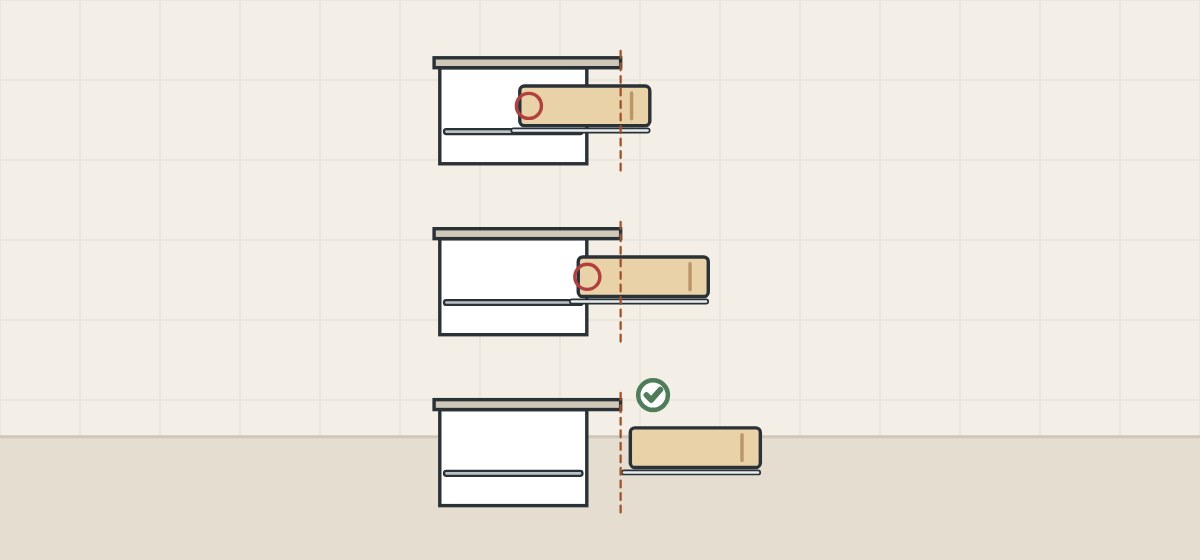
Accuride Europe states that 3/4 extension needs only two sliding members, while full extension needs at least three. The difference shows at the back of the drawer.
| Travel type | Drawer position when open | Named examples |
|---|---|---|
| 3/4 extension | The rear of the drawer may stay covered, restricting access. | Accuride: an 18 in. 3/4-travel slide gives about 13 in. of travel. |
| Full extension | The drawer back comes about level with the cabinet front (Knape & Vogt), subject to datum and setback. | Travel about equal to slide length. |
| Over-travel | The drawer back moves past the cabinet front. | Accuride 3834E and 3634EC: 1 in. beyond slide length; Knape & Vogt 8525: 1.25 in. |
Accuride markets its 3834E over-travel slide as giving full access to the rear of drawers. That is a claim for one product; the figure that matters is how far past the cabinet front it goes, compared with what overhangs the drawer.
Side-mount or concealed undermount: what changes?
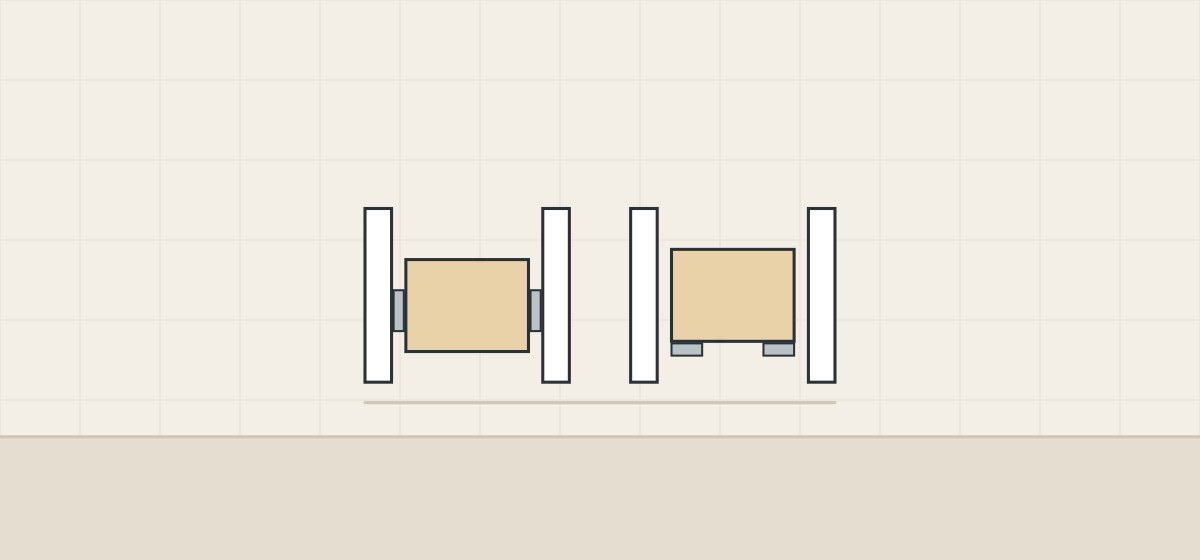
Accuride contrasts side-mount slides, fixed to the drawer side inside the cabinet, with undermount slides, which need a specially designed drawer that sits on the suspension. Each brings its own clearances.
Side space for ball-bearing slides
Accuride Europe asks for side space slightly larger than the slide: 0.2–0.5 mm more than slide thickness, for example 12.9–13.2 mm for a 12.7 mm slide. Too narrow or too wide causes poor running or early failure.
Drawer boxes for concealed runners
Blum’s TANDEM catalog specifies wooden drawer sides 11–16 mm thick. Hettich’s Quadro leaflet accepts 1/2 in. (13 mm) or 5/8 in. (16 mm) sides.
Cabinet depth
Concealed runners need an inside depth greater than their length. Grass gives installation depth as nominal length plus 3 mm for Dynapro; Salice’s 457 mm Progressa+ Push needs at least 475 mm.
Drawer length
Blum’s MOVENTO documentation and Grass both set drawer length at nominal runner length minus 10 mm, and Blum states a 2.5 mm minimum front gap with TIP-ON BLUMOTION.
Motion options
Blum lists soft-close and push-to-open options for its concealed runners. Salice states that its Progressa+ Push meets ANSI/BHMA A156.9 Grade 1.
- Slide type and mounting position
- Side space or drawer-side thickness
- Inside cabinet depth against runner length
- Drawer length and front gap
What limits access to the back of a vanity drawer?
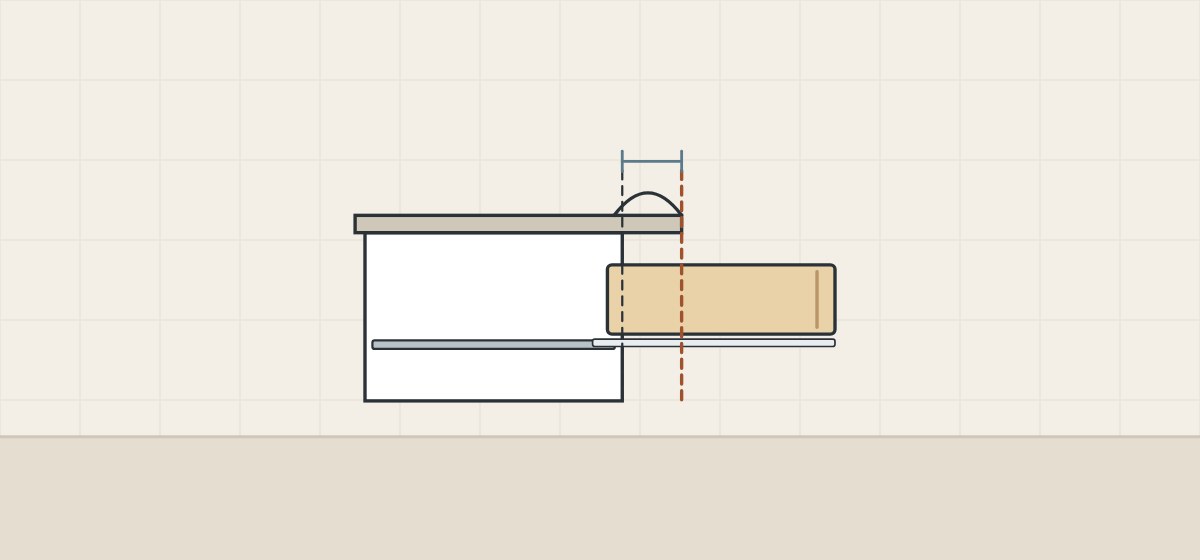
Travel is measured against the cabinet. Access is limited by whatever sits above or in front of the drawer. Four points need checking on the side section.
The cabinet front line
Full travel brings the drawer back to about this line, per Knape & Vogt’s definition; the datum and setback below shift the actual position. It is the reference for every other comparison.
Top or basin overhang
Anything projecting past the cabinet front still covers a fully extended drawer. No source we found states how much over-travel a given overhang needs, so measure the projection and compare it with the maker’s stated over-travel.
Slide and front setback
Accuride Europe sets slides about 2 mm back from the cabinet edge and 2 mm from the drawer front, and more for inset fronts. Setback reduces how far the drawer passes the front.
Cabinet depth and runner length
A longer runner gives more travel, but concealed runners need the inside depth their maker states.
We found no manufacturer source on handle projection or face-frame depth as a travel factor. Treat them as items to measure on the drawing, not as rules.
How are drawer slide load ratings stated?
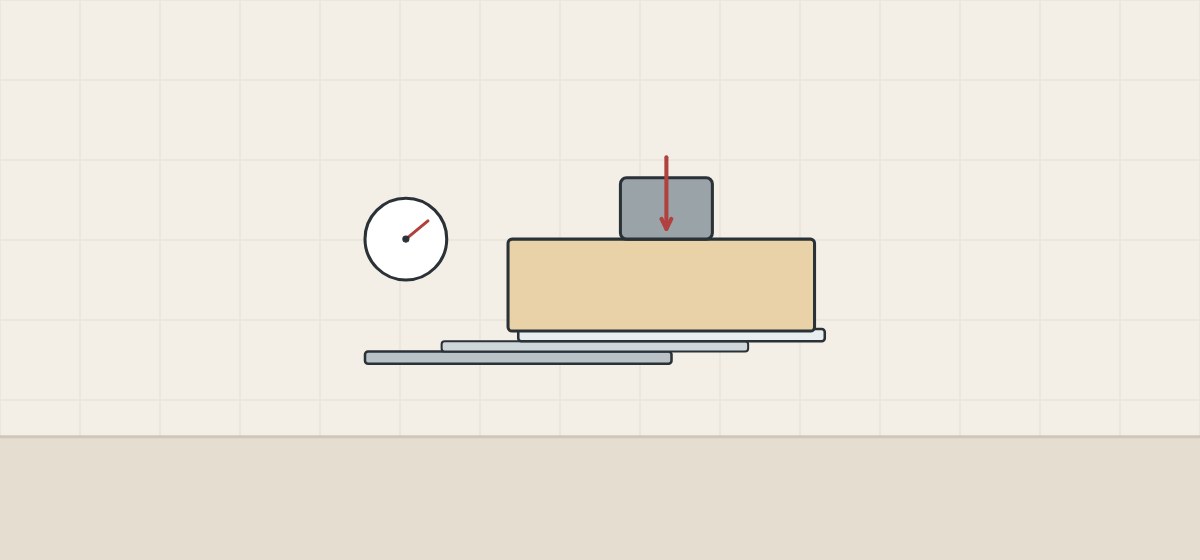
Travel and load are separate specifications. A load rating belongs to a test set-up and a mounting position, not to the slide alone. The statements below show how the named makers and standards frame it.
| Rating statement | What it depends on |
|---|---|
| Accuride ratings are dynamic loads for an 18 in. pair of slides on a 16 in. wide drawer, unless stated otherwise. | Accuride states the rating decreases proportionally beyond 18 in. of length. |
| Accuride Europe says wider drawers need higher-rated slides and static capacity is at least twice the rating. | Flat mounting reduces capacity by 75%, and every fixing position must be used. |
| Knape & Vogt rates by dynamic loading, for example 150 lb at 50,000 cycles or 200 lb at 25,000 cycles for one model. | Knape & Vogt states ratings vary with slide length, application and case construction. |
| Hettich rates Quadro V6 at up to 90 lb dynamic and 100 lb static under ANSI/BHMA A156.9 grade 1. | The model and its 2019 leaflet. |
| ANSI/BHMA A156.9 covers cabinet hardware, including slides; its 2010 edition sets Standard and Heavy Duty levels with Grade 1 the highest. | The duty level and the test drawer used; a third-party test report for one Salice slide, tested to the 2020 edition and hosted by a distributor, used a 24 × 22 in. drawer with 50 lb for 50,000 cycles. |
| EN 15338, in its 2007 edition, specifies strength and durability tests for extension elements; a 2024 edition has since been published and was not reviewed. | The 2007 edition does not cover aging, heat or humidity. |
How should a buyer specify drawer access?
These steps apply the facts above to a vanity order. They are procurement guidance, not an installation instruction.
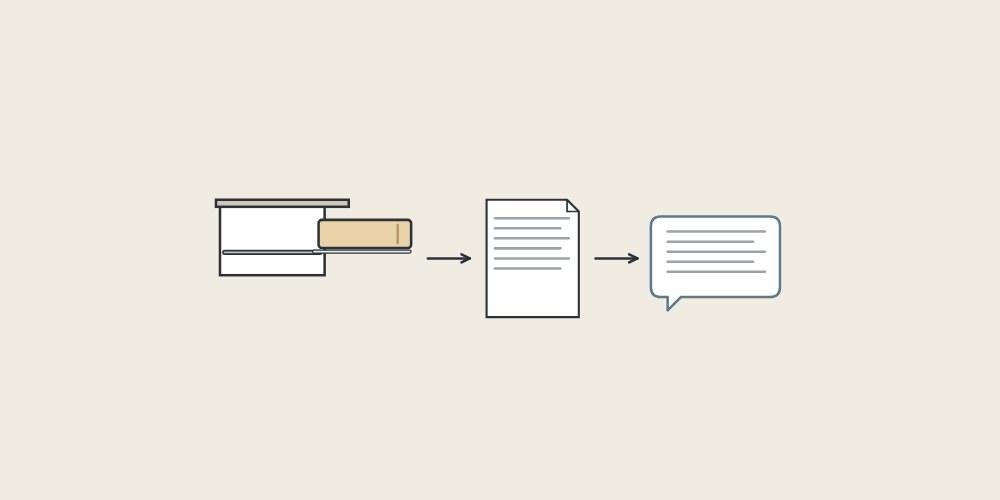
- Draw the side section. Show the cabinet front, drawer front, top and any basin or lip over the drawer.
- State the access outcome. Say whether the back of the drawer must clear the top, not just “full extension”; a layout change may meet it as well as a longer-travel slide.
- Name the slide. Record the product, length and travel type from its data sheet.
- Check the datum. Confirm where the travel figure is measured and how far the slide is set back.
- Compare with the overhang. Set the maker’s stated over-travel against the measured projection.
- Check depth and box. Match inside depth, drawer length and side thickness to the named runner.
- Tie the load to the drawer. Quote the rating with the drawer width and slide length it applies to.
When the top changes late
A new countertop or basin can change the overhang after slides were chosen. Re-check the side section whenever the top changes, because full travel reaches only about the cabinet front.
See also: How are drawer slide load ratings stated?
What should you send and ask before a quotation?

A clear request turns “full extension” into a checkable access requirement. Each question maps to a point earlier in this guide.
| Question | Why it matters |
|---|---|
| Which slide product and length are offered? | Travel and ratings belong to that model. |
| What travel type and figure does it have? | 3/4, full and over-travel give different access. |
| Where is the travel figure measured from? | Some slides measure from behind the slide front. |
| How far does the drawer back pass the cabinet front? | That is what must clear any overhang. |
| What cabinet depth and drawer box does it need? | Concealed runners have product-specific depth and side rules. |
| What drawer size does the load rating assume? | Ratings change with width and length. |
Include with your request
- Side section with cabinet front and top overhang
- Drawer inside dimensions and front type
- Required access to the back of the drawer
- Expected load in each drawer
- Soft-close or push-to-open requirement
WNS Global confirms any offered slide, cabinet construction and commercial terms separately in writing. This guide does not state that WNS Global uses or supplies any brand named above.