
From inspection to crate
Why record a vanity top’s condition before packing?
A record made just before packing shows the state of one identified top at the last point it can be seen. Kohler’s instructions for two Forefront vanity tops say to unpack the lavatory and inspect it for damage before installation.
Crane Plumbing’s cultured marble instructions state that installing the product constitutes acceptance. A record made at packing helps place in time any damage found before that.
Identity matters as much as the picture. Cosentino’s Silestone manual says claims must come with the serial number of the slab used to make the worktop.
| Source | Stage | What it says |
|---|---|---|
| Cosentino Dekton worktop manual | Unloading | Check pieces have not moved and are in correct condition. |
| Kohler K-2748T/K-2749T | Before installation | Unpack and inspect for damage. |
| Crane Plumbing | Before installation | Inspect thoroughly; installation is acceptance. |
What should be checked and photographed before a top is covered?
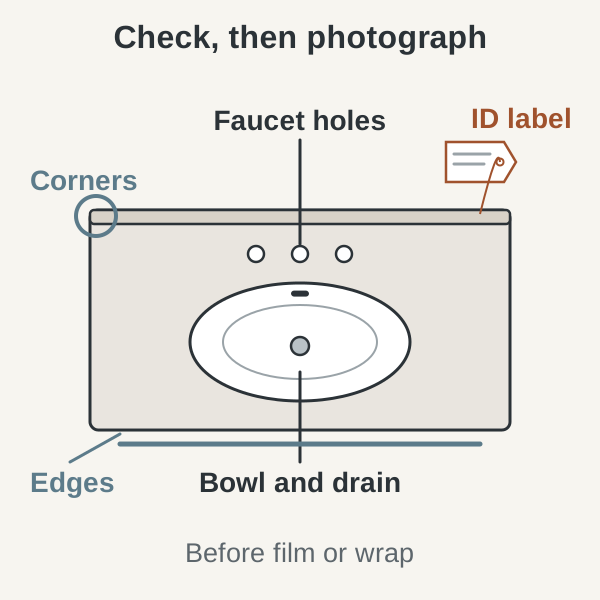
Check the whole top, then photograph it with its ID, before any film or wrap goes on. The sequence is this guide’s own advice.
- Clean the top so no grit sits under film.
- Inspect surface, edges, corners, bowl, drain area and faucet holes under low-angle light.
- Set aside any top with visible damage before packing starts.
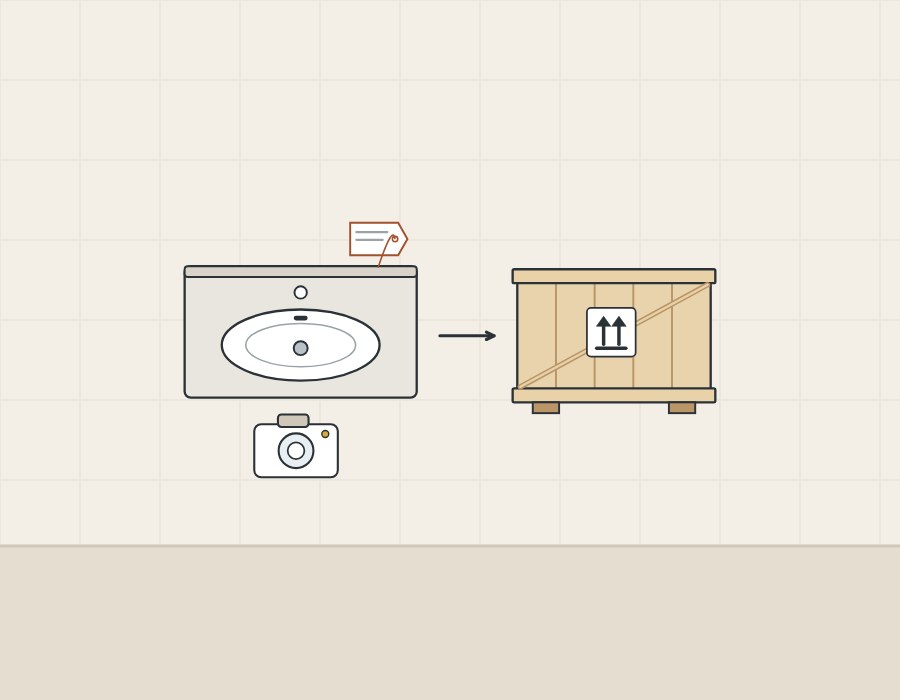
- Photograph the whole top with its ID label in the frame.
- Photograph corners, edges, cut-outs and the bowl close up.
- Fit film and edge protection, then photograph the protection.
- Record which crate or carton the top went into.
Cleaning comes first: Cosentino’s Dekton technical manual (2014 version) says to clean a cut piece well so abrasive particles do not damage the surface in transport.
Should vanity tops travel flat or on edge?

Follow the maker of the material. Both transport instructions read for this guide say on edge or upright; the only flat instruction is for storage.
| Maker and product | Instruction | Applies to |
|---|---|---|
| Corian solid surface | Best transported on edge; not horizontally on roof racks. | Parts in transport |
| Cosentino Dekton worktops | Upright, with particular attention to pieces with cut-outs. | Pieces in transport |
| North Coast cultured product | In original packaging, lying flat, until installed. | Storage |
| Kohler K-2748T/K-2749T | Back in the protective carton until installation. | Storage |
Corian’s reason is that horizontal carriage on a roof rack stresses the part, which may bounce and break. This guide found no published support spacing for a long finished top, so have orientation and support written into the packing specification.
How are edges, corners and cut-outs protected?
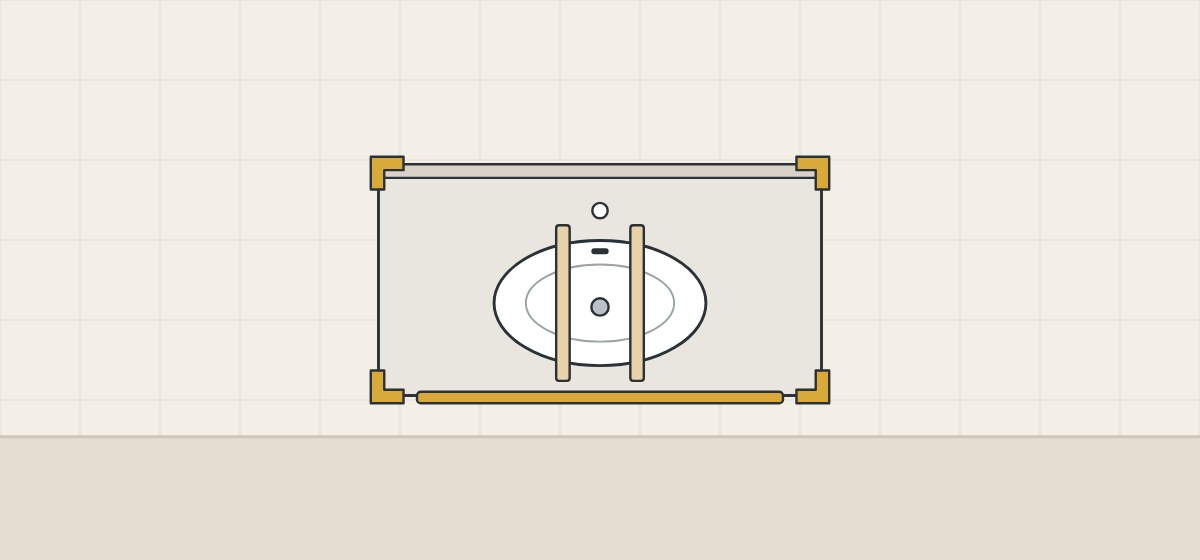
Cosentino calls for edge protectors and advises fixation bars across large cut-outs; Corian braces cut-outs and keeps faces apart. Each row applies to that maker’s own material.
| Point | Source | What it says |
|---|---|---|
| Edges | Dekton worktop manual | Cover the edge with protectors against knocks. |
| Edge frame | Dekton technical manual | Frame the edges with a rim of at least 2 cm on each side. |
| Cut-outs | Corian | Brace any cutouts so seams and corners do not flex. |
| Large cut-outs | Dekton worktop manual | Fixation bars are advisable against movement and breakage. |
| Faces | Corian | No parts touching face to face; protection between each. |
Corian says special transport jigs are commonly used for parts with installed sinks. No source used here covers bowls in other materials; this guide’s own advice is to cover or fill the bowl so nothing presses into it.
What are the limits of protective surface film?

Film is temporary. The figures below come from one film maker, Pregis (SG PolyMask brand), for its own masking films. Four points:
Clean, dry surface
Pregis’s storage and usage guide says surfaces should be dry and clear of lubricants, solvents or other contamination.
Time under film
Pregis says not to store substrates for longer than 6 months with its masking films applied. Ask the maker of the film used for its figure.
Sun and heat
Pregis says non-UV films left outside risk breaking down and transferring adhesive, and that above 90 °F adhesives soften. Corian says not to let its parts overheat in the sun.
Film in transport
Cosentino’s Dekton worktop manual calls for protective film over the worktop surface.
- Film maker and type
- Faces covered
- Date applied
- Removal instruction for site
How should the crate or frame hold the tops?

The load should be padded, balanced and strapped so nothing can shift. Four points:
Padded and balanced
Cosentino’s Dekton worktop manual describes a trestle covered with wooden blocks or padding, product on both sides to balance the load, and wood or ratchet straps holding it firmly without over-tightening.
Supports in containers
An OSHA bulletin on stone slabs says that without the wood supports some suppliers fit in containers, slabs can shift, slide or collapse.
Wood packaging
USDA APHIS says regulated wood packaging used to support, protect or carry cargo into the United States must be treated and certified per ISPM 15.
Handling marks
ISO 780:2015 specifies graphical symbols for marking packages with handling instructions.
The sources used here do not compare crates with cartons; settle that in the packing specification.
What can a packing record or a transit test prove?
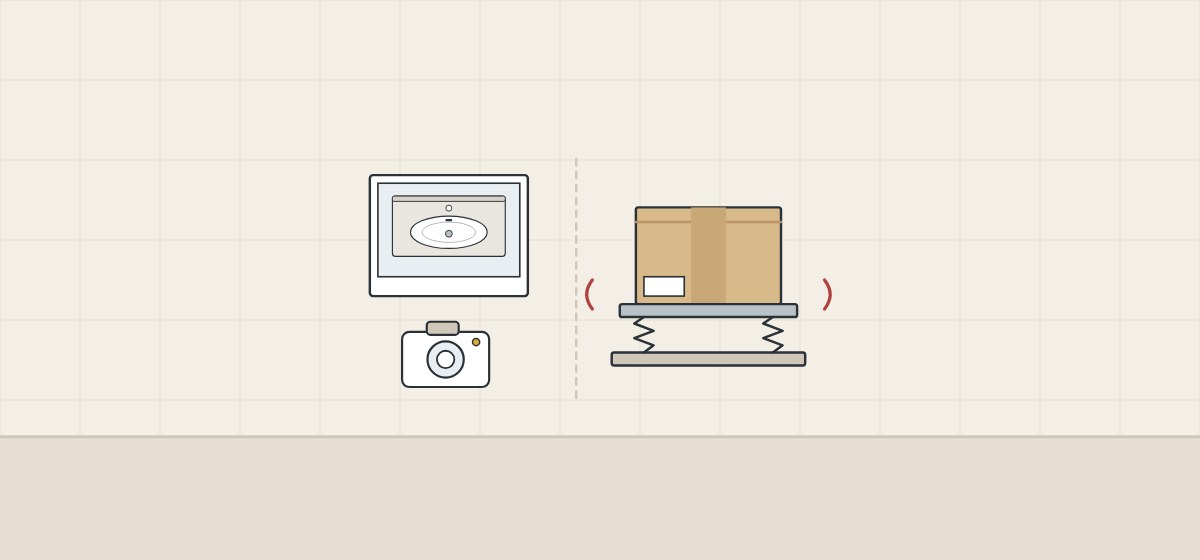
Each proves one narrow thing. ISTA says a test protocol evaluates packaging only for the hazards it represents, and that even ten successful replicate tests do not guarantee that all future tests will succeed. The last four rows are this guide’s own.
| Evidence | Can show | Cannot show |
|---|---|---|
| ISTA 1-Series test | Integrity of product and package together | A simulated environment |
| ISTA 3-Series test | Simulated transport motions and forces | Hazards outside the protocol |
| Condition photos with ID | State of that top at packing | Faces not photographed |
| Protection photos | How that top was protected | That protection survived handling |
| Packing list by crate | Where each top is | Its condition |
| Unpacking photos | Condition on arrival | When damage occurred, without the earlier set |
How should a buyer write packing into an order?

Write the record and the protection into the packing specification before production ends. These steps are procurement guidance.
- Agree what counts as damage. Chips, scratches, cracks and marks, by face.
- Name the maker’s instruction. Orientation and support follow that document.
- Require photographs by top ID. Whole top with label, then close-ups.
- Specify protection. Edge guards, cut-out bracing, bowl cover and film.
- Specify the crate or frame. Padding, strapping, balance and wood packaging rules.
- Label and list. Project, room type, unit and orientation on crate and packing list.
Packing errors to rule out
Without photographs before packing, every chip is open to dispute. A long top resting on two end points is this guide’s main breakage concern; ask for support along the length unless the material maker says otherwise. Also rule out unprotected bowls and unlabeled tops, and label mirrored room types.
What should you send and ask before a quotation?

Ask how each top is recorded and protected, not only how it is made.
| Question | Why it matters |
|---|---|
| Is each top photographed with its ID before packing? | The record ties condition to one top. |
| Whose handling instruction does the packing follow? | Orientation instructions read here differ between transport and storage. |
| How are edges and cut-outs protected? | Cosentino calls for edge protectors; Corian for braced cut-outs. |
| Which film is used, and when is it removed? | Pregis sets time and heat limits; ask your film maker. |
| Is wood packaging treated for the destination? | APHIS: ISPM 15 applies for the United States. |
Include with your request
- Top material, lengths and thickness
- Bowl and cut-out layout
- Room types and quantities
- Destination and route
- Unloading equipment on site
WNS Global confirms any offered vanity top, packing method, records and commercial terms separately in writing. This guide does not state that WNS Global packs, films, crates, tests or photographs its products in any way named above.