From noise to the right device
What is the difference between an arrestor and a pressure reducer?
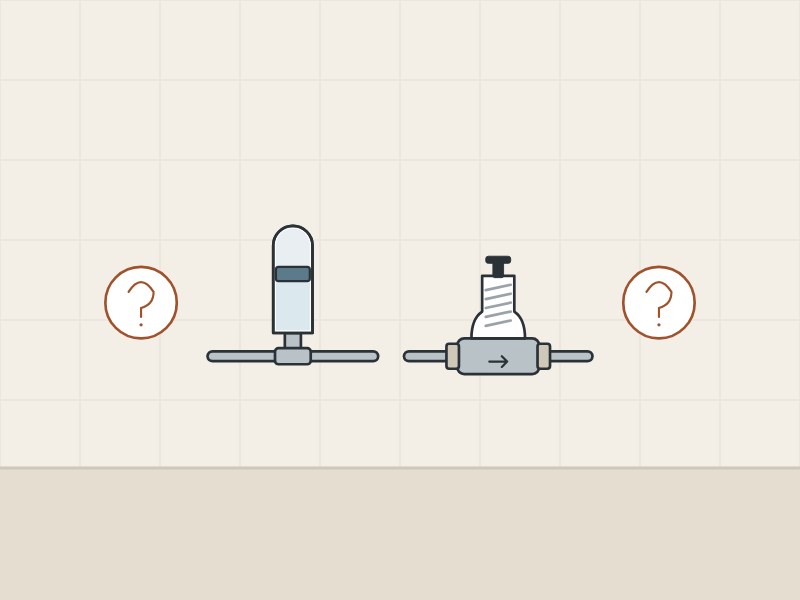
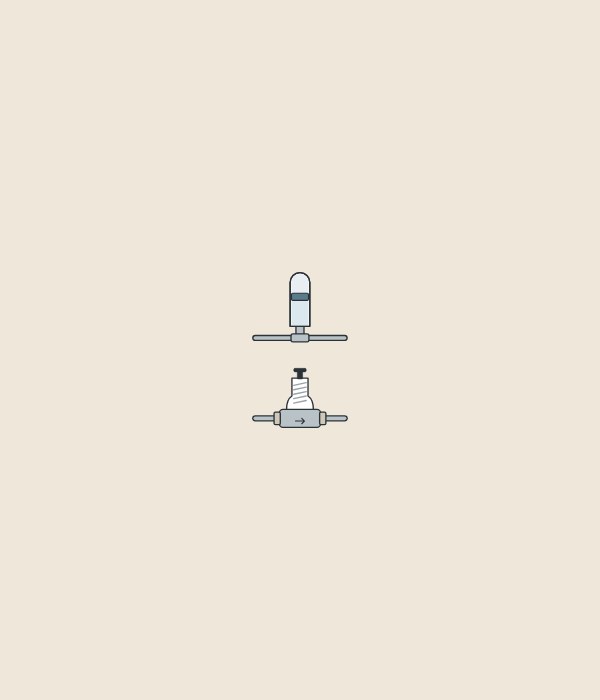
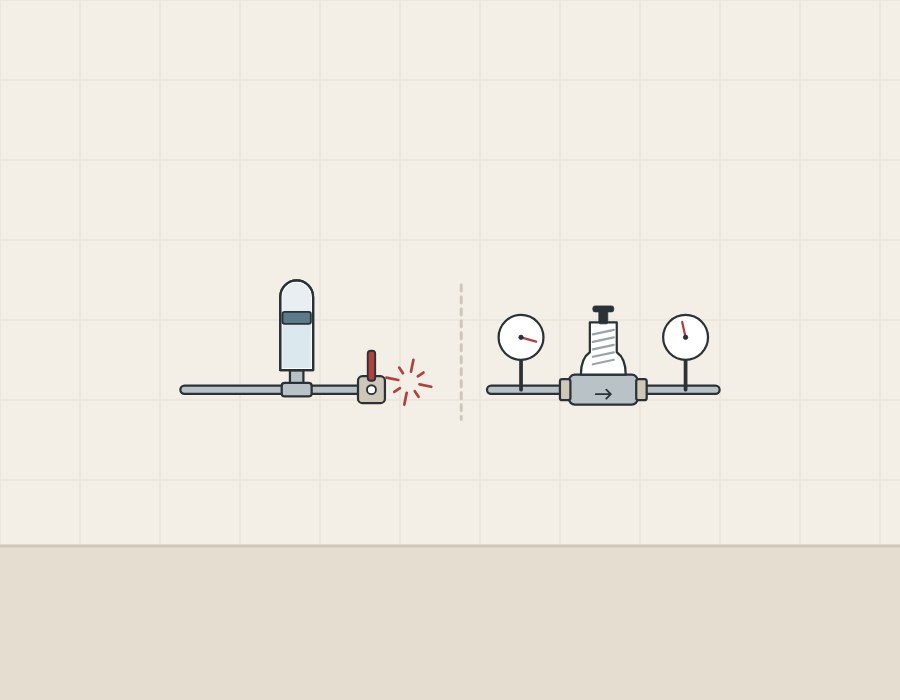
An arrestor absorbs a shock; a reducer lowers and holds supply pressure. Watts says its shock arrestors absorb the shock of water hammer, which it says generally results from sudden changes in flow velocity.
Watts gives a pressure reducing valve two functions: it automatically reduces high incoming pressure from the city mains, and it maintains a set pressure in the home, usually 50 lbs in Watts’ words.
The two problems are linked: asked whether high water pressure causes water hammer, the same Watts FAQ answers yes. The devices still act on different things.
| Term | What it means |
|---|---|
| Water hammer | Shock when moving water is suddenly stopped by a closing valve (Sioux Chief). |
| Arrestor / arrester | Device that absorbs that pressure surge. |
| Pressure reducing valve | Lowers incoming pressure and holds a set pressure; also called a regulator or PRV. |
| Quick-closing valve | Closes automatically on release or by fast mechanical action (Boca Raton memo). |
How does water hammer happen?
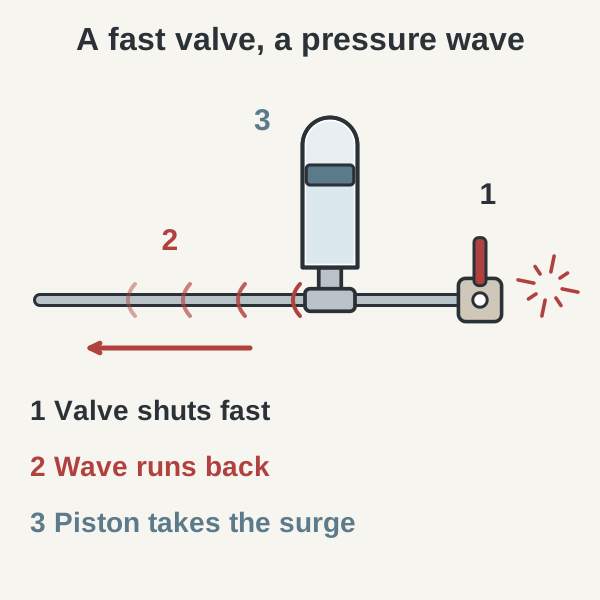
Water hammer happens when moving water is stopped suddenly by a closing valve, per Sioux Chief’s water hammer FAQ. The sequence combines that FAQ with Watts’ LF15M2 arrestor page.
- Water flows along the pipe to an open valve.
- The valve closes quickly.
- The moving water is stopped suddenly.
- A pressure wave travels back through the piping until it finds a point of relief.
- With a piston arrester fitted, the water column is diverted into it and pushes the piston up.
- The air cushion behind the piston reacts and prevents the spike.
Sioux Chief says uncontrolled hammer on a line of just 50 PSIG will commonly produce spikes of 250 to 400 PSIG; the figure is the maker’s own. It says that in homes quick-closing valves are typically at the washing machine, dishwasher, tub/shower and ice maker.
What does each device act on?
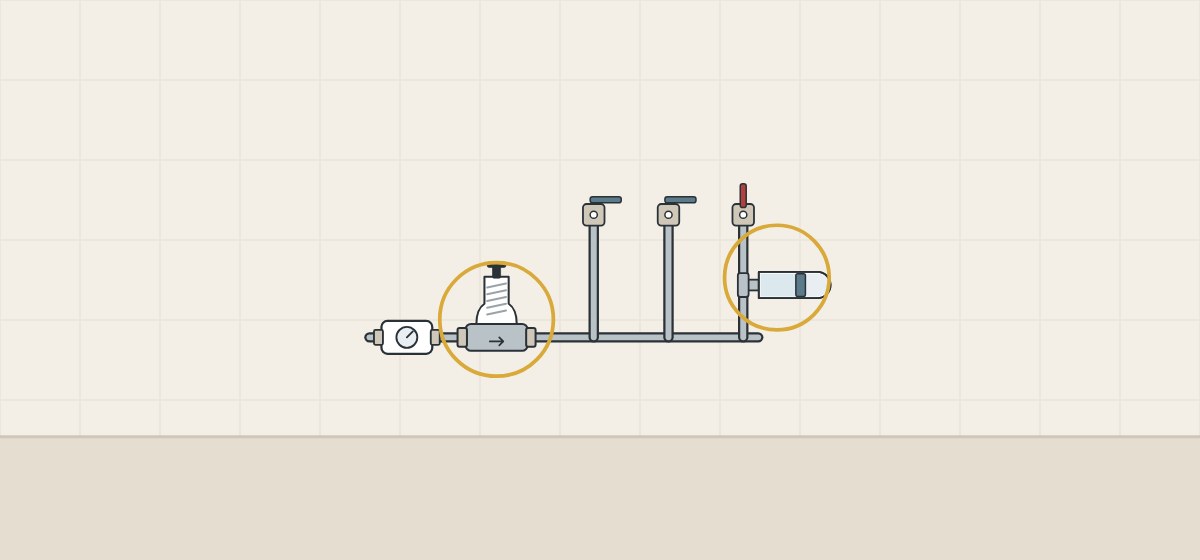
An arrestor acts on a surge; a reducer acts on static and flowing supply pressure.
| Device | What the source says |
|---|---|
| Arrester (ASSE 1010) | Prevents detrimental surge pressures in the distribution system; eliminates noise. |
| Arrestor (Boca Raton memo) | Absorbs the pressure surge that occurs when water flow is suddenly stopped. |
| Reducing valve (ASSE 1003/CSA B356) | Reduces static and flowing pressures in water distribution systems. |
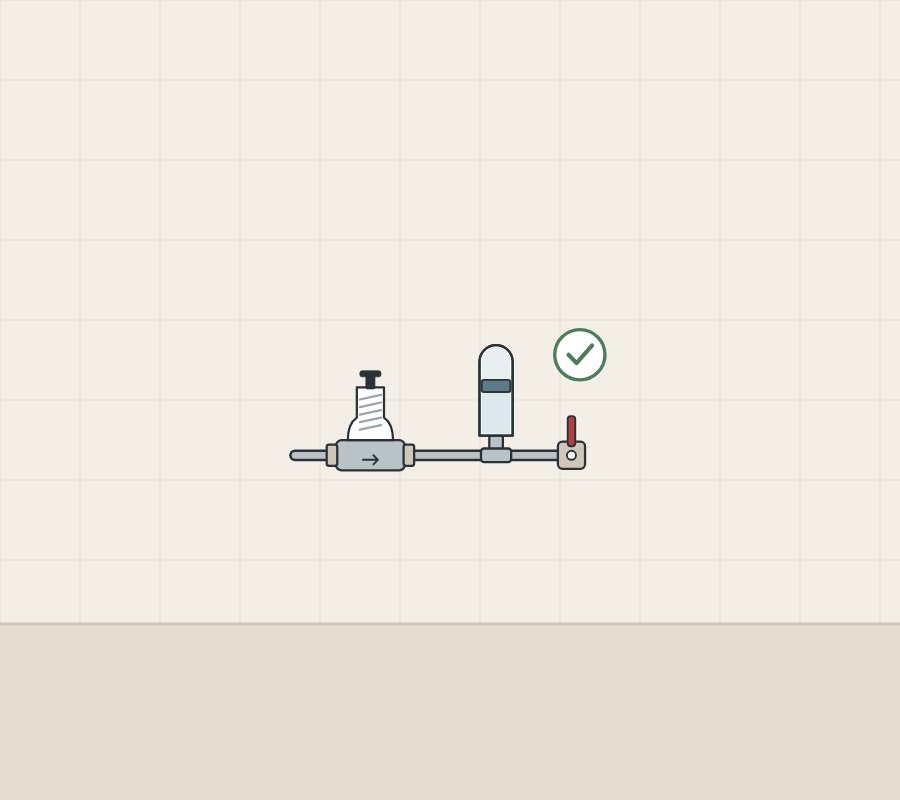
Sioux Chief calls it a myth that one large, centrally located arrester controls hammer throughout a piping system. Reducing valves, Watts says, are commonly installed at the meter.
What do named products state about themselves?
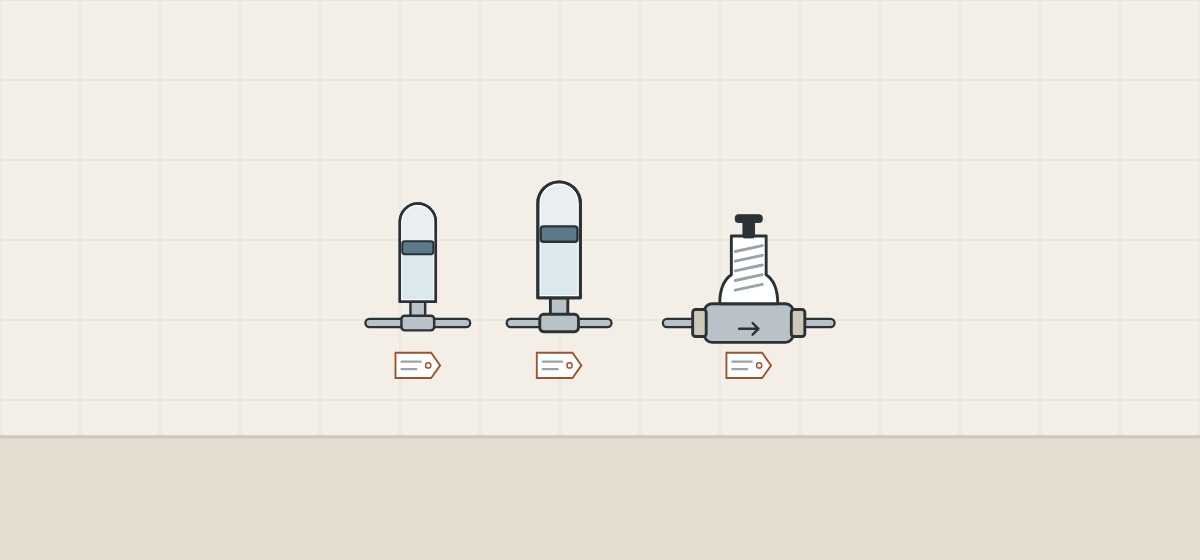
Maker pages for the two device types describe different parts and ratings. Three examples:
| Product | Type | What the maker states |
|---|---|---|
| Watts LF15M2 | Arrestor | Pre-charged, permanently sealed air chamber; the piston is the only moving part. |
| Sioux Chief 650 Series | Arrester | Piston type, copper tube body; max working pressure 350 PSIG; any angle. |
| Watts LFN45B | Reducing valve | Standard setting 50 psi, adjustable 25–75 psi; integral strainer and bypass. |
Watts says the LFN45B bypass controls thermal expansion pressure. In the text retrieved for this guide, none of these pages describes an arrestor that sets pressure or a reducing valve that absorbs a shock.
Which standards cover each device?
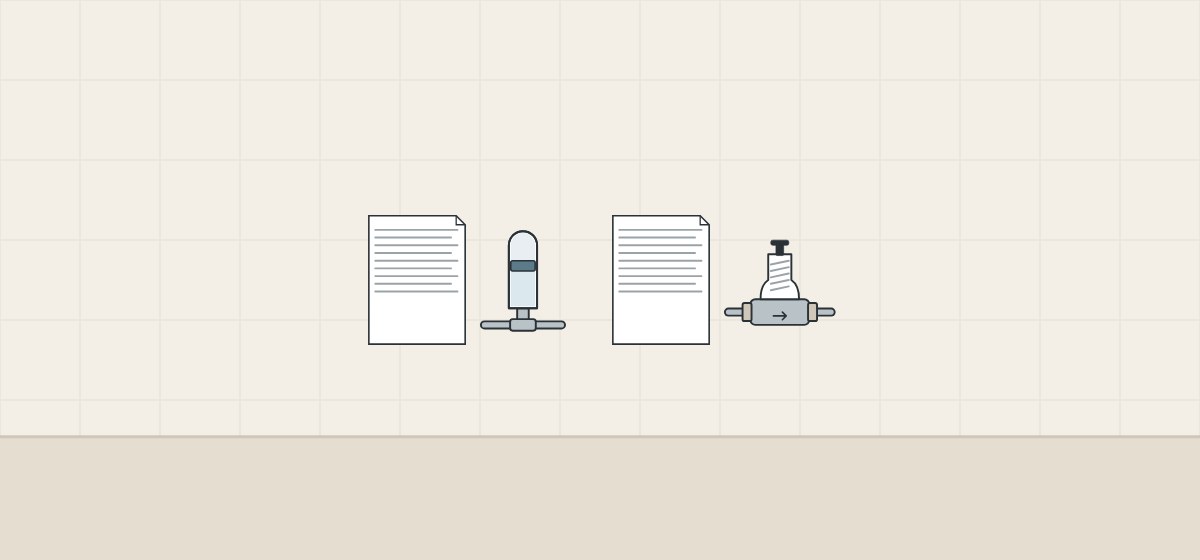
Each device has its own product standard. ASSE’s standards list shows these designations:
ASSE/IAPMO/ANSI/CAN 1010-2025
Water hammer arresters: test methods and performance requirements, per ASSE. Sioux Chief’s 650 Series sheet names the earlier ANSI/ASSE 1010-2004 edition.
ASSE 1003-23/CSA B356:23
Water pressure reducing valves for potable water distribution systems. CSA’s store page shows a first edition, 2023, and nominal sizes from 1/2 to 4 inches.
Arrester size letters
Sioux Chief says the letter states an arrester’s capacity, from AA, the smallest, through A to F. Its 650 Series sheet gives A as 1–11 fixture units and F as 155–330.
- The standard and edition on the data sheet
- The certifier named for that standard
- For arresters, the size letter
- For reducers, the size and setting range
Where do makers place arrestors?
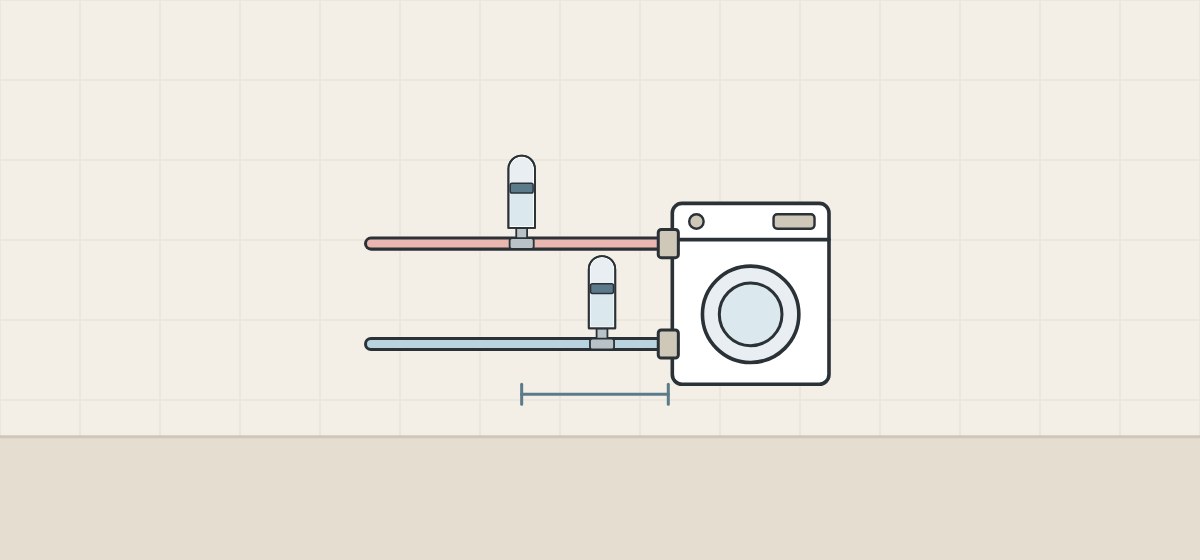
The two makers quoted here place an arrestor close to the valve that causes the shock. Three points:
Close to the valve
Sioux Chief says arresters should go as close to the culprit valve as possible; it recommends within six feet of the valve, on both the hot and the cold line where applicable.
At the fixture piping
Jay R. Smith’s arrester FAQ says a unit at the top of a riser is not effective; the location should be at the piping serving the fixtures, normally between the last two fixtures.
Access differs by maker
Sioux Chief’s 650 Series sheet says no access panels are required; Jay R. Smith says it is always wise to provide access.
Sioux Chief also says a capped air chamber is not an effective fix, because its air is absorbed into the water within a few short weeks. Sizing and location belong to the plumbing designer and the chosen maker’s instructions.
What do codes and utilities say about pressure and hammer?

Requirements come from the code adopted where the project is built. Four published statements, two on hammer and two on supply pressure; confirm with the local authority.
| Source | What it says |
|---|---|
| Chicago, 18-29-604.9 | An air chamber or arrestor where quick-closing valves are used; arrestors conform to ASSE 1010. |
| Boca Raton memo | Cites Florida’s 2020 code (7th Edition): an arrestor where quick-closing valves are used. |
| EPA WaterSense | Most U.S. plumbing codes require a PRV where supplied pressure exceeds 80 psi; it recommends 45 to 60 psi service pressure. |
| San Jose Water | California’s code requires a regulator in new buildings above 80 psi; the customer installs and maintains it. |
How should a buyer work out which device is needed?
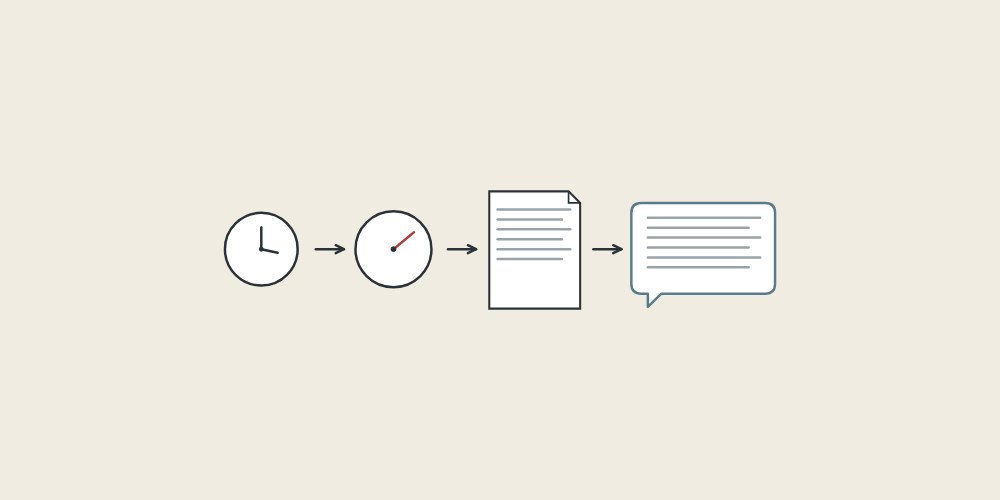
Record the event and the steady pressure separately, then let a plumbing professional choose. This is procurement guidance, not a diagnosis.
- Note when the noise happens. After one outlet shuts, during steady flow, or at another time.
- Name the valve. Which fixture or appliance closed, and whether hot, cold or both.
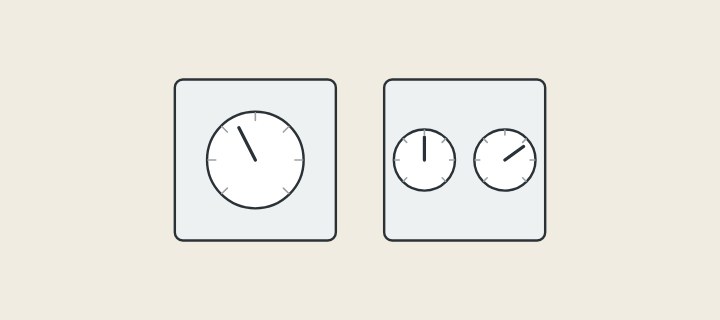
- Measure the steady pressure. A gauge reading with no water flowing, with the time of day.
- Keep the two records apart. One steady reading is not a record of a short spike.
- Check for an existing reducer. Whether a regulator is fitted, and its setting.
- Ask about the local code. Pressure limits and arrestor rules come from the adopted code.
- Give each device its own reason. If both are proposed, a separate reason for each.
When pipes bang
A bang does not identify the cause by itself. Watts ties banging pipes to water hammer on its arrestor page and, as a rule of thumb in its FAQ, to excessive pressure. San Jose Water says clanging or rattling pipes when a faucet, dishwasher or washing machine shuts off are caused by a high-pressure water hammer. Have the cause investigated before parts are specified.
What should you send and ask before a quotation?
Send the evidence that matches the device proposed. Each proposal needs different evidence.
| Proposal | Evidence still needed |
|---|---|
| Hammer arrestor | An identified shock event, the valve, the line size and what the valve serves. |
| Pressure reducer | Measured supply pressure and the pressure the fixtures need. |
| Both | A separate reason for each. |
| Cause unclear | A qualified investigation before specifying parts. |
Include with your request
- Project location and adopted plumbing code
- Fixtures and appliances on the affected line
- When the noise happens and what was operated
- Static pressure readings, with date and time
- Any existing regulator, its model and setting
This guide sets no pressure and promises no cure from either device. WNS Global confirms any product and terms it offers separately in writing. This guide does not state that WNS Global products have the features, ratings or listings named above.