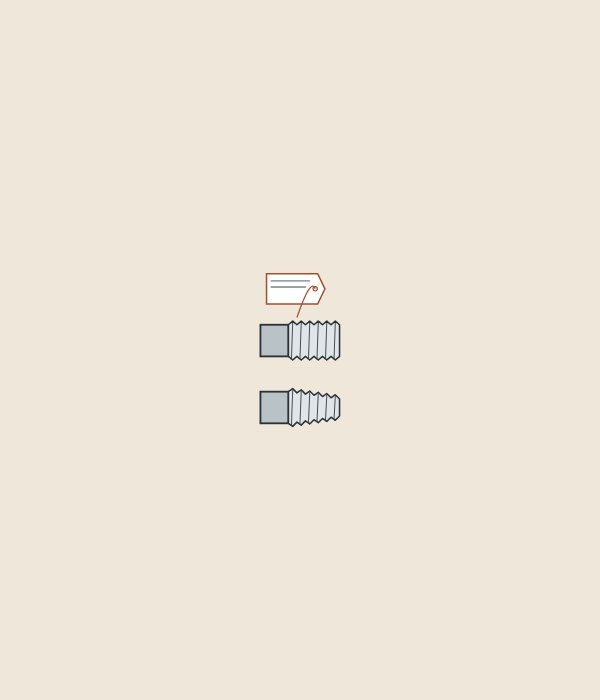
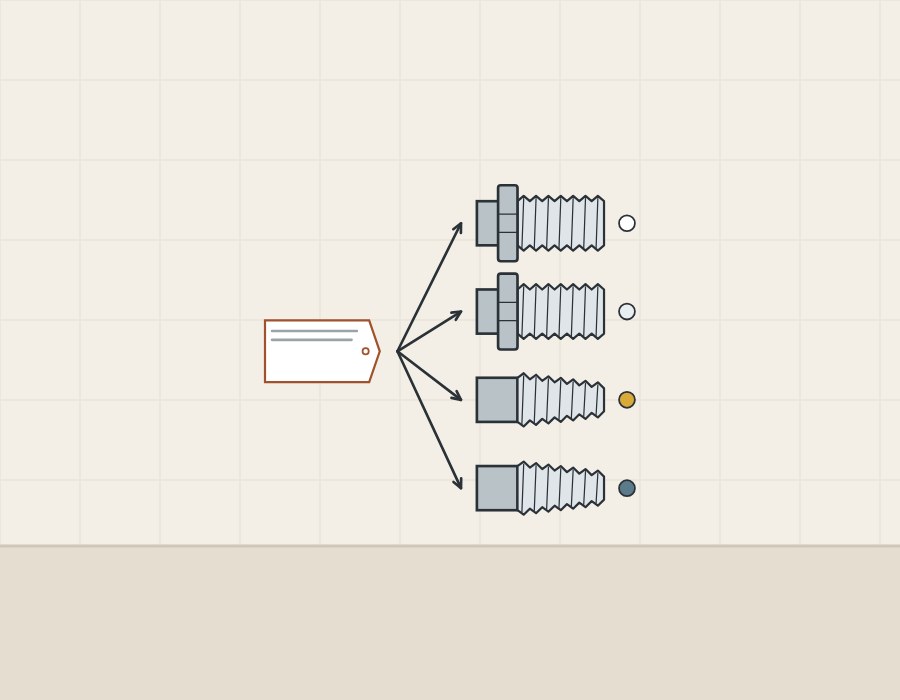
From thread family to order line
What do G, BSPP, BSPT and NPT mean?
They name pipe-thread families that differ in shape and angle. Swagelok’s identification guide lists NPT as tapered with a 60° angle, ISO 7/1 (BSPT) as tapered with 55°, and ISO 228/1 (BSPP) as straight with 55°.
A Swagelok sales-centre article says BSPP threads are most commonly marked with a “G” prefix. A second sales-centre article heads ISO 7/1 as British Standard Pipe Taper and ISO 228/1 as British Standard Pipe Parallel.
Swagelok gives NPT and ISO 7/1 the same taper, 1°47′. That second article says ISO and NPT threads must not be intermixed, and notes the 55° and 60° angles.
| Thread | Shape | Angle listed |
|---|---|---|
| BSPP (ISO 228/1), commonly marked G | Straight (parallel) | 55° |
| BSPT (ISO 7/1) | Tapered, 1°47′ | 55° |
| NPT | Tapered, 1°47′ | 60° |
How is an unknown thread identified?
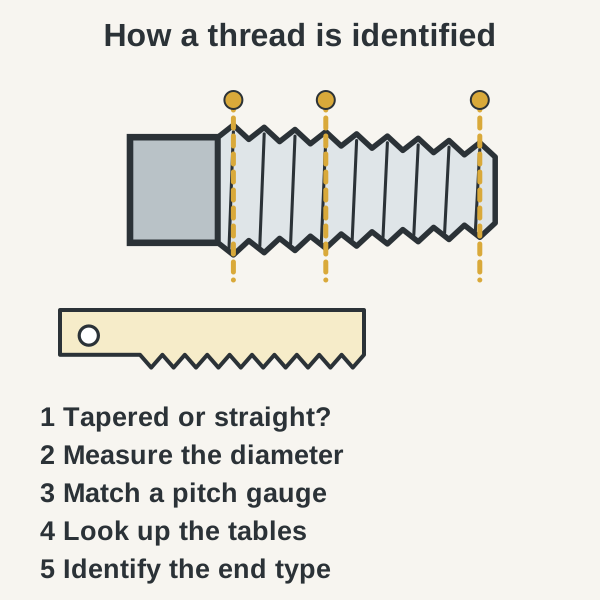
By measuring taper, diameter and pitch, then using reference tables. Swagelok’s guide sets out this five-step sequence, using a caliper and pitch gauges.
- Measure the crest-to-crest diameter on the first, fourth and last full threads. If the diameters increase on a male end or decrease on a female end, the thread is tapered. If all are the same, it is straight.
- Measure the thread diameter: the fourth or fifth full thread if tapered, any full thread if straight.
- Check the thread against pitch gauge forms until one matches.
- With diameter, male or female, taper and pitch known, find the thread in the reference tables.
- Identify the end connection type.
Swagelok adds that the measured diameter may differ from the listed nominal size, mainly because of tolerances.
Where does each thread family seal?
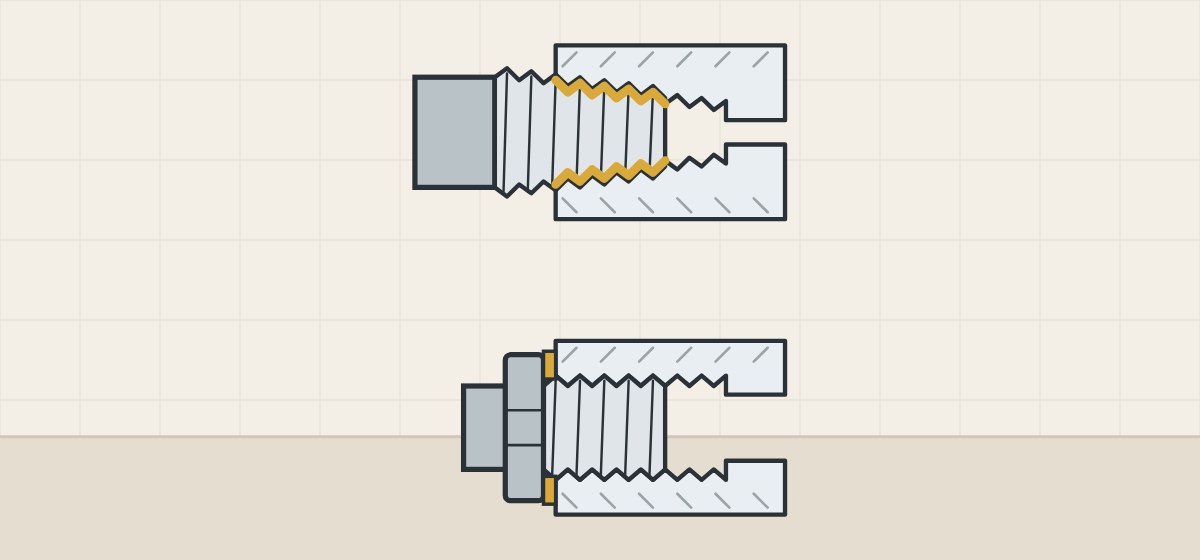
It depends on the family. The table gives each source’s own statement.
| Thread | What the source says |
|---|---|
| NPT and ISO 7/1 | Swagelok guide: the seal is designed to be made at the tapered threads. |
| Tapered pipe threads | Swagelok guide: always need a sealant. |
| BS EN 10226-1 threads | BSI overview: pressure tight by mating of the threads; a thread sealant or jointing compound should be used. |
| ISO 228-1 threads | ISO abstract: not suitable where the pressure-tight joint is made on the thread. |
| Parallel female thread | Swagelok article: an O-ring or gasket is normally used to seal. |
For its ISO 228/1 end connections, the Swagelok guide shows a compressed gasket, a compressed O-ring or a 30° cone, by connection type. So for a G thread, the sealing face and its seal are part of the connection to specify.
Which threads do named bathroom products state?

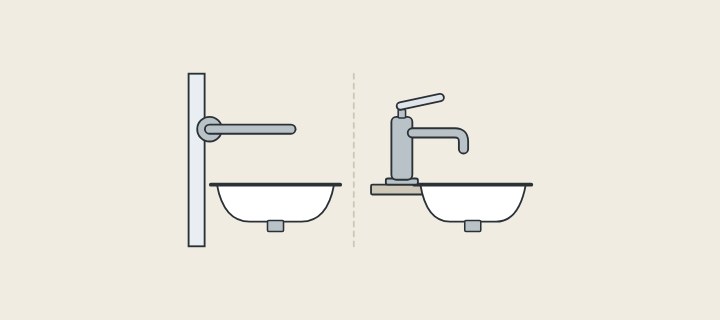
It depends on the product. Each example is the maker’s own data for one item, not a rule for a product type.
| Product | Thread stated | Detail |
|---|---|---|
| Kohler K-933 shower arm | 1/2-14 NPT | Stated as the connection. |
| Kallista shower arm instructions | 1/2 in NPT nipple | Thread sealant tape on the nipple. |
| hansgrohe Isiflex hose, 160 cm | G ½ | Conical nut on both ends. |
| Kohler K-14406-4 basin faucet | 1/2 NPSM | Marked on the specification sheet. |
| Neoperl aerator housings, standard size | M22×1 female, M24×1 male | US: 55/64 in-27 and 15/16 in-27 UNS. |
In a separate step, the Kallista sheet fits an O-ring over the shower arm threads before an adapter is threaded on; that is not the NPT nipple joint. Neoperl says its housings have either a female or a male thread.
Which standards define these threads?
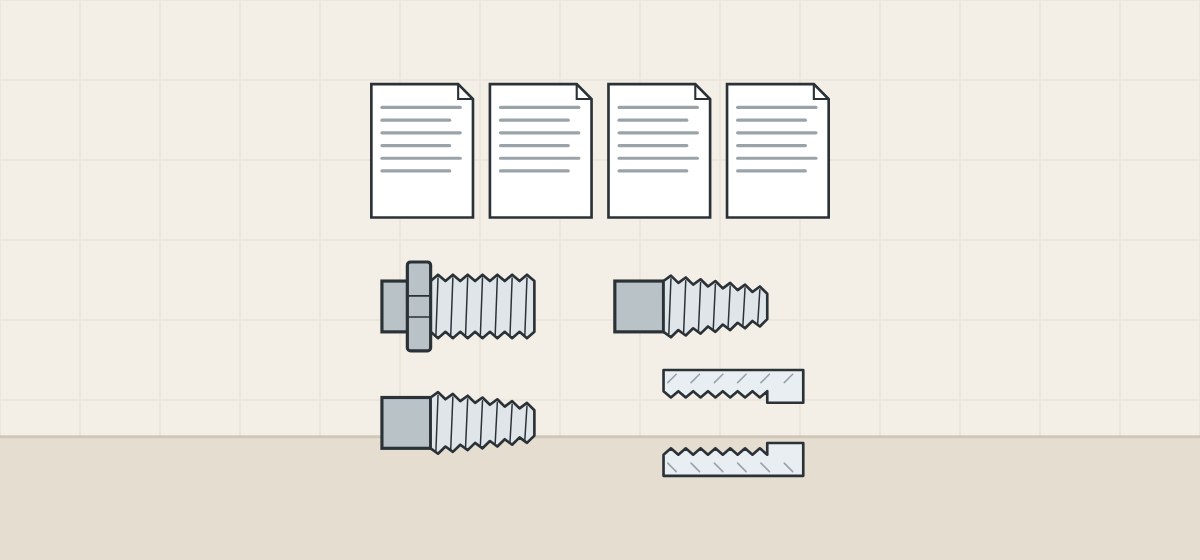
These threads are defined in published standards. Four are relevant here:
ISO 228-1:2000
Parallel fastening pipe threads, internal and external, sizes 1/16 to 6. ISO lists this fourth edition as confirmed in 2022.
ISO 7-1:1994
Pipe threads where the pressure-tight joint is made on the thread. ISO lists the third edition with a 2007 corrigendum.
BS EN 10226-1:2004
Taper external and parallel internal threads, sizes 1/16 to 6. BSI shows it as current and under review. So a parallel internal thread is not always an ISO 228-1 thread.
ASME B1.20.1
Dimensions and gaging of NPT, NPSC, NPTR, NPSM and NPSL. ASME shows the 2013 edition, reaffirmed in 2018. The 1983 edition’s contents put NPSM under straight pipe threads for mechanical joints.
- The full designation, not only a size
- The standard the designation belongs to
- Male or female at each mating part
- The sealing face or seal the joint needs
Why is a thread that starts to turn not a match?
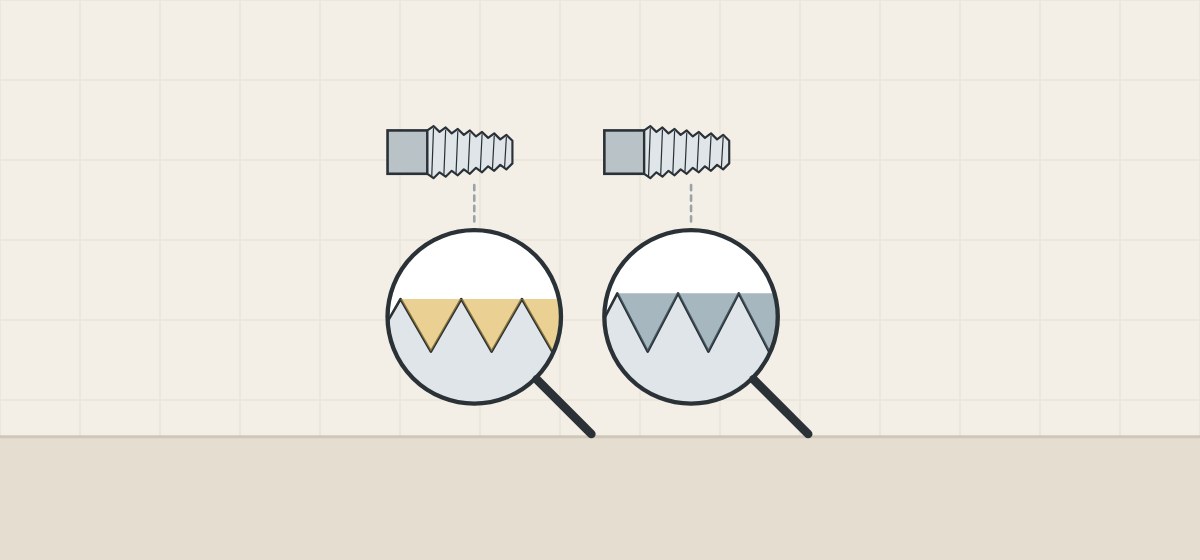
Because at some sizes two families are hard to tell apart. Swagelok’s reference tables show how close they are:
Same thread count
Swagelok lists 1/2 NPT and 1/2 ISO 7/1 each with 14 threads per inch. The 3/4 sizes are also both listed at 14.
Near-equal diameter
The male thread is listed at 0.832 in (21.14 mm) for 1/2 NPT and 0.825 in (20.96 mm) for 1/2 ISO 7/1.
Different thread form
The NPT pitch is marked Unified and the ISO pitch Whitworth, with 60° and 55° angles.
Not at every size
At 3/8 the tables list 18 threads per inch for NPT and 19 for ISO 7/1.
Swagelok says 1/2 and 3/4 in ISO 7/1 and NPT threads can be difficult to identify because they are “very close in design”. A trial fit is therefore not an identification.
What does a “½ inch” label leave out?
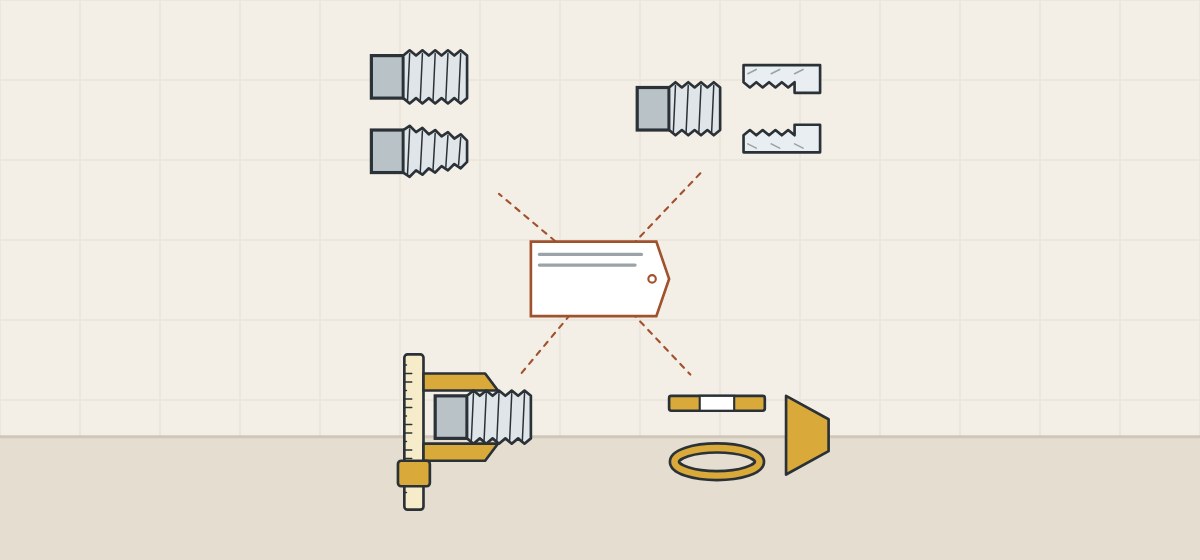
It leaves out everything except a nominal size. Each gap below follows from the sources above.
| Missing item | Why it matters |
|---|---|
| Family | Swagelok’s tables list four pipe threads at 1/2. |
| Taper or parallel | The families seal in different places. |
| Actual diameter | Swagelok lists male 1/2 pipe threads at about 21 mm. |
| Male or female | Neoperl housings come either way. |
| Seal | Sealant, gasket, O-ring or cone. |
| Non-pipe threads | Neoperl lists housings in metric and UNS threads. |
How should a buyer record a connection?
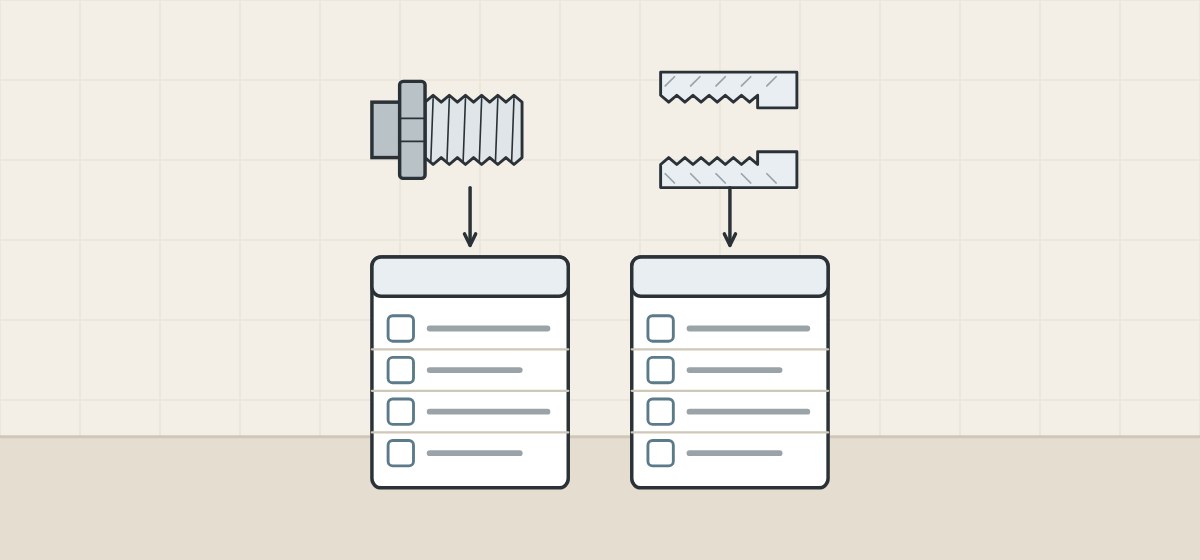
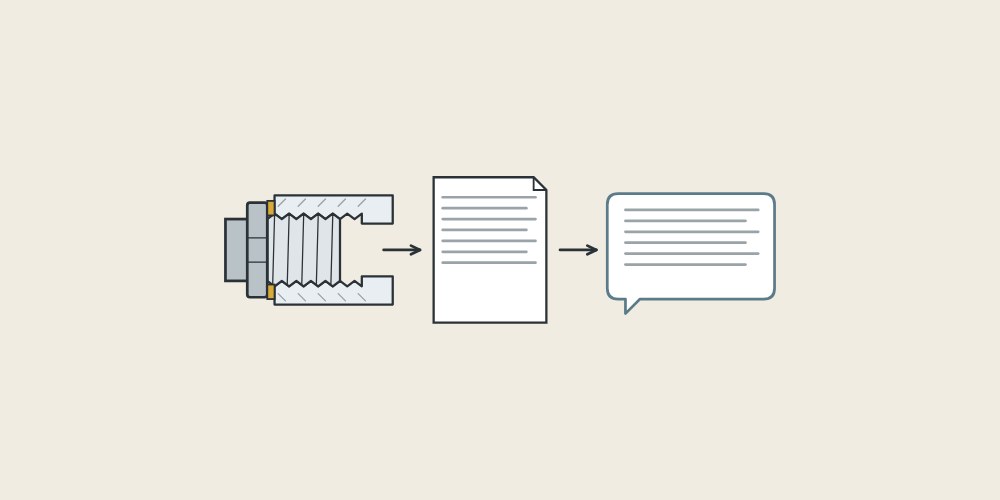
Write one record for each mating end, taken from drawings. These steps are procurement guidance, not an installation method.
- List every mating pair. Supply to valve, valve to hose, hose to hand shower.
- Copy the designation in full. For example “G ½” or “1/2-14 NPT”.
- Record male or female. For both parts of each pair.
- Record the seal. Sealant, gasket, O-ring or cone.
- Note the market version. Ask whether its threads are the same.
- Have unmarked threads measured. By a qualified installer, before ordering.
When an adapter is offered
Ask for the adapter’s part number, the designation of both ends and how each end seals. Keep the adapter on the order as its own line.
What should you send and ask before a quotation?
Send the record for both sides of every connection and ask the supplier to confirm each line.
| Question | Why it matters |
|---|---|
| What is the full thread designation of each end? | Swagelok’s tables list four pipe threads at 1/2. |
| Is each end male or female? | Both parts of a pair must be stated. |
| Where does each joint seal? | At the thread, or on a gasket, O-ring or cone. |
| Which seals are supplied? | ISO 228-1 (G) threads do not seal on the thread. |
| Does the destination version change any thread? | The thread must match the site supply. |
| Is any adapter included, and what are its ends? | Each adapter is another joint. |
Include with your request
- Destination market and site supply thread
- Drawings for the mating parts you already hold
- A connection record for each end
- Any local code requirement; confirm it with the local authority
- Quantity by product and version
WNS Global confirms any product and terms it offers separately in writing. This guide does not state that WNS Global products have the features, ratings or listings named above.