From log to specification
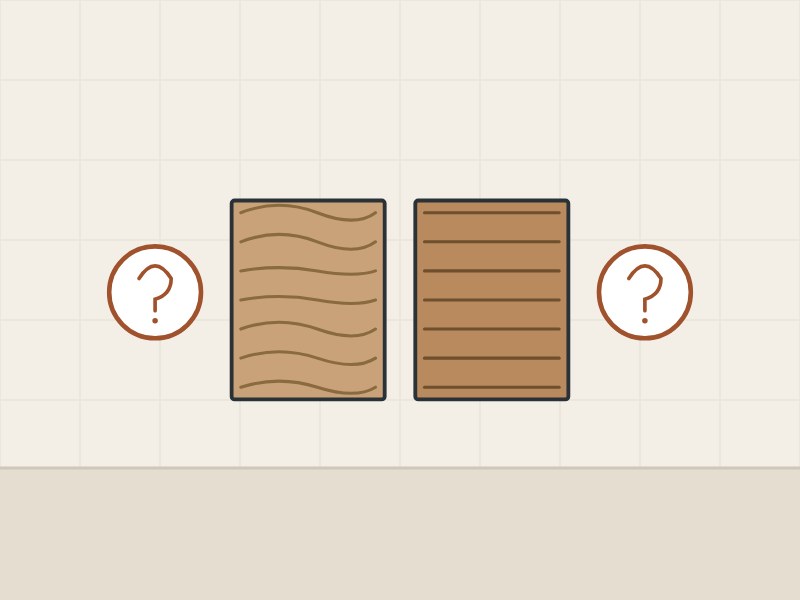
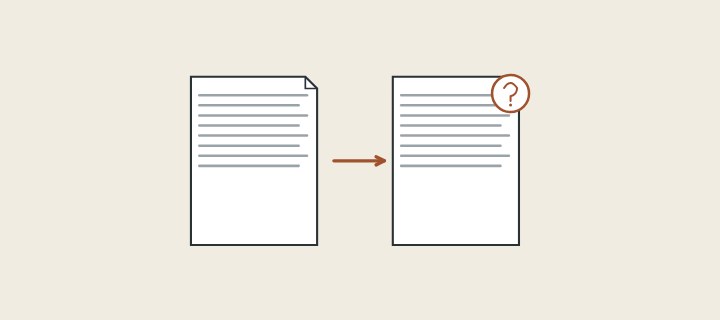
What is the difference between reconstituted and natural veneer?
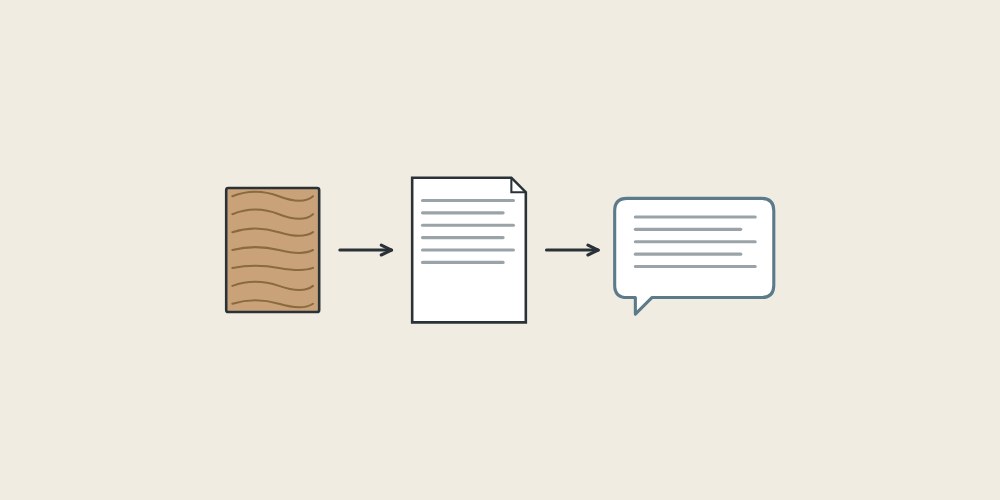
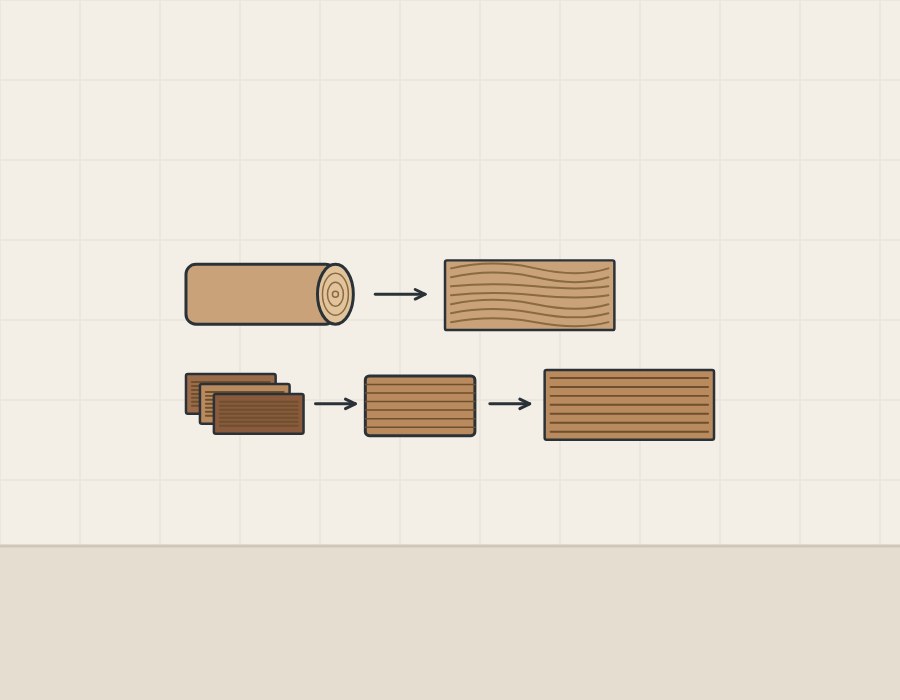
Decospan describes natural veneer as thin layers sliced from a tree trunk with a knife, typically around 0.6 mm thick. Every tree differs, so color and figure vary from log to log and across a sheet.
Reconstituted veneer starts as real wood too. HP-1 notes it is typically made from obeche (ayous), poplar, basswood or other abundant, fast-growing hardwoods, which are dyed and rebuilt to a designed appearance.
The same family is sold under several names. Oakwood Veneer lists “reconstituted”, “engineered” and “recon”; Decospan and ALPI use “composite”, and Tabu and ALPI “multilaminar”.
| Term | What it means |
|---|---|
| Natural veneer | A slice of the log of the species named. |
| Reconstituted veneer | Real wood, dyed and rebuilt into a block, then sliced to a designed pattern. |
| Engineered, recon, composite, multilaminar | Trade names used for reconstituted veneer. |
| Printed woodgrain laminate | A printed decor paper pressed over resin-impregnated core sheets; no wood veneer face. |
| Species name on an offer | Either the wood of the face or the look it imitates; the offer must say which. |
How is reconstituted veneer made?
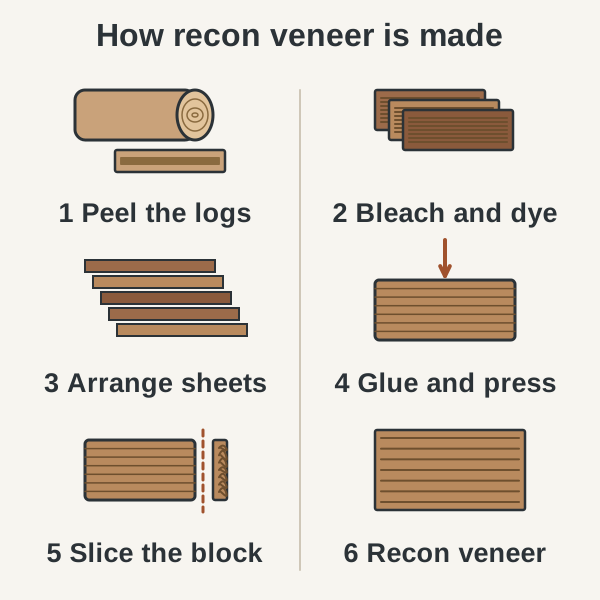
The makers describe the same basic sequence with small differences. Combining ALPI’s and Decospan’s descriptions with HP-1:
- Logs of poplar, ayous or basswood are peeled or rotary cut into thin sheets.
- The sheets are bleached, then dyed to the target color.
- Dyed sheets are arranged or mixed to form the design.
- The sheets are stacked and glued in a mold.
- The stack is pressed into a new block, sometimes called a new log.
- The block is sliced across the glue lines into decorative veneer.
ALPI says it introduced the first composite veneer in 1961; its company page lists stripping, dyeing, compositing, gluing, pressing, squaring, shearing and testing. Decospan cuts its blocks into 0.6 mm veneer. These are the makers’ own descriptions.
How is natural veneer cut and matched?
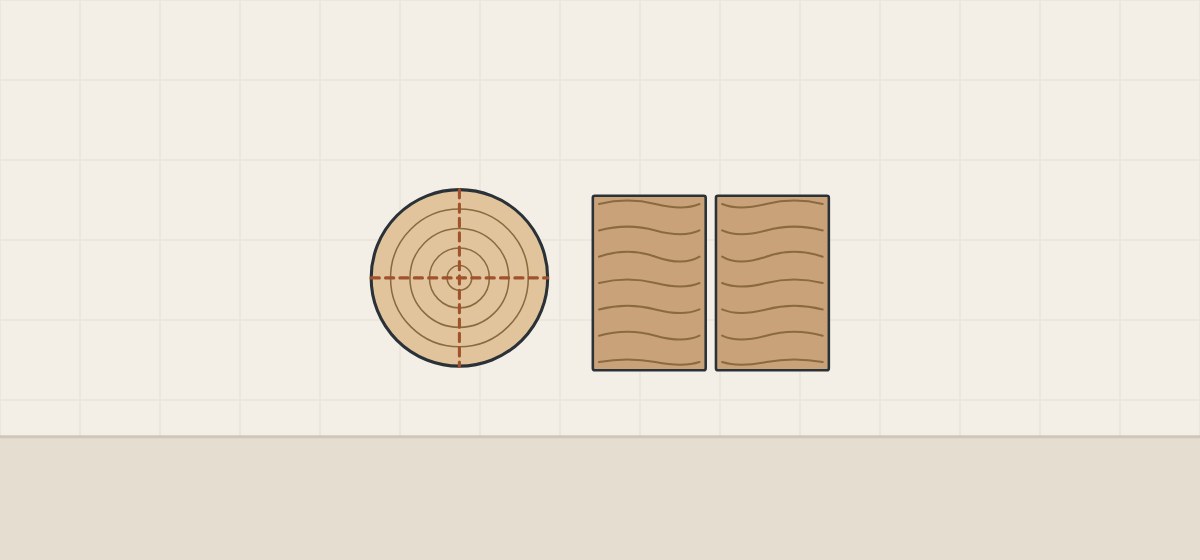
For natural veneer, the figure depends on how the log is cut and how the leaves are laid. The AWS definitions:
| Method | What the AWS or maker says |
|---|---|
| Rotary cut | Peeled on a lathe, following the growth rings. |
| Plain sliced | Parallel to a line through the log center; States Industries notes it typically shows cathedral grain. |
| Quarter sliced | Roughly parallel to a radius of the log. |
| Rift cut | Slightly off the radius to reduce fleck; States Industries says it is most often used for oak. |
| Book match | Every other leaf is turned over, like the pages of a book. |
| Slip match | Leaves are placed in sequence without turning. |
The AWS also notes that leaves from a sliced flitch grow wider or narrower as slicing progresses. Natural leaves are never identical, which is why sequence and matching matter on a run of doors.
Natural, reconstituted or printed: how do they compare?
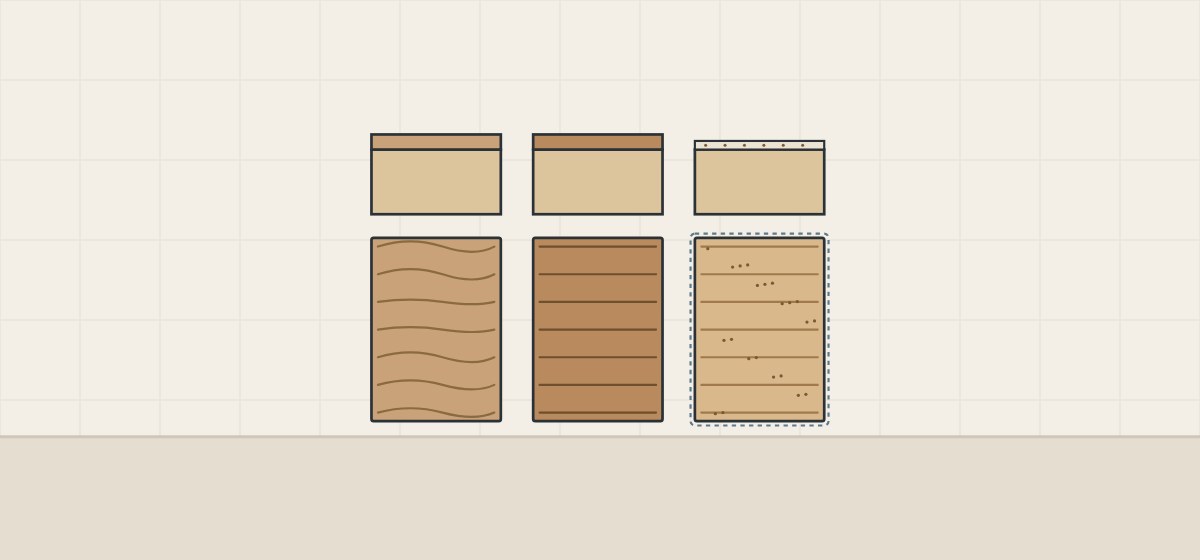
The table compares the two veneers and notes where a printed laminate differs. It describes the materials, not a quality ranking.
| Aspect | Natural veneer | Reconstituted veneer |
|---|---|---|
| Wood in the face | The species named. | Usually poplar, ayous or basswood. |
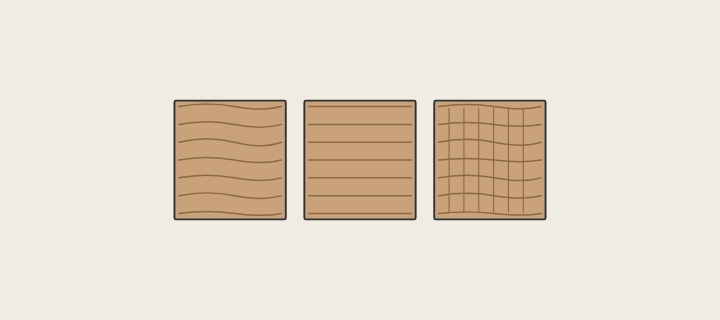
| Pattern | Grown figure of that log. | Designed, repeatable figure. |
| Variation | Varies log to log and within a sheet. | Positioned as consistent; ALPI still notes batch color variation. |
| Color source | The wood itself. | Bleaching and dyeing. |
| HP-1 naming | Species of the face. | “Recon” or similar before the species. |
| Light exposure | Can change color. | Can change color; depends on the finish. |
A printed woodgrain is neither. Wilsonart’s data sheet describes high-pressure laminate as printed decor papers pressed over resin-impregnated kraft sheets, and Decospan says such surfaces only mimic wood.
What does a species name mean on a quotation?
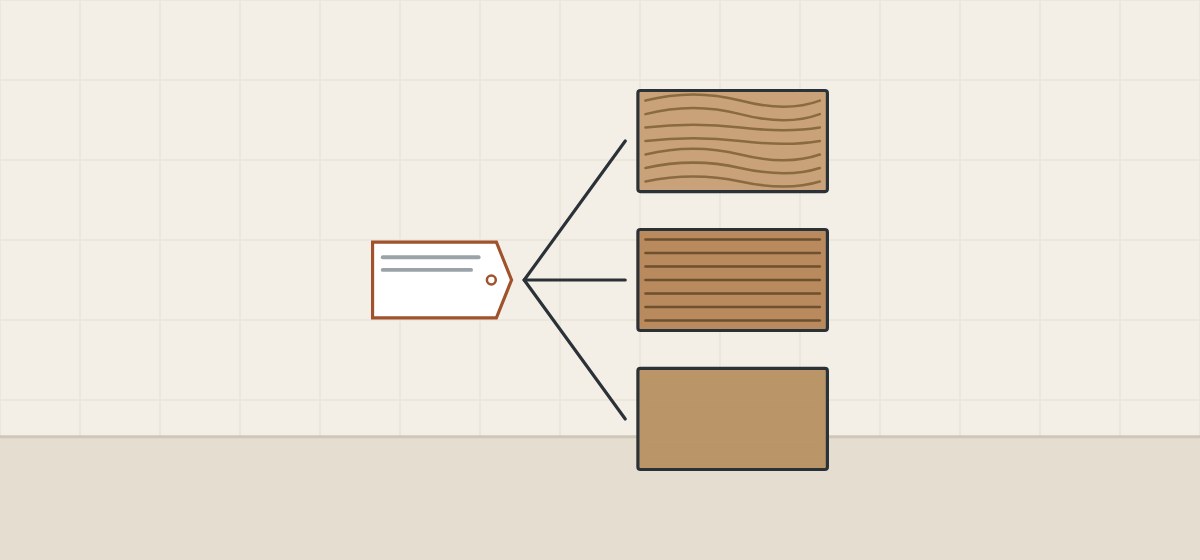
HP-1 is a voluntary standard, but its naming rules show what a buyer should ask. Five points:
The face species identifies the panel
HP-1 identifies hardwood plywood by the species of its faces.
Recon must be declared first
Panels with reconstituted faces should put “recon”, “reconstituted”, “engineered” or similar before the species in labels and marketing.
The named look is not the wood
HP-1’s own example: recon made from obeche may be sold as “Recon Quartered Teak”. It encourages disclosing the actual species before purchase.
Simulated grain on wall panels
HP-1 does not require a face species for wall panels whose surface simulates another species’ grain.
Printed decors carry wood names too
Laminate makers offer woodgrains among their printed patterns, so a wood name alone does not prove there is veneer.
- Is the face natural or reconstituted?
- Which species is actually in the face?
- Is the name the wood or the decor?
- Is the surface veneer or printed?
What sits beneath the veneer face?
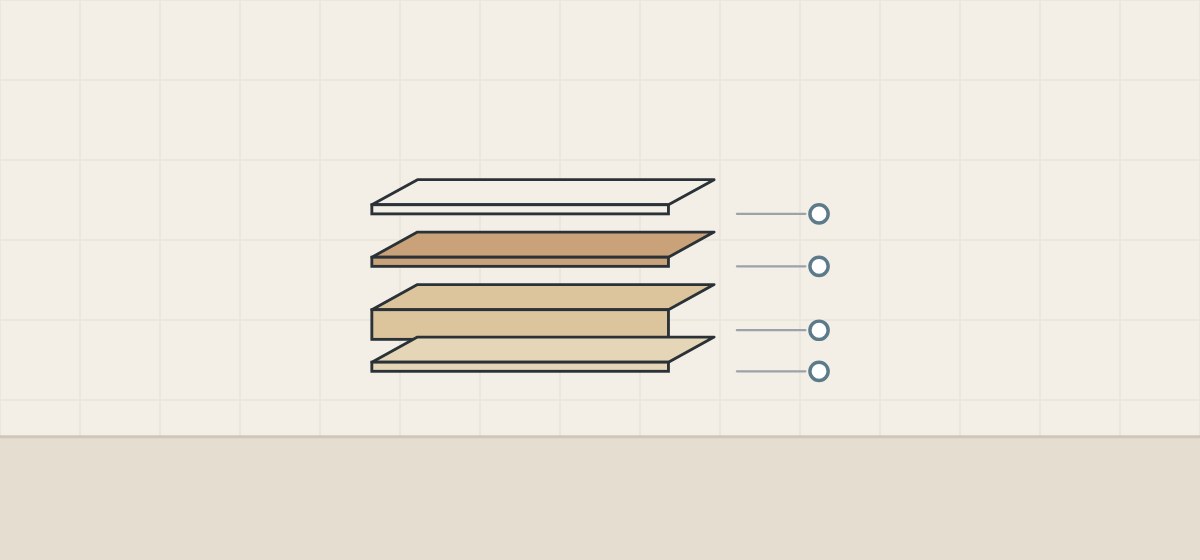
A veneer is only the outer layer. The AWS describes a panel as a core with a decorative face and a balancing back. Four points apply whichever veneer is used:
Face and back
The two outside veneer layers are the face and the back.
Balanced construction
An odd number of layers, symmetrical about the center, with materials and adhesives on both sides that move with moisture at the same rate.
Core options
MDF is resin-bonded wood fiber; particleboard is resin-bonded wood particles; veneer core has an odd number of plies, three or more.
Thickness and sanding
The AWS says veneer thickness matters little to the result as long as show-through and sand-through are avoided.
“Real wood” therefore describes the face, not the board beneath it. The core, the back and the adhesive belong in the same material record as the veneer.
See also: How do finishing and light affect veneer? · How should a buyer specify the veneer face?
How do finishing and light affect veneer?
The sources agree that color stability is a property of the finished panel, not of the veneer alone. None compares natural and reconstituted veneer directly.
| Topic | What the source says |
|---|---|
| Light exposure | The Timber Veneer Association of Australia: red and dark woods tend to bleach and blonde woods to yellow; UV-absorbing coats reduce change but do not stop it. |
| Reconstituted veneer | ALPI’s technical data sheet: supplied uncoated; lightfastness depends on the varnish; light can fade or change the color. |
| Multilaminar veneer | Tabu’s data sheet: light resistance depends on the finish; varnish delays natural yellowing. |
| Sanding | ALPI and Tabu both recommend 120, 150 then 180 grit for their veneers. |
| Stains | Oakwood warns a high-solvent NGR stain may make the lines of recon veneer bleed and advises a sealer or shellac wash-coat first. |
| Oxidation | The AWS notes hardwoods discolor toward yellow or reddish-brown after sawing or peeling, and photodegrade under light. |
How should a buyer specify the veneer face?
These steps apply the facts above to a vanity or furniture order. They are procurement guidance, not a finishing specification.
- Name the face type. Write natural or reconstituted; do not leave the species name alone.
- Record the actual species. For recon, ask which wood the face is made of.
- Name the cut and match. For natural veneer, state the cut and whether leaves are book or slip matched.
- Record the panel. Core, back and adhesive belong with the face.
- Approve a finished sample. Color depends on the coating, so approve veneer and finish together; a photograph shows the look, not the species.
- Allow for variation. Natural veneer varies; recon can still vary between batches.
- Treat substitutes as a change. A look-alike offered in place of a specified veneer needs its own approval.
When the drawing names only a color
If a design calls for “walnut tone” rather than walnut, say so. Either veneer or a printed decor could meet a color brief, but each is a different material with different records.
What should you send and ask before a quotation?

A complete request separates the face, the panel and the paperwork. Import and forestry rules apply to the wood, so the importer should confirm them for the destination.
| Question | Why it matters |
|---|---|
| Is the face natural or reconstituted? | The same species name can mean either. |
| Which species are in the face and core? | A US Lacey Act declaration must give genus and species, country of harvest, value and quantity. |
| Who files and corrects the declaration? | APHIS says only the importer of record can revise it. |
| Which forestry rules apply in the EU? | The Commission lists the EU Deforestation Regulation as replacing the EU Timber Regulation; recheck its dates. |
| Is any FSC claim made on the product? | FSC says chain of custody verifies that certified material is identified and kept separate along the supply chain; it does not present it as a species or appearance check. |
| Which formaldehyde rules apply to the panel? | EPA’s TSCA Title VI covers hardwood plywood, MDF and particleboard sold in the US. |
Include with your request
- Required face type and species
- Cut and match, if natural
- Approved color or finish sample
- Panel core and thickness
- Destination market and importer
WNS Global confirms any offered face, panel, finish and commercial terms separately in writing. This guide does not state that WNS Global uses any material named above, holds any certification or meets any listed standard.