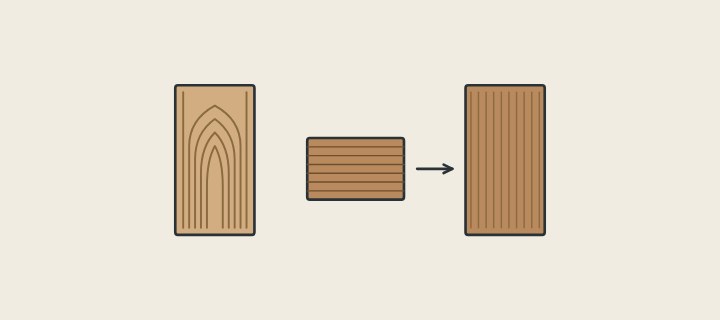
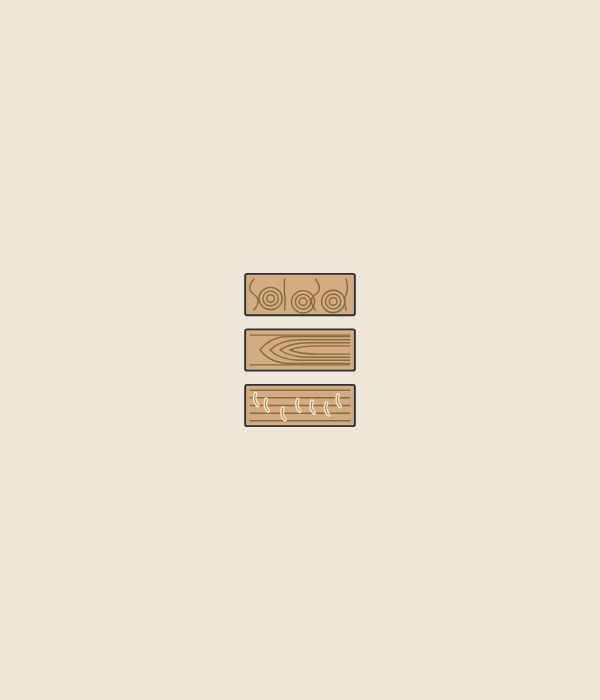
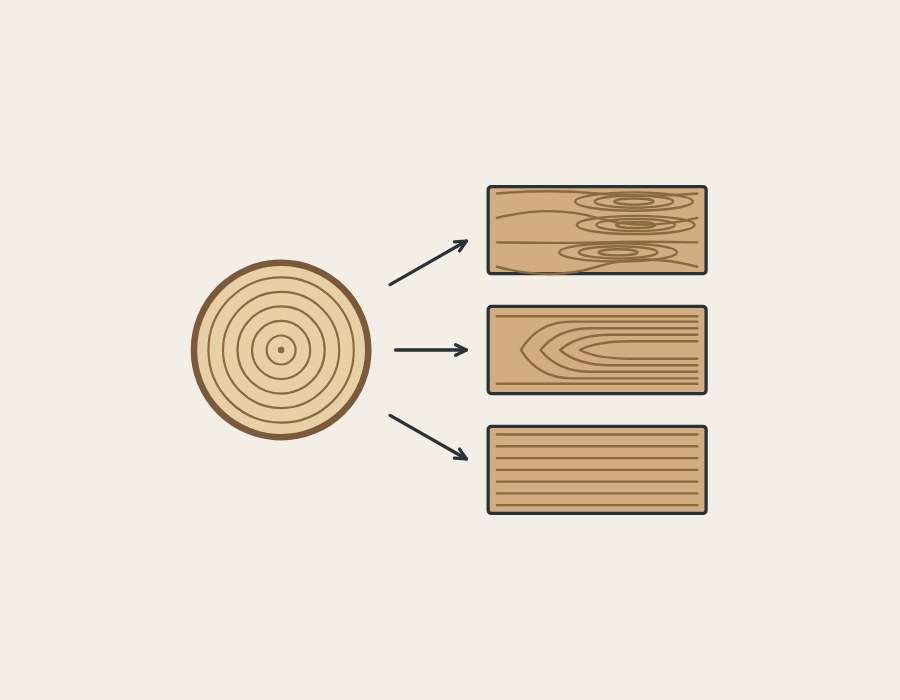
From log to approved front
What are rotary, plain-sliced and quarter-cut veneer?
They are three positions of the log against the knife. Columbia Forest Products describes rotary cutting as peeling a log into thin sheets as if unrolled from a spool. AWS adds that the log is centre mounted on a lathe.
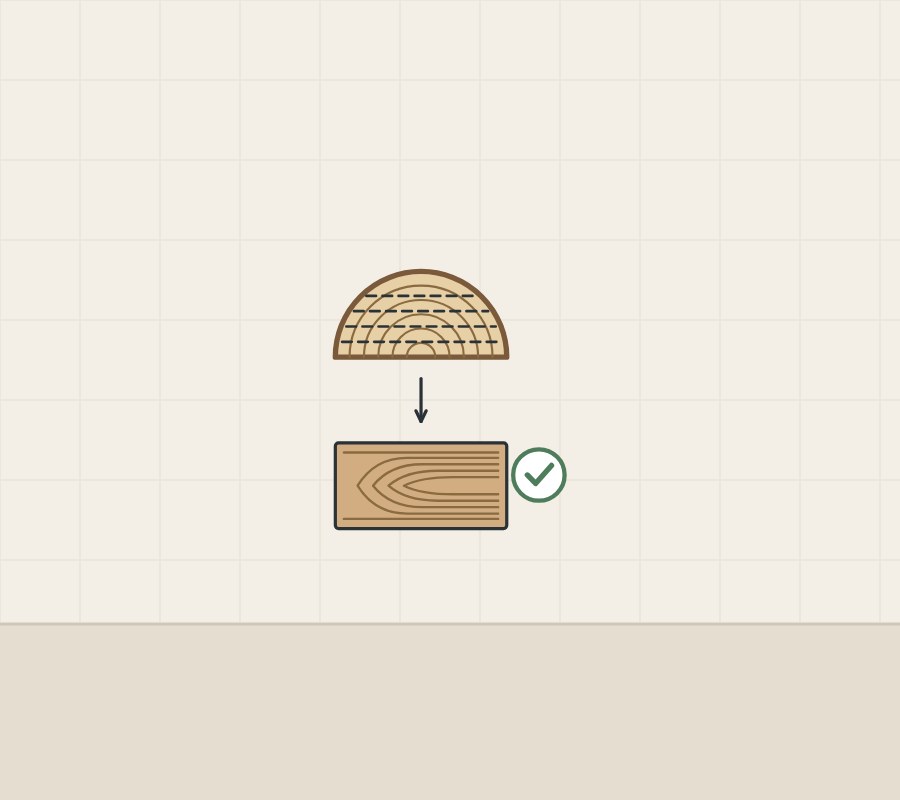
For plain slicing, Columbia’s grades and cuts page says the log is cut in half lengthwise and each half is sliced. AWS calls it the method most often used for architectural woodwork.
For quarter slicing, Columbia says the log is divided into quarters and sliced roughly perpendicular to the growth rings.
| Term | What the source says |
|---|---|
| Rotary cut | Columbia: the entire log is peeled into a continuous ribbon. |
| Plain sliced | Columbia: also called plain sawn or flat cut. |
| Quarter sliced | Columbia: also called quarter cut or quartered. |
| Rift cut | Columbia: gives a fine pencil stripe. |
| Leaf | AWS: one piece of veneer in a sliced flitch. |
| Flitch | AWS: the group of leaves from one slicing. |
How does a log become a set of veneer leaves?
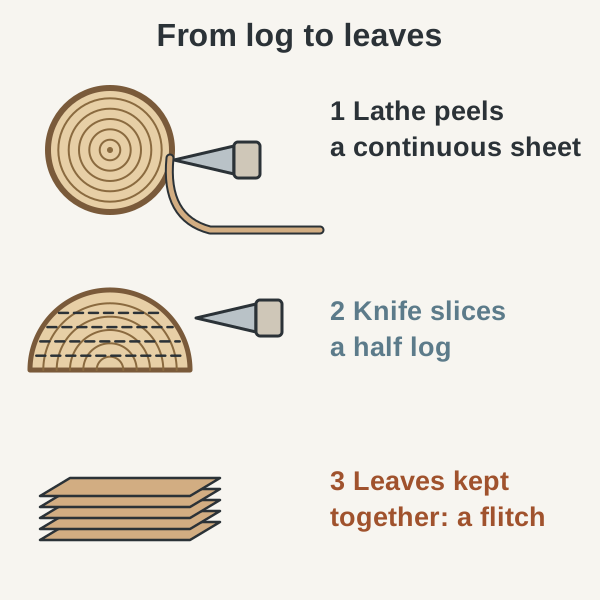
The log is either turned against a knife or cut into segments that are sliced into leaves. The steps combine the USDA Forest Products Laboratory’s Wood Handbook with the AWS, Columbia and M. Bohlke texts.
- For rotary veneer, the block turns on a lathe against a stationary knife.
- The veneer comes off as a continuous, thin sheet.
- For sliced veneer, the log is first cut into halves or quarters.
- Slicing the segment produces consecutive leaves.
- The leaves from one slicing form a flitch, usually numbered.
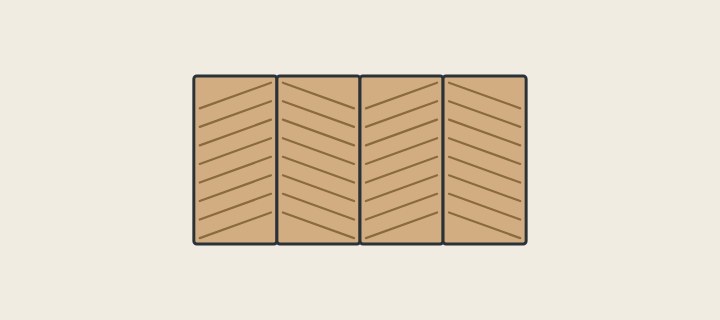
- The leaves of a flitch are edge glued together in patterns.
AWS notes that leaves in a sliced flitch grow wider or narrower as slicing progresses. The Wood Handbook says veneer for hardwood and decorative plywood is much thinner than the 1.6 to 4.8 mm it gives for softwood plywood.
What grain figure does each cut produce?
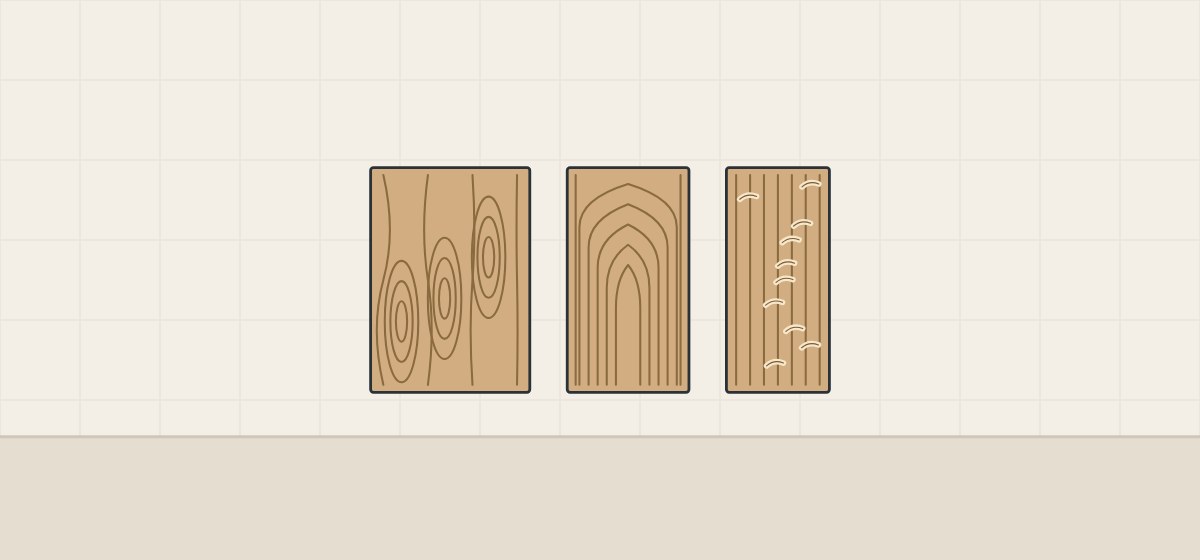
Each cut meets the growth rings differently, so each shows a different figure. These are tendencies, not guarantees for every leaf.
| Cut | Figure described | Source |
|---|---|---|
| Rotary | Generally bold, random appearance | AWS 2nd Edition |
| Rotary | Flat, random grain; may vary widely in pattern or colour | States Industries |
| Plain sliced | Cathedral and straight grain, progressing from leaf to leaf | AWS 2nd Edition |
| Plain sliced | Distinct cathedral grain | Timber Products |
| Quarter sliced | A series of stripes that varies from species to species | AWS 2nd Edition |
| Quarter-sliced red oak | Large rays produce pronounced flake | Columbia, red oak page |
The Wood Handbook explains why: on plainsawn boards and rotary-cut veneer the growth rings often form elliptic and parabolic patterns, and on quartersawn oak and sycamore the large rays can show as flecks. AWS names fleck, also called flake, as characteristic of quarter slicing in red and white oak.
How wide are the leaves, and what does each cut yield?
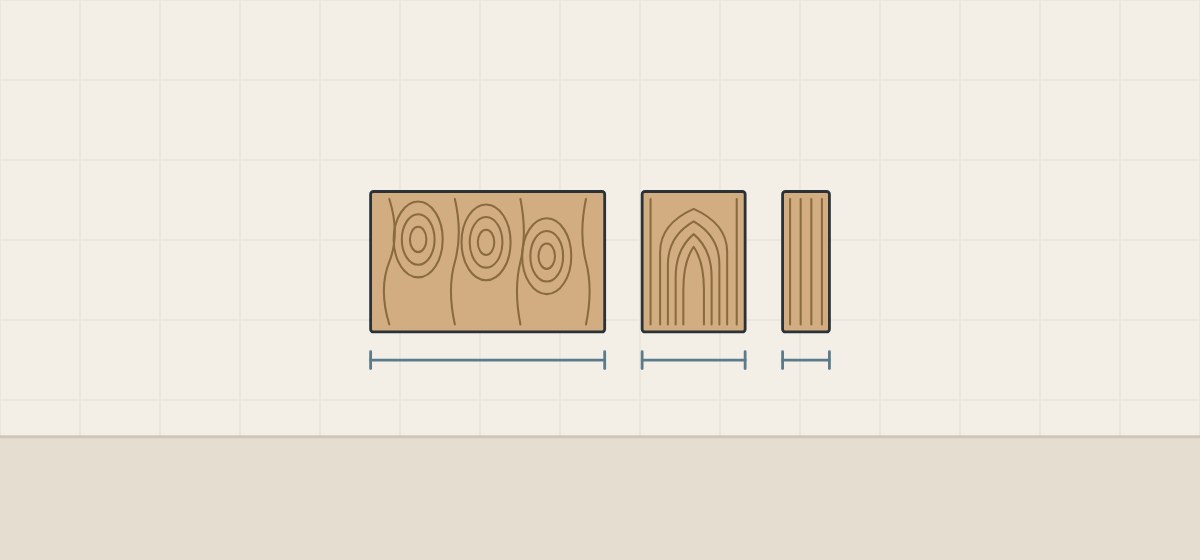
Width depends on the cut. Columbia says plain-sliced veneers are no wider than the log; AWS says quarter-sliced leaves are narrow in many species. Each figure below belongs to its source.
| Source | What it states |
|---|---|
| States Industries | Plain-sliced leaves 6 to 12 inches wide; smaller leaves from quarter slicing. |
| AWS 2nd Edition, Table 4-020 | Red oak widths to 36 in rotary, 18 in plain sliced, 8 in quarter sliced or rift. |
| M. Bohlke | Rotary veneer can be wide enough for full-sheet, single-piece faces. |
| HP-1-2024, Grade AA | Inner components at least 6 in on plain-sliced and rotary faces, 3 in on quarter-cut or rift. |
| States Industries, yield and cost | Plain slicing gives the highest yield; rift is the most expensive because it results in the most waste. |
Narrow leaves mean more joints across a wide front. M. Bohlke says rotary veneer does not lend itself to matched faces, while quartered leaves are easily matched.
What are rift cut, comb grain and half-round?
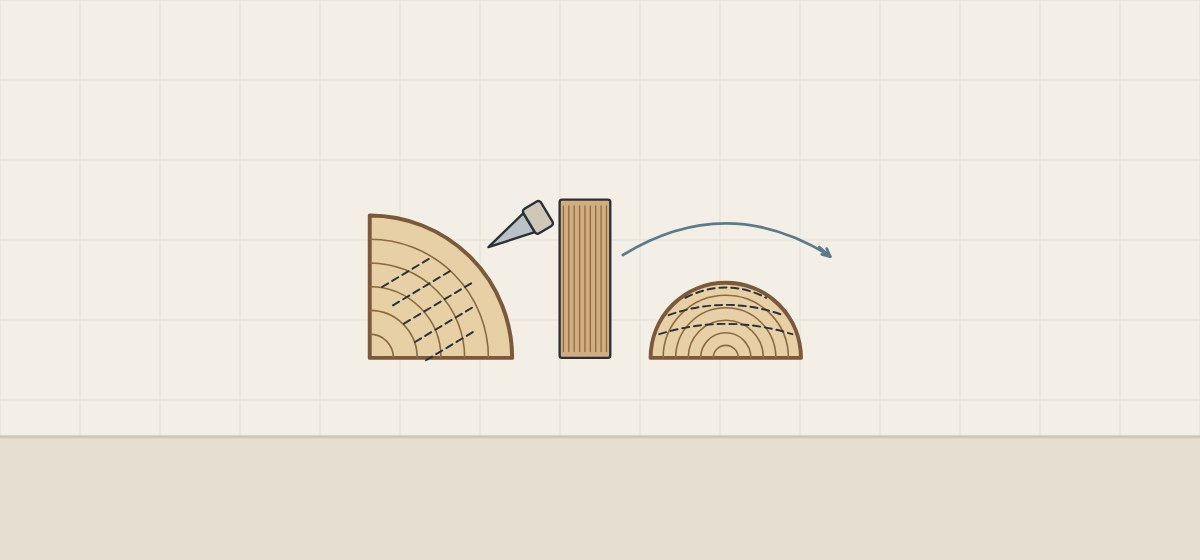
They are further cuts and patterns besides the main three:
Rift cut
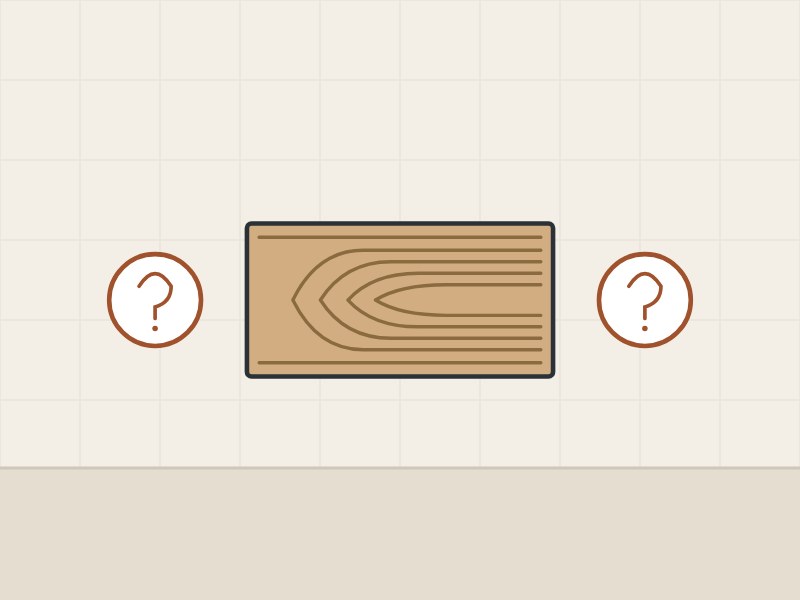
AWS says rift veneers are produced most often in red and white oak, cut slightly off the radius lines to minimise fleck. States Industries gives the angle as 15 degrees to the radius of the log.
Comb grain
HP-1-2024 sets tighter limits on grain slope, sweep and fleck for comb grain than for rift in oak. AWS says comb grain must be specified.
Half-round
M. Bohlke says half-round slicing adds width to an otherwise narrow log and can give a plain-sliced appearance.
Pattern or method
In its Table 2, HP-1-2024 says the headings plain-sliced, quarter-cut, rift-cut and rotary-cut name the face veneer pattern, not the cutting method.
- The pattern wanted on the face
- The cutting method, if it matters
- Whether flake is wanted or not
- Rift or comb grain, by name
Does the cut decide the match, the grade or the species?
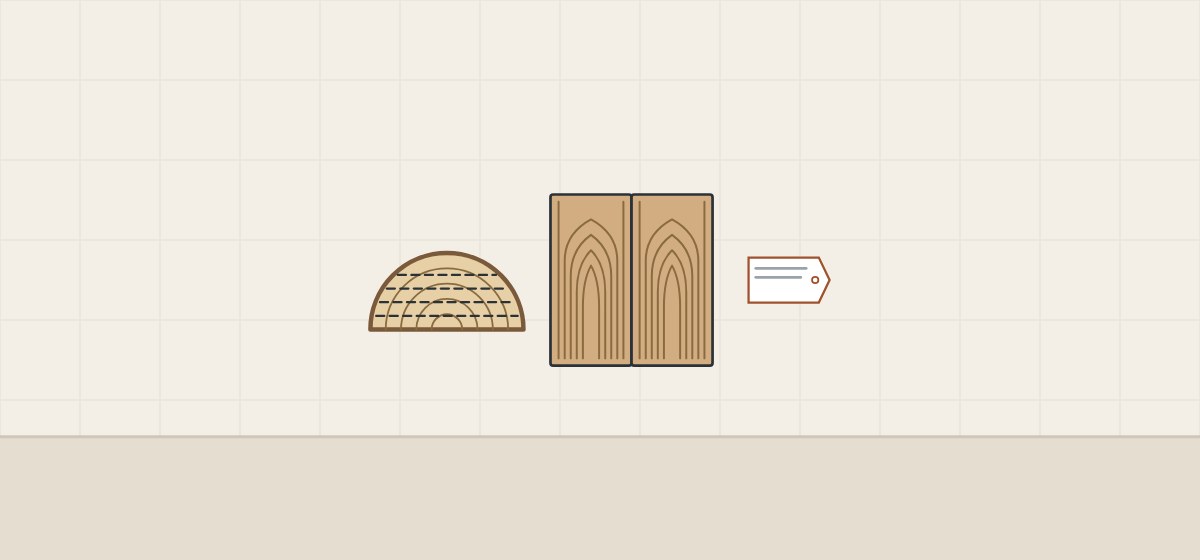
No. The cut is one line of a veneer description; match, grade and species are others:
Matching comes after cutting
Columbia describes book matching as reversing every other leaf for a mirror image at the joint, and slip matching as joining leaves without turning them.
Grade is a separate scale
HP-1-2024 bases its face grades primarily on appearance features. In Grade AA, all components of a book or slip matched face come from the same flitch.
Species changes the result
AWS says the stripes of quarter slicing vary in density and thickness from species to species.
Finish can show the match
AWS notes that in a book match the tight and loose faces of the leaves alternate and may accept stain differently.
A quote for book-matched oak leaves the cut open. A quote for quarter-cut oak leaves the layout open. No cut is a quality grade in itself.
How do standards ask for the cut to be specified?

AWI’s supplemental information lists the slicing method among the items the specifier states, and HP-1 leaves the method to the mill when the buyer does not specify it. These are North American documents, cited for wording only.
| Document | What it says |
|---|---|
| HP-1-2024, Table 2 note | The cutting method is “at mill option unless otherwise specified by the buyer”. |
| ANSI/AWI 1235-2024, supplemental information | The design professional states the slicing method, the matching, any required figure, and flitch numbers for pre-selected veneer. |
| ANSI/AWI 0642-2024, wood paneling | For transparent finish: plain-sliced veneer for Premium and Custom grades; manufacturer’s option for Economy. |
| AWS 2nd Edition (2014, superseded) | Special characteristics such as ribbon stripe and comb grain must be specified. |
How should a buyer specify the veneer cut for vanity fronts?

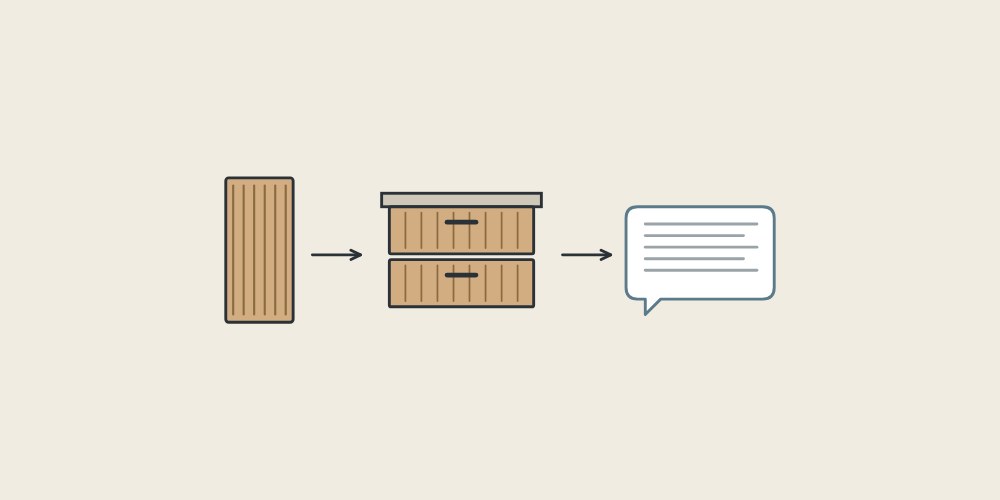
Write the cut as its own line and approve the fronts as a layout. These steps are procurement guidance, not a standard.
- Name the species and the cut. One species can come in several cuts.
- Say whether you mean the pattern or the method. Say so if a half-round cut is not acceptable.
- State the match separately. Show it on a front elevation.
- Decide on flake. For oak: wanted, accepted or excluded.
- Approve the whole layout. A close-up hides the joints between leaves and fronts.
- Record the range. Keep samples of light, dark and figured areas.
- Ask about leaf width. Narrow leaves mean more joints.
When the veneer lot changes
Keep the sample reference and the approved layout with the order. If the veneer available for production looks different, review it before it becomes a finished front. For a repeat order, send the earlier approval and say whether matching installed fronts is required.
What should you send and ask before a quotation?
A complete request names species, cut, match and accepted range, not only a wood.
| Question | Why it matters |
|---|---|
| Which cut is offered? | Each cut gives a different figure. |
| Is that the pattern or the method? | One pattern can come from different machines. |
| How are the leaves matched? | Cut and match are separate lines. |
| Will oak fronts show flake? | Quarter slicing shows it; rift reduces it. |
| How wide are the leaves? | Width sets the joints per front. |
| Do all fronts come from one flitch? | Leaves from one slicing follow one another. |
Include with your request
- Species, cut and match wanted
- Front elevation with grain direction
- Sample or photo of the target look
- Accepted range of colour and figure
- Quantity and repeat-order plans
WNS Global confirms any offered veneer, cut, match and commercial terms separately in writing. This guide does not state that WNS Global products use any cut, grade or species named above, or meet any standard cited here.