From face veneer to core
What is veneer core telegraphing?
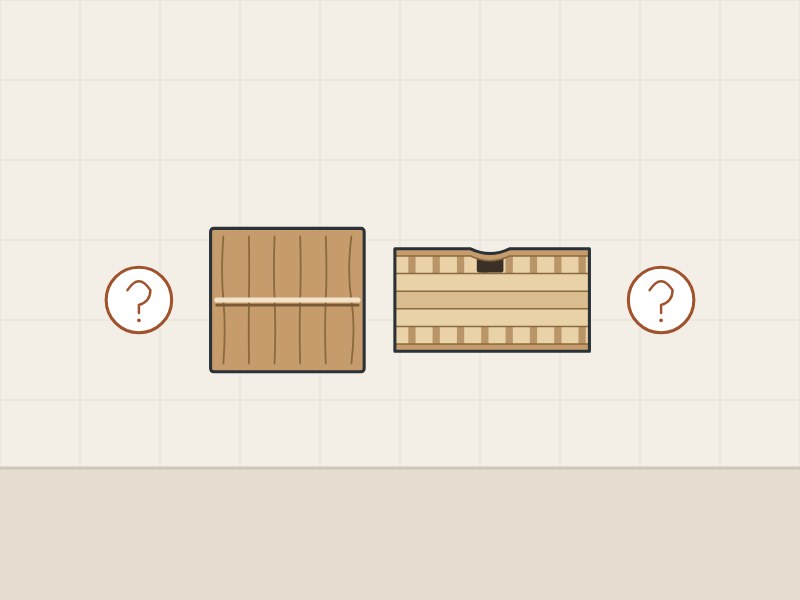
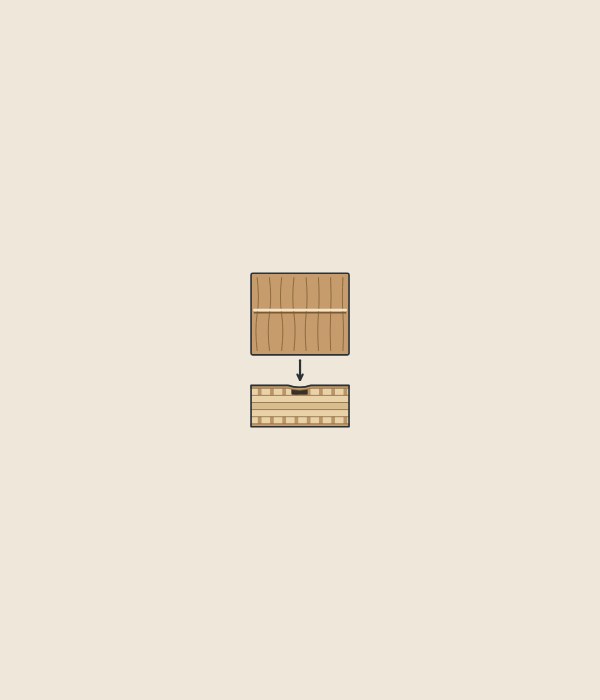
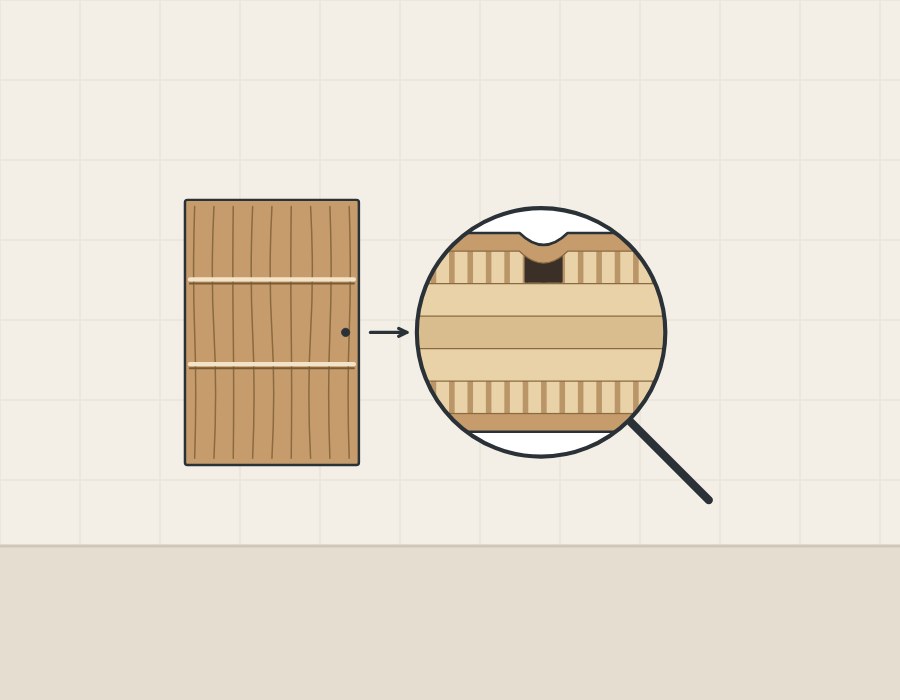
Core telegraphing is the makers’ term for features of the core showing through the decorative face. Columbia Forest Products says on its Classic Core page that its MDF crossbands give a smoother surface than softwood veneer cross bands, reducing “core telegraphing potential through the decorative wood face and back”.
The same maker’s core guide also speaks of core transfer. No formal definition of the term was retrieved for this guide.
When a line or uneven area shows on a finished face, note whether it follows the decorative grain or a different pattern underneath. A photo alone cannot establish the cause.
| Term | What it means |
|---|---|
| Face veneer | The decorative veneer on the visible side. |
| Crossband | Wood Handbook: an inner ply with grain perpendicular to the faces. |
| Center | Wood Handbook: an inner ply with grain parallel to the faces. |
| Core transfer | A term Columbia’s core guide uses alongside core telegraphing. |
What lies under the face veneer?
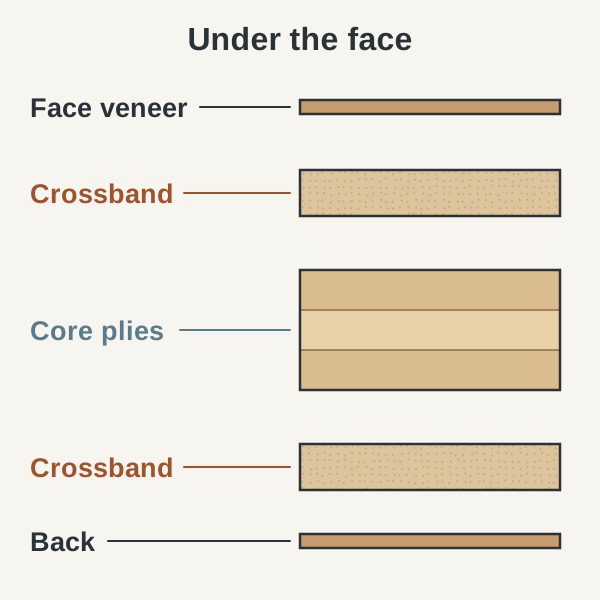
In the veneer-core and combination panels described here, a crossband lies directly under the face. The Wood Handbook names inner plies by grain direction and says the center layer may be veneer, lumber, particleboard or fiberboard. From the visible side inward, the panels the makers describe run:
- The finish coat.
- The decorative face veneer.
- The crossband directly beneath the face.
- The inner plies or core.
- A second crossband, next to the back.
- The back veneer.
The Wood Handbook adds that hardwood plywood is normally used where appearance may matter more than strength.
Why does the crossband under the face matter?
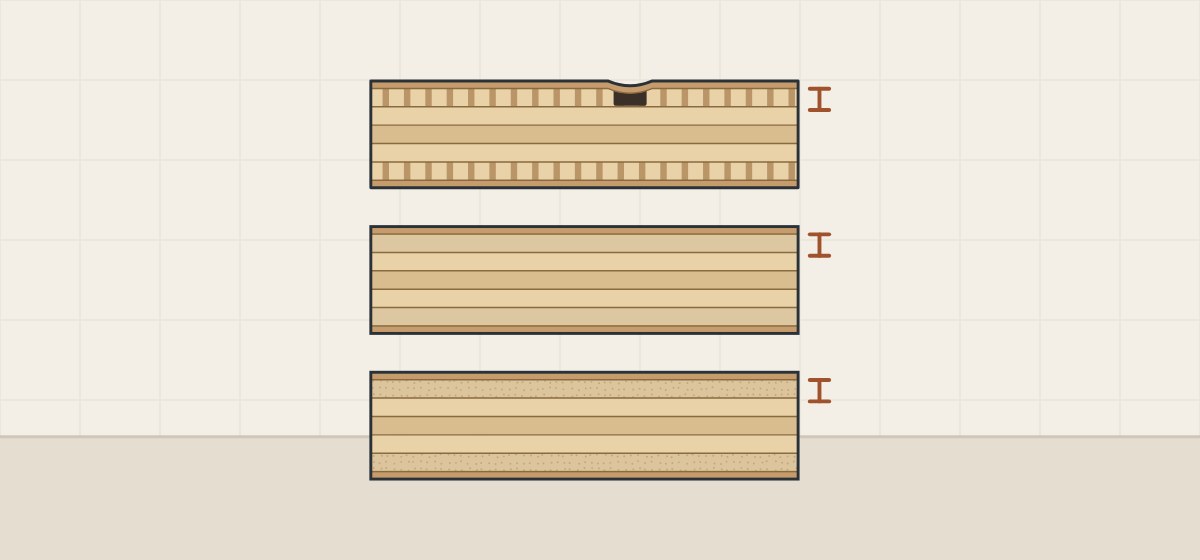
The crossband is the layer the face veneer sits on, and makers change it to change the face. Each claim below is the maker’s own, for its own product.
| Under the face | What the maker says |
|---|---|
| Hardwood crossband, Columbia MPX | Reduces the potential for core telegraphing; hardwood lacks the extreme springwood and summerwood density difference of softwood cross bands. |
| Hardwood crossband, Roseburg HXB | Smoother, with less potential for core telegraphing. |
| MDF crossband, Columbia Classic Core | Smoother than softwood veneer core cross bands; reduces core telegraphing potential. |
| MDF crossband, Roseburg CFC | An ultra-smooth surface to reduce telegraphing through the face. |
| Sanded platform (two-step), Columbia | Recommended for high-end, plain sliced woods to alleviate core telegraphing. |
Every claim speaks of reducing telegraphing; none speaks of preventing it. Columbia and Roseburg sell MDF crossbands as a deliberate construction; check any panel against what was specified.
Which cores do makers offer under a veneer face?
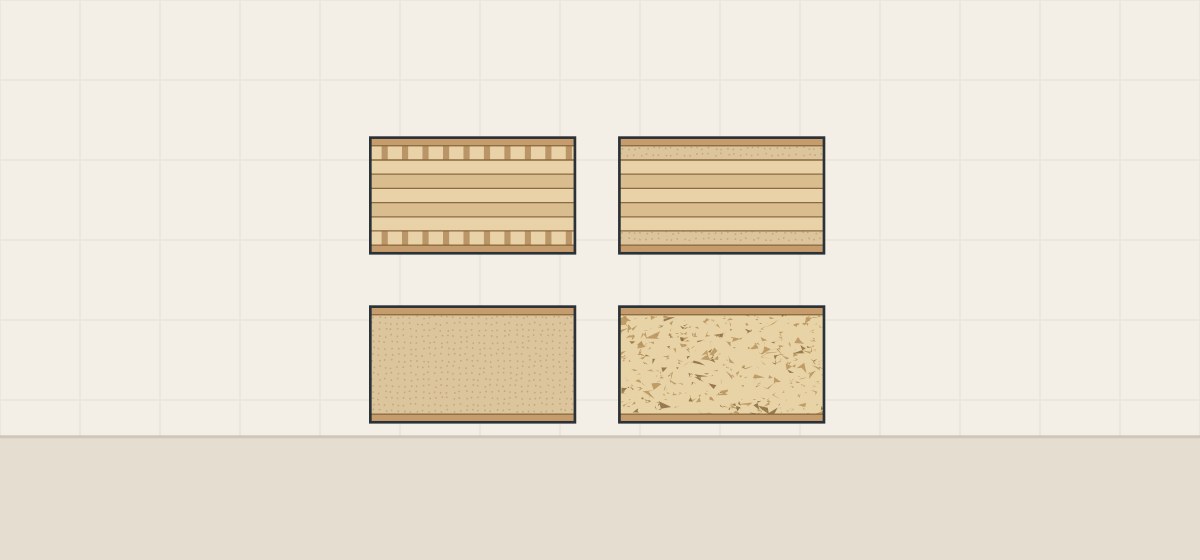
Makers offer all-veneer cores, two-step veneer cores, combination cores with composite crossbands, and full MDF or particleboard cores. Named examples:
| Core | Named example | What the maker says |
|---|---|---|
| Veneer core | Columbia core guide | Less forgiving with thinner face veneers; core transfer possible. |
| Two-step veneer core | States Industries | Blank sanded to a calibrated tolerance, then faced; smoother surface, consistent thickness. |
| Combination core | States ArmorCore | Composite crossbands over veneer inner plies; a flat, smooth surface. |
| MDF core | Roseburg SkyPly | A very smooth, consistent panel; a substrate for high-end veneer. |
| Particleboard core | Columbia core guide | Smooth, void-free surface; greatest expansion if exposed to moisture. |
Columbia adds that pre-sanding gives its two-step panels a tighter thickness tolerance than one-step.
What do the standards say about telegraphing?
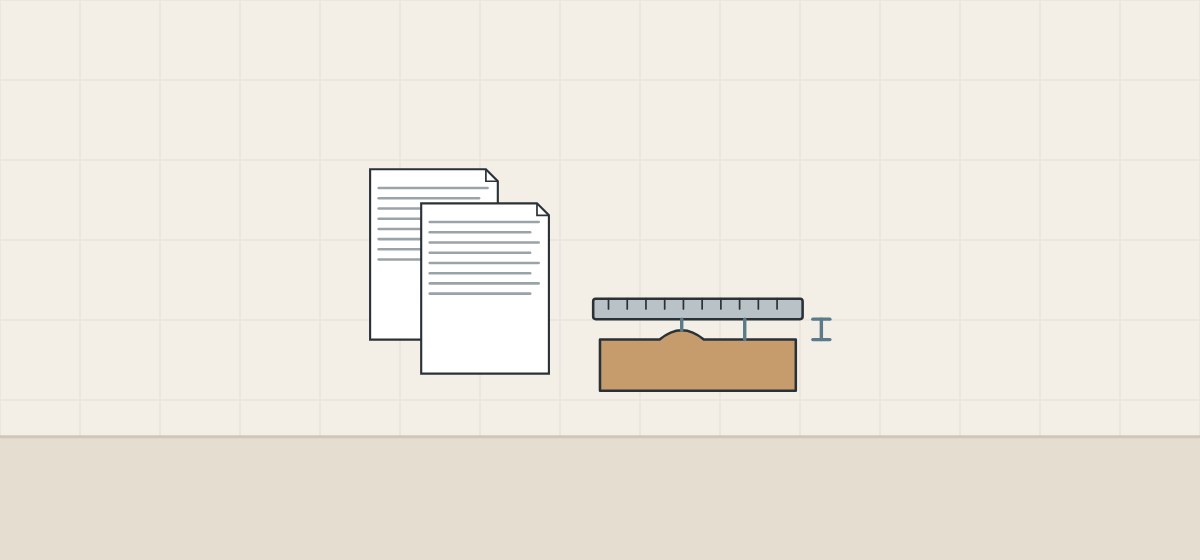
AWI 300 sets a numeric telegraphing limit; the HP-1 clauses read for this guide grade the inner plies and leave veneer thickness to agreement. Four points, then this guide’s own checks:
AWI 300: the limit
The Architectural Woodwork Institute’s panel products section says telegraphing shall not exceed 0.1 mm (.004 in) in any 76.2 mm (3 in) span.
AWI 300: cores
Veneer, OSB or lumber cores are not guaranteed against warping, telegraphing or delamination, and veneer core shall not be used for cabinet door or drawer front components.
AWI 300: veneer
Veneer shall be thick enough to prevent exposure of the core after sanding or finishing.
ANSI/HPVA HP-1-2024
The hardwood plywood standard limits inner plies by the size of openings and describes four inner-ply grades, J, K, L and M. It sets no fixed minimum veneer thickness except as buyer and seller agree.
What to confirm
This guide suggests confirming these points for the project:
- Whether AWI 300 applies to the project
- The inner-ply grade under the face
- The agreed face veneer thickness
- The core for doors and drawer fronts
What in the core can show through a finished face?
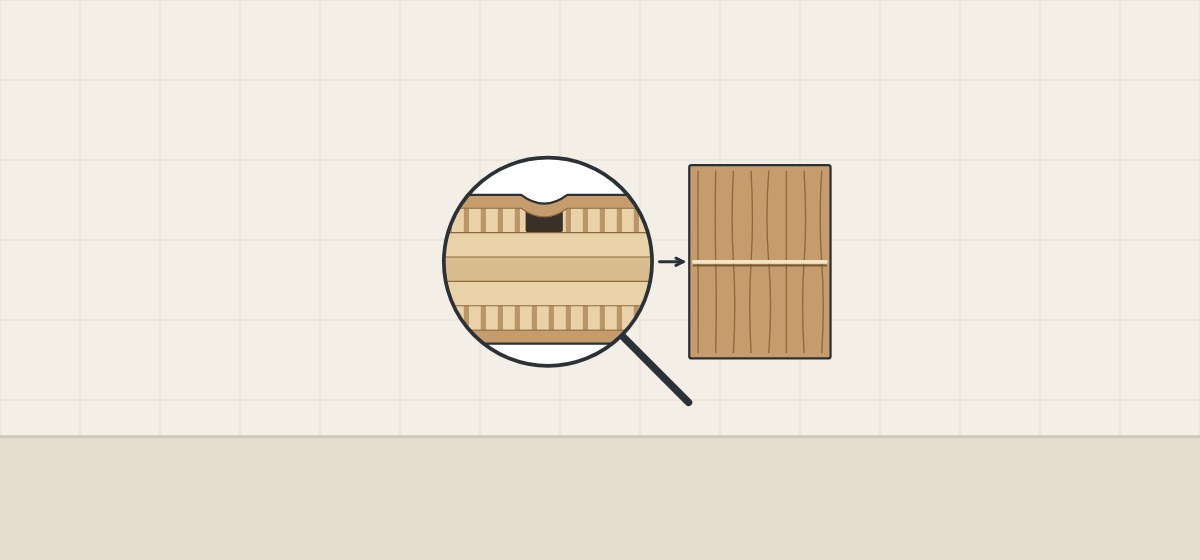
Makers name open knots, open joints and splices in the crossband; the Wood Handbook describes a related glue-line effect. Three examples:
Open knots and joints
Columbia says Classic Core reduces finishing problems that stem from open knot holes or open joints in veneer core cross bands, which it notes HP-1 allows.
Crossband splices
Oshkosh Architectural Door Company’s crossbanding bulletin says splices in natural crossbanding cause sand-throughs or may telegraph through the face veneer as a visible line across a door.
Sunken bondlines
The Wood Handbook’s adhesives chapter describes a related effect in edge-glued wood, not in veneered panels: an edge-grain joint bonded with waterborne adhesive and surfaced before the moisture has evened out later shrinks below the surface, and the sunken bondline is very conspicuous under a high-gloss finish.
The Oshkosh example concerns architectural doors, not cabinets; it is included as a door maker’s account of a joint under the face.
Does telegraphing also affect laminate faces?
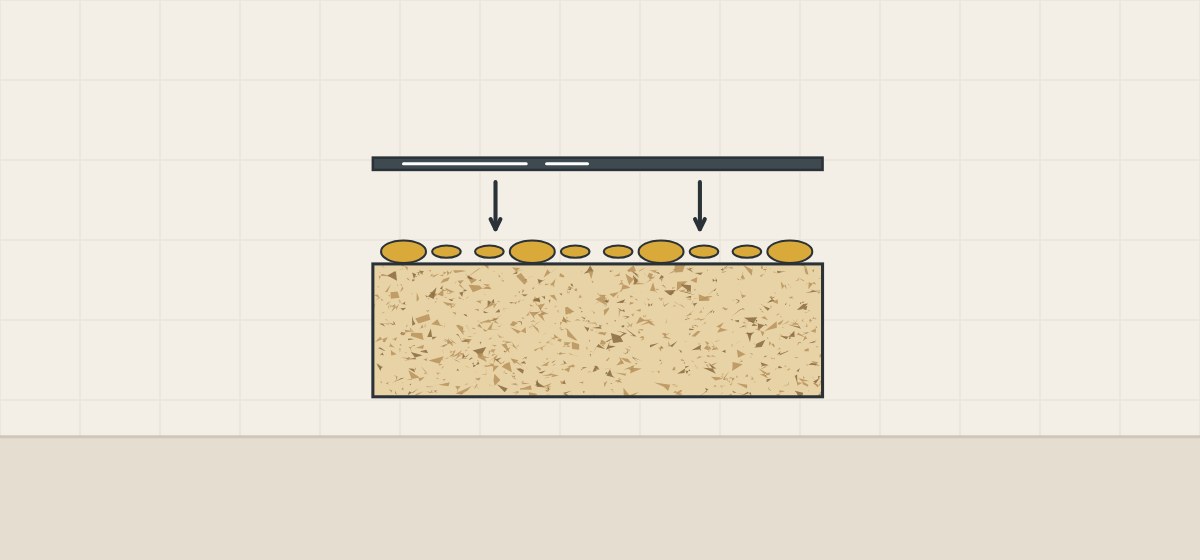
Laminate makers use the same word for their own products. Formica says certain combinations of finish, substrate and adhesive can cause telegraphing.
| Source | What it says |
|---|---|
| Formica technical guide | Its Grade 20 laminate in the 90 gloss finish (“Grade 20-90”) will show a degree of telegraphing on a panel application; Formica recommends Grade 10-90 or 12-90 gloss instead. |
| Formica, substrates | Sanded smooth and uniform in thickness; plywood is a marginal substrate. |
| Wilsonart SOLICOR bulletin | Take care with the amount of adhesive to minimize telegraphing; plywood should not be considered. |
| Composite Panel Association storage bulletin | Condition panels and laminate at 35% to 45% relative humidity and 70 °F; moisture affects the smoothness of most uncoated panel surfaces. |
How should a buyer specify what lies under a veneered face?

Name the layers, then approve a finished part. These steps are procurement guidance, not a standard.
- List the visible parts. Doors, drawer fronts, side panels or hidden parts.
- Name the face separately. Species, cut and match describe the face, not what supports it.
- Name the crossband and core. Veneer, MDF or HDF crossband; veneer, combination or composite core; one-step or two-step.
- Ask for a cut section. An offcut or edge photo shows the layers; a face photo does not.
- Approve a finished sample. Same face, core, finish and gloss, viewed under agreed light.
- Tie changes to a new sample. A change of core needs re-approval, not only new wording.
Before any rework
If a pattern appears, ask the fabricator to identify the affected panel, the face material and the finishing sequence before anything is sanded. AWI 300 expects the veneer to cover the core after sanding or finishing.
What should you send and ask before a quotation?

Send the list of visible parts and ask for the construction under each face. The questions and the list of items to include are this guide’s own.
| Question | Why it matters |
|---|---|
| What is the crossband under the face? | Makers change this layer to reduce telegraphing. |
| Is the core one-step or two-step? | A two-step core is sanded before facing. |
| Which inner-ply grade sits under the face? | HP-1 grades inner plies by openings. |
| What face veneer thickness is agreed? | HP-1 leaves it to buyer and seller. |
| Which core is used for doors and drawer fronts? | AWI 300 excludes veneer core for these. |
| Which gloss level is the finish? | The Wood Handbook ties sunken bondlines in edge-glued wood to high gloss. |
Include with your request
- Elevations marking visible faces
- Face species, cut and match
- Finish type and gloss level
- Any standard the project names
- Quantity per part type
WNS Global confirms any product and terms it offers separately in writing. This guide does not state that WNS Global products have the features, ratings or listings named above.