
From meter to record
What produces a wood moisture reading?
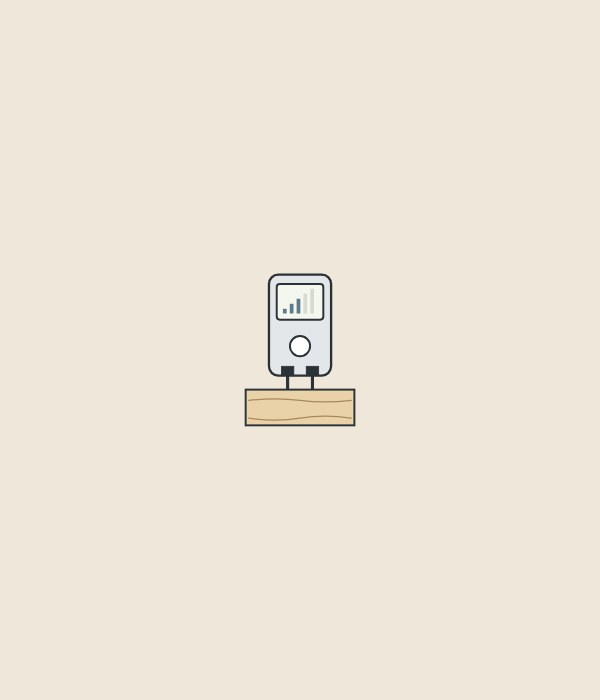
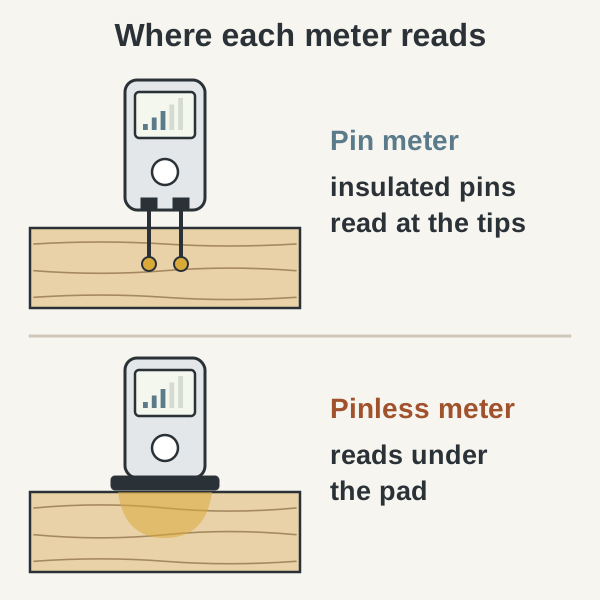
A hand-held meter measures an electrical property of the wood and converts it into a moisture percentage. Wagner says a pin meter measures the resistance to a current between two pin tips; a pinless meter uses a large sensor pad and electromagnetic signals.
The percentage itself is defined by weight: the Wood Handbook’s chapter 4 defines moisture content as the mass of water divided by the oven-dry mass of the wood. Its chapter 13 calls oven-drying the most universally accepted method, but slow and needing the wood cut; the electrical method is rapid and needs no cutting.
| Term | What it means |
|---|---|
| Moisture content | Mass of water as a percentage of oven-dry mass (Wood Handbook). |
| Pin meter | A conductance-type or resistance meter in the Wood Handbook. |
| Pinless meter | A dielectric meter in the Wood Handbook. |
How does a meter turn a signal into a percentage?
A meter turns its signal into a percentage through the maker’s calibration, a species or density setting and, on a pin meter, a temperature correction. The five steps combine statements from the Wood Handbook, Wagner and Delmhorst as a general chain, not one model.
- The meter senses an electrical property; per the Wood Handbook, the conductivity of wood is a strong function of moisture content.
- The maker’s calibration converts the signal; Delmhorst bases its wood calibrations on Douglas fir and says species read differently at the same moisture content.
- On a pinless meter, Wagner says the density setting must be set before measuring.
- On a pin meter, Wagner says quality models come with a temperature correction chart.
- The figure applies to where the meter reached; Wagner says a pin meter reads at the depth of the pins.
ASTM’s D4444-25 page says a reading also depends on other wood properties, the surroundings, the probe shape and the meter’s design.
How do pin and pinless meters differ?
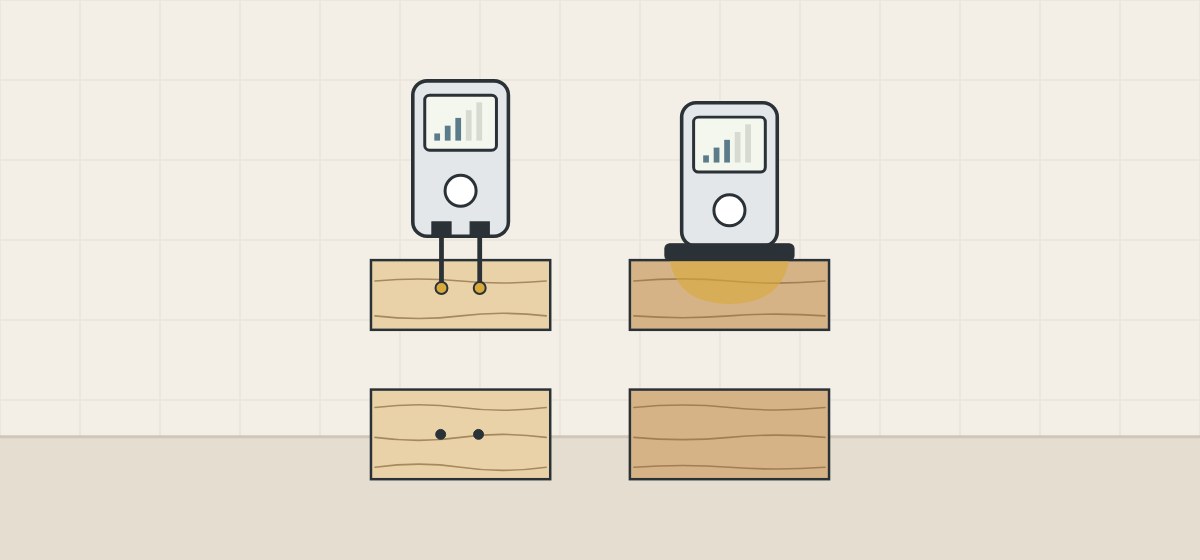
Pin and pinless meters differ in what they sense, where in the part they read and what they leave behind. The table cites Wagner, Lignomat and the Wood Handbook.
| Point | Pin meter | Pinless meter |
|---|---|---|
| Where it reads | At the depth of the pins (Wagner). | An average within the measuring field (Lignomat). |
| Depth | Insulated pins read only at the depth driven (Lignomat). | Generally 1/4 in or 3/4 in below the surface (Wagner). |
| Surface and core | Uninsulated pins sense the highest level along their length (Wood Handbook). | Surface layers predominantly influence the reading (Wood Handbook). |
| Marks left | A pair of pinholes per reading (Wagner). | None; the pad does not damage the wood (Wagner). |
Pinholes are visible marks on a finished vanity part, so agree in advance on where pins may be used.
Which settings and conditions change the reading?
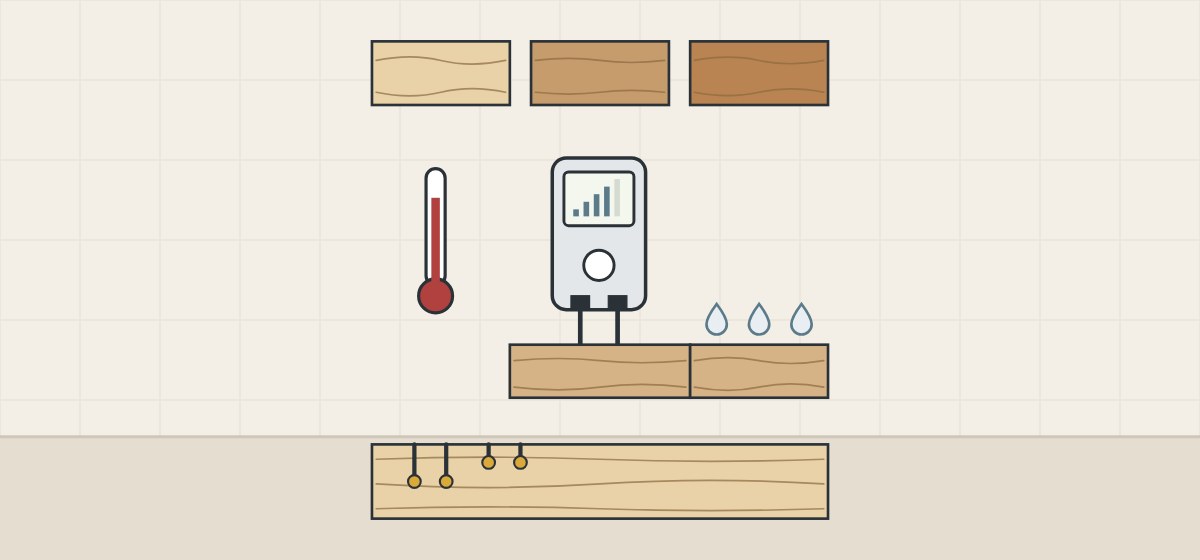
Temperature, pin depth and surface moisture each change what a meter shows. Each figure below belongs to the named source.
| Factor | Source | What it says |
|---|---|---|
| Temperature | Delmhorst | No correction needed when the wood is between 50 °F (10 °C) and 90 °F (32 °C). |
| Temperature | Wood Handbook | Resistance meters: an approximate correction of about 0.5% per 10 °F (5.6 °C). |
| Pin depth | Wood Handbook | Where wood is wetter at the center, insulated pins driven about one-fifth to one-fourth of the thickness reflect the average of the piece. |
| Surface moisture | Wagner | A small amount of condensation might make a pinless meter read higher. |
| Range | Wood Handbook | Reliable from 4% to about 30% for commercial dielectric meters; about 6% to 30% for resistance meters. |
The Wood Handbook also warns that moisture gradients between surface and interior can lead to confusion.
What do the ASTM moisture standards cover?

Three ASTM standards separate the direct method, laboratory calibration of meters and field use. Only the scope and significance text on their public store pages was read:
ASTM D4442-20(2025)
Direct measurement of moisture content in wood, veneer and other wood-based materials. Its scope treats oven-drying Method A as the one primary method.
ASTM D4444-25
Laboratory standardization and calibration of hand-held meters on solid wood products, using clear specimens with straight grain. Calibration is against moisture content measured directly under D4442.
ASTM D7438-20(2025)
A practice for hand-held meters on wood as it is actually used. Its scope takes in uneven grain, the direction of growth rings and moisture gradients, and calls for meters already calibrated under D4444.
What to ask a supplier
The ASTM pages give no record format. As this guide’s own guidance, ask for:
- The meter type and model
- Whether its calibration was verified
- The species or density setting used
- Any correction applied to the figure
What moisture values do published references give?
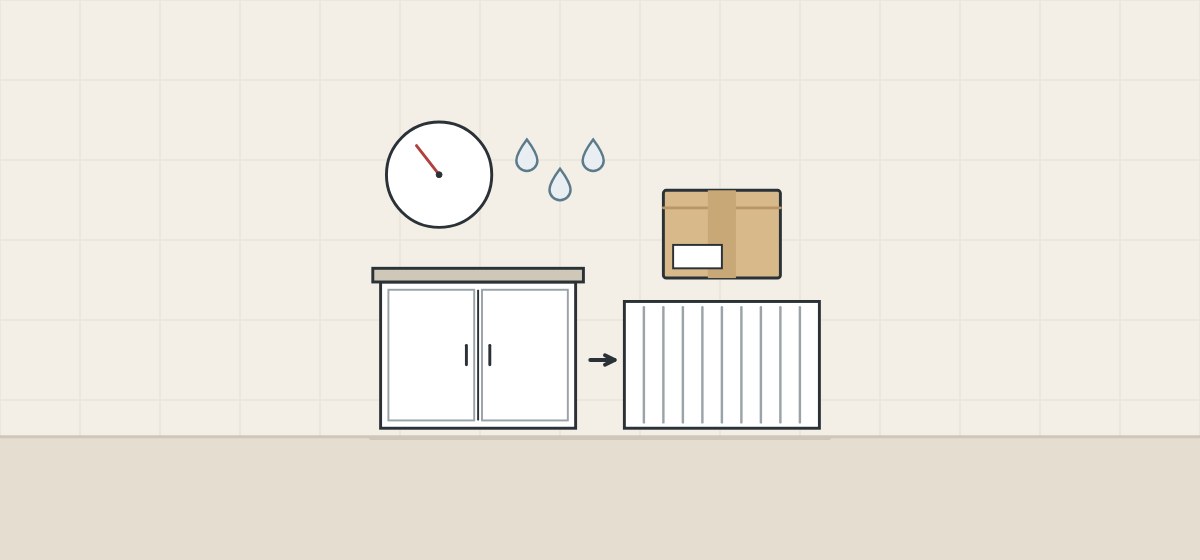
Published values are tied to a region, a product and a point in time, so none is a limit for an order until the contract adopts one. Three reference points:
Wood Handbook, Table 13-2
For interior woodwork, flooring and furniture at the time of installation, the handbook recommends an 8% average, with 6% to 10% for individual pieces, in most areas of the United States; 6% in dry southwestern and 11% in damp, warm coastal areas.
Architectural Woodwork Standards
The 2014 second edition gives, in Section 2, an optimum of 5% to 10% for climate-controlled environments in most of the United States and Canada, alongside 25% to 55% relative humidity. The institute now lists NAAWS 5.0, a standard not read here.
Transit
For standard 19-mm (nominal 1-in.) dry softwood lumber in tightly closed containers or intact wrappers, the handbook says the average change for a package can generally be held to 0.2% or less per month. In ship holds, it says dry material usually adsorbs about 1.5% during normal shipping periods.
These figures describe North American regions and lumber or architectural woodwork, not a specific vanity. Per the handbook, wood below fiber saturation swells and shrinks as it gains and loses moisture, so a factory reading does not fix the value at the destination.
How much of an order does one reading cover?
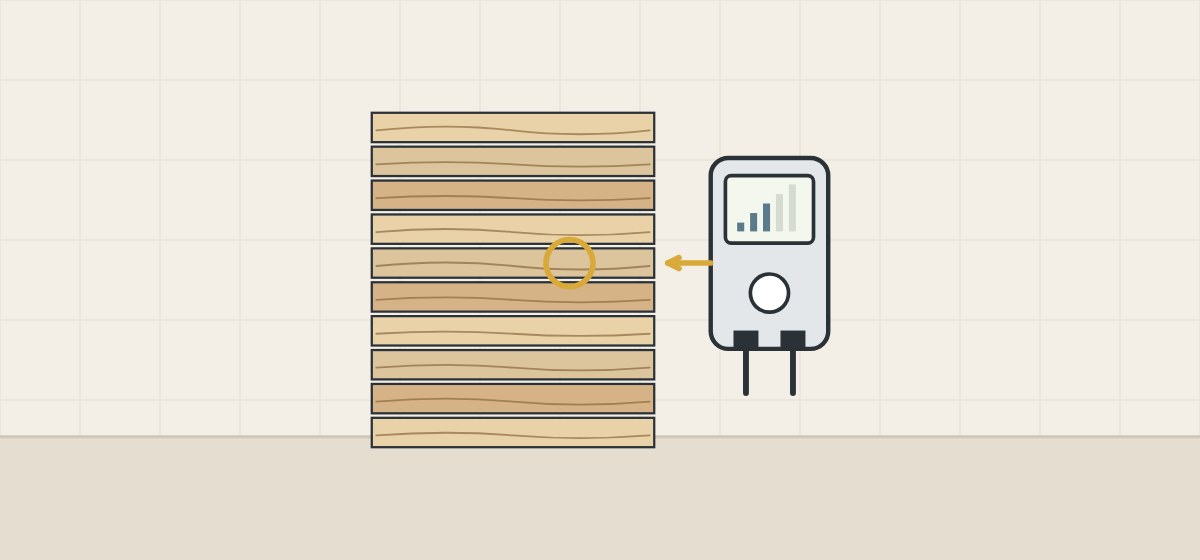
One reading covers one spot on one part; anything wider needs a stated sampling plan. The table gives two Wood Handbook points on lumber and boards.
| Source | What it says |
|---|---|
| Wood Handbook, Table 13-2 note | For a realistic average, test at least 10% of each item; if the quantity is small, make several tests. |
| Wood Handbook, board products | Hot-pressed plywood, particleboard and hardboard usually do not have the same moisture content as lumber. |
What should a wood moisture record contain?

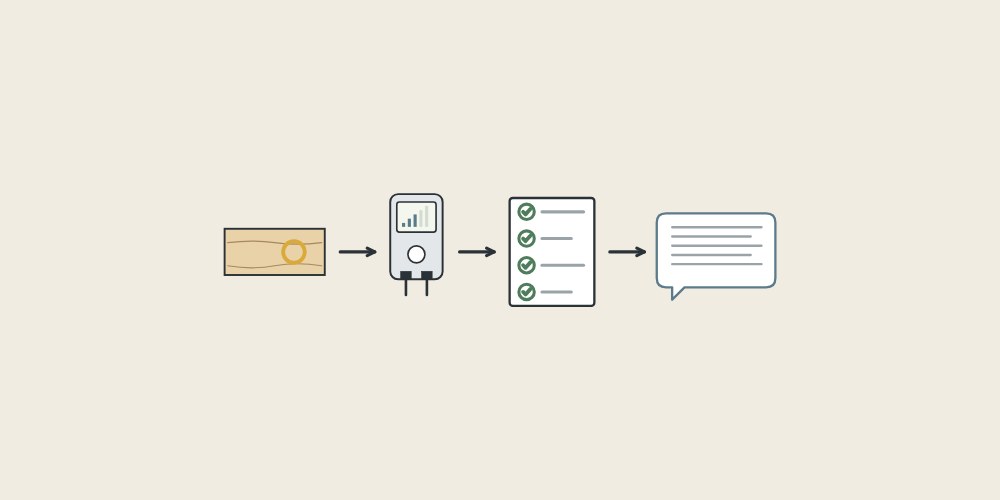
A usable record names the part, the spot, the meter, its settings and the sampling behind each figure. These six fields are procurement guidance.
- Component and spot. Name the part and mark the spot on a drawing or labeled photo.
- Meter make and model. This points to the instructions that apply.
- Type, mode and setting. Pin or pinless, any relative mode, and the species or density setting.
- Temperature and depth. Wood temperature, any correction, and pin or pad depth.
- Date and stage. Keep readings from different production stages apart.
- Sampling plan. How many parts were measured and how they were chosen; keep every reading.
When two records disagree
First check that both records refer to the same part and spot, the same meter type and settings, and a comparable time. Keep figures from two meter types in separate series. Then ask for a repeat under an agreed method, not a new photo of a better number.
What should you send and ask before a quotation?

A complete request states how moisture will be measured and recorded, not only a target figure.
| Question | Why it matters |
|---|---|
| Which meter type and model is used? | Pin and pinless figures can differ. |
| Which species or density setting? | The setting changes the figure. |
| Which parts and spots are measured? | One reading covers one spot. |
| How many parts of each item are sampled? | One display photo is not a sampling record. |
| Which limit and method apply? | Published values are tied to named regions. |
This guide suggests sending
- Wood species and components concerned
- Destination and expected indoor conditions
- Any moisture limit and its source document
- The meter type your inspector will use
- The record format and sampling you expect
WNS Global confirms any product and terms it offers separately in writing. This guide does not state that WNS Global products meet any moisture value named above, or that WNS Global performs any measurement or record described here. It does not replace a qualified inspection or approve a shipment.