From identity to release
What identifies a replacement roller beyond its appearance?
A matching request should identify the complete door, the affected panel and the relevant assembly drawing. The roller is connected to a glass attachment, a track and retention features. Similar wheels do not establish that these connections are compatible.
For a new order, ask for the parts and drawing set belonging to the offered configuration. For service, begin with the installed door identity and its generation. An attractive catalog photograph of a different current system is not enough to identify the old one.
| Record | What to establish |
|---|---|
| Complete door | Maker, model and known generation |
| Affected panel | Sliding/fixed and the maker’s panel designation |
| Assembly reference | Applicable manual and parts drawing revision |
| Related components | Track, guide, roller and anti-jump references |
| Compatibility answer | Maker or responsible supplier confirmation for the actual system |
Where should the buyer look for the complete door identity?
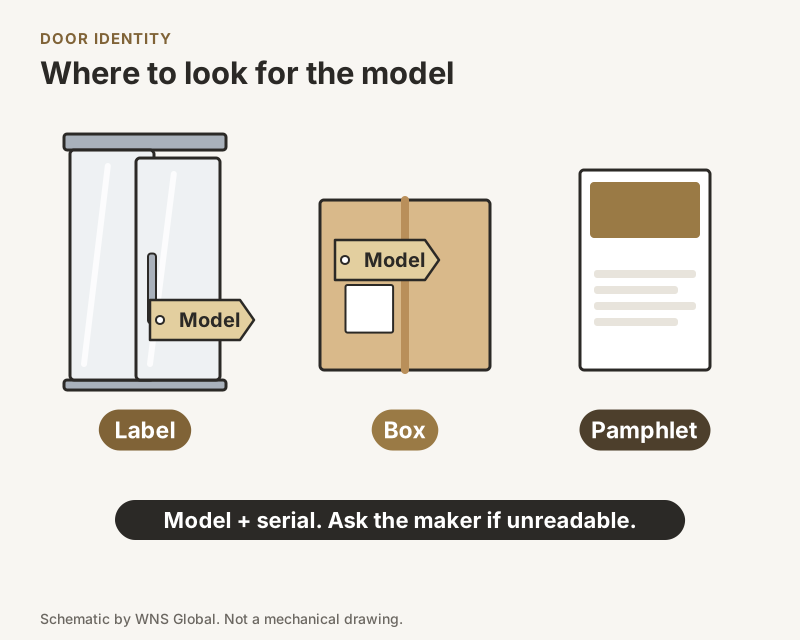
Kohler’s model-identification page gives examples of labels on products, boxes and supplied pamphlets. Label positions depend on the door type and maker; use its examples as a prompt to collect the actual identity.
- Retain the model and serial information from the product or supplied documents where available.
- Photograph an accessible label and the whole installed door without dismantling or moving unsafe glass.
- Keep the box or original purchase reference if it links to the installed configuration.
- Ask the maker or responsible supplier to identify a missing or unreadable model from the information it requests.
- Obtain the applicable manual and parts drawing before ordering a proposed substitute.
Do not equate a decorative finish name with the complete system model. If no reliable identity can be established, leave compatibility open rather than choose a roller by approximate dimensions.
Why must panel roles remain part of the matching file?
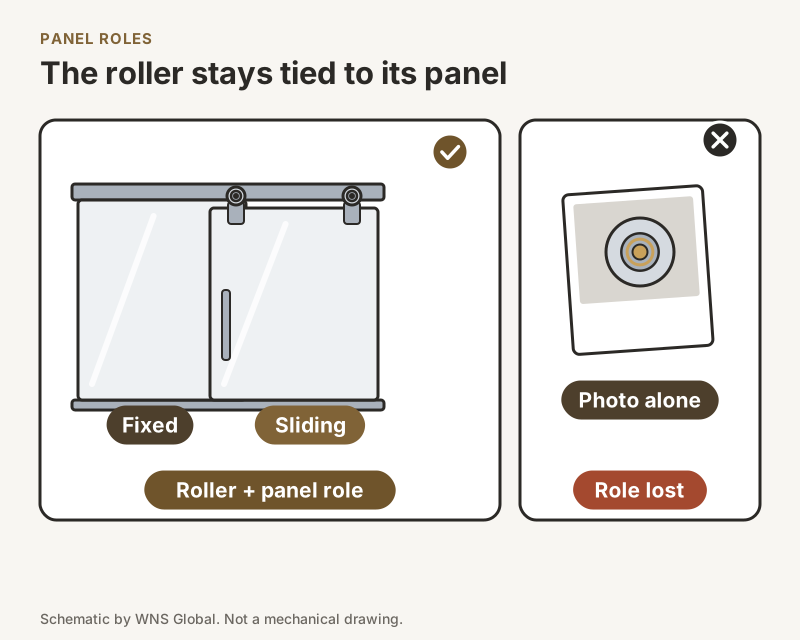
One sliding system can use different roller assemblies on different panels. A parts photograph detached from its panel designation can lose the information needed to match it.
Swipe or use the arrow keys to see mistake to avoid.
| Record | Information to preserve | Mistake to avoid |
|---|---|---|
| Sliding or fixed panel | Role shown in the applicable drawing | Treating every glass panel as carrying the same hardware |
| Inside or outside designation | Maker’s drawing terminology | Guessing role from a loose part |
| Attachment and glass scope | Exact assembly and applicable panel details | Assuming equal glass thickness proves compatibility |
| Handing / configuration | The order’s applicable arrangement | Reusing the opposite configuration without confirmation |
Kohler’s Levity support page distinguishes inside and outside roller components, including the outside anti-jump clips. This page intentionally does not reproduce its hole dimensions or use its ambiguous repeated side-position wording. Confirm physical orientation from the actual system drawing.
Which component references should be kept separate?
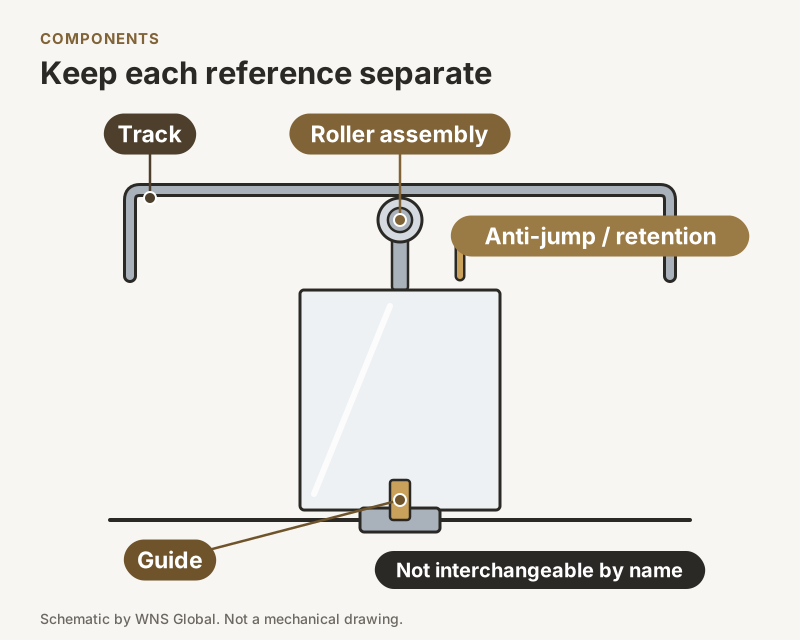
A guide and a retention feature may both help control panel movement, but their names do not make them interchangeable. Identify each one in the maker’s assembly.
Swipe or use the arrow keys to see evidence to request.
| Component field | Matching question | Evidence to request |
|---|---|---|
| Roller assembly | Which assembly belongs to this panel? | Applicable parts drawing and part reference |
| Track | Which track interface does that assembly use? | Same named-system drawing |
| Guide | Which guide controls this panel’s path? | Model-specific guide reference |
| Anti-jump / retention | Which identified feature retains the panel as designed? | Maker’s named arrangement and applicable part |
| Stops and other related parts | Which associated components are required? | Complete system list, not a roller-only offer |
Kohler’s panel-guide page notes that guide installation depends on the model. Keep the guide reference with the matching request; do not conclude that replacing a guide also replaces the identified anti-jump function.
What does the Levity example show about part identity?
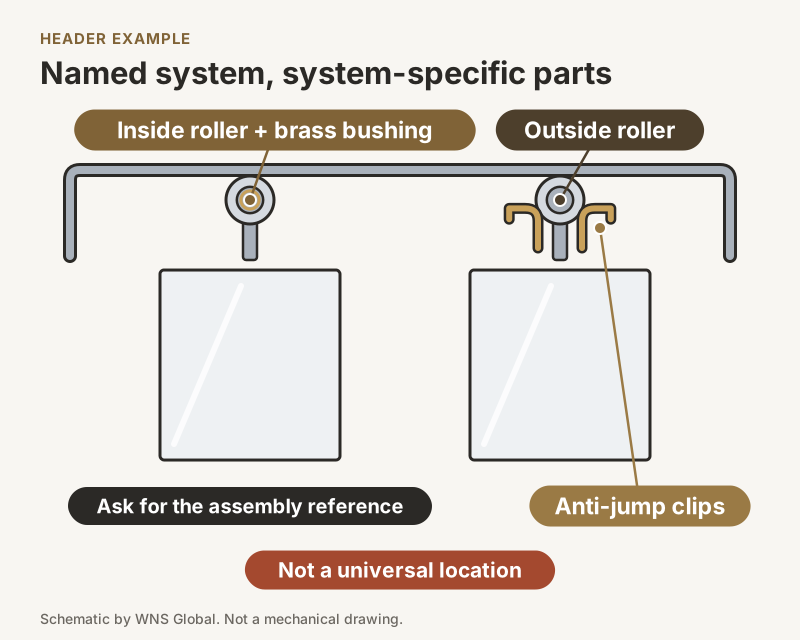
The Levity support page provides a named header-system example. Use it to recognize the need for system-specific information, not as a set of instructions for another door.
Different panel assemblies
The source distinguishes an inside roller assembly with a brass bushing from outside roller components. A buyer should request the applicable assembly reference rather than order one generic roller for all panels.
Outside retention component
The source identifies anti-jump clips with the outside rollers and describes their hooks within the header. That relation belongs to this named arrangement; it is not a universal location for anti-jump parts.
Actual installation stays with its manual
The article does not reproduce cam adjustment, fastening steps or glass hole positions. A proposed service part must be checked against the actual model and applicable instructions before an installer uses it.
- Record the named system and affected panel.
- Preserve the roller and anti-jump assembly references together.
- Obtain the maker’s compatibility answer for the proposed part.
Why must a bottom-track example stay separate?
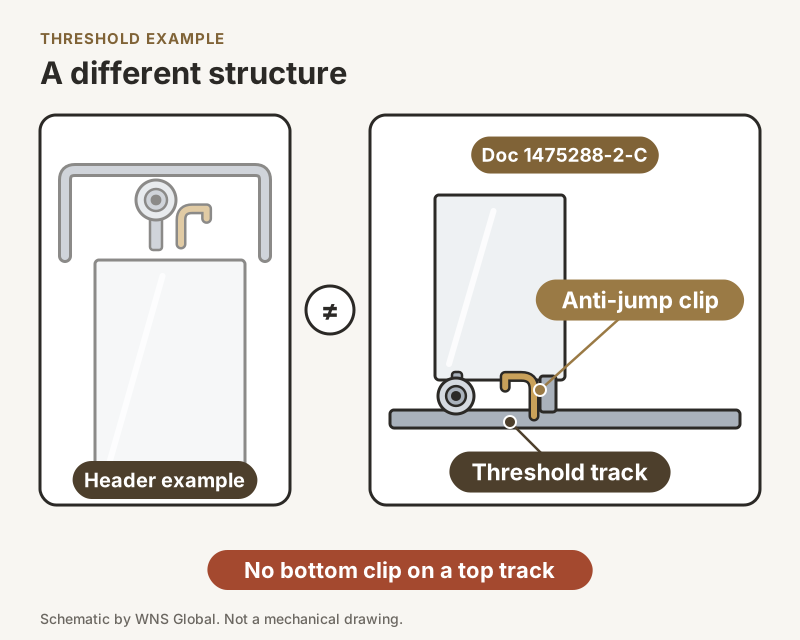
Kohler document 1475288-2-C describes a sliding panel whose rollers sit on a threshold track and whose anti-jump clips engage a threshold feature. Its structure differs from the Levity header example.
Name the evidence accurately
The PDF cover says Sliding Shower Door and provides the document revision. This research has not established the product series from that cover. The example is identified by document number and must not be relabeled Levity.
Keep the track relationship with the part
The printed-page diagrams show retention at the threshold. That is evidence of a different arrangement, not a recommendation to put a bottom-track clip onto a top-track door.
Avoid transferring adjustments
Do not borrow fastening or clearance directions from this document for an unidentified system. The buyer’s matching file should point the installer to the manual confirmed for the actual door.
The two examples establish a limited point: anti-jump parts cannot be matched by the generic word alone. They require the named system, assembly relationship and applicable parts information.
How should system generation enter a spare-part request?
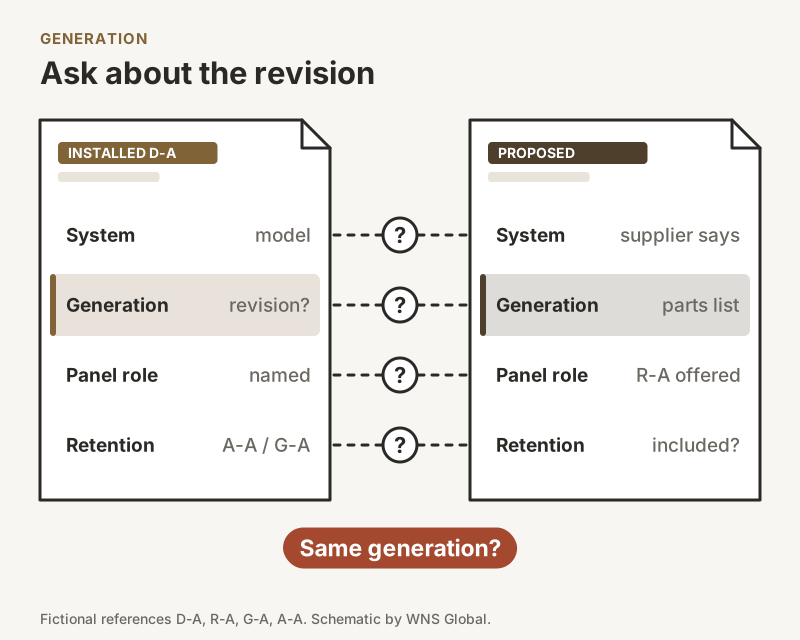
Sterling’s 660/690 change page documents a design update. It supports asking about the generation, but this guide does not identify old/new parts from its unverified photographs or from color alone.
Swipe or use the arrow keys to see unresolved question.
| Field | Installed / ordered D-A | Proposed replacement | Unresolved question |
|---|---|---|---|
| System identity | Recorded maker and model | Supplier states compatible model | Does the statement cover this exact door? |
| Generation / manual | Applicable revision or unknown | Part-list revision supplied | Are these the same applicable generation? |
| Panel role | Named sliding panel | Roller R-A offered | Is R-A the assembly for that panel? |
| Associated retention | Anti-jump A-A / guide G-A | Included or omitted | Which associated parts are required? |
| Compatibility basis | Actual drawing and maker reply | Reference to that reply | Is there a documented basis beyond appearance? |
What should remain open before a part is accepted?
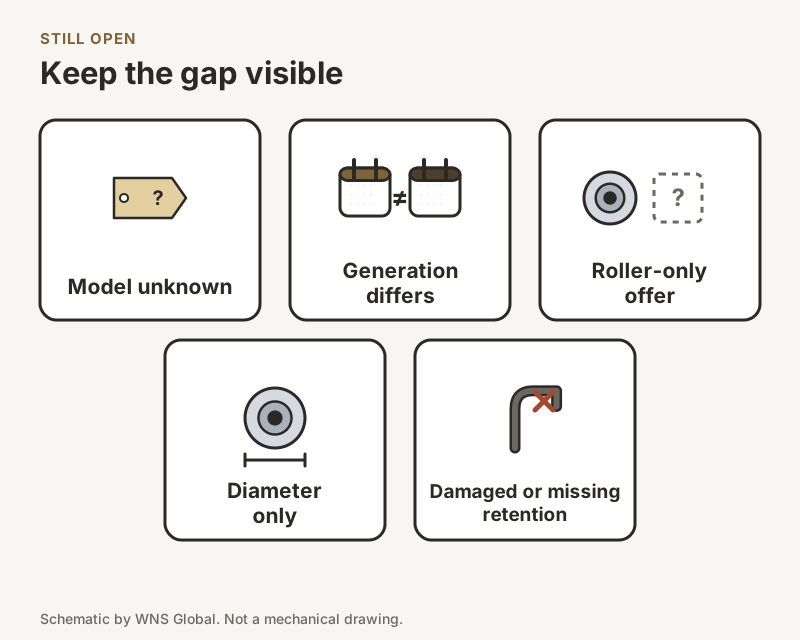
A usable answer connects the proposed part to the actual system. Preserve uncertainty when that connection is missing.
- Model unknown Ask the maker or supplier what information it needs for identification. Do not dismantle unsafe glass to obtain a guessed dimension.
- Generation differs Request the applicable parts list or a confirmed replacement relationship for the installed generation.
- Roller-only offer Ask whether the named assembly requires associated bushings, fasteners, guides or retention parts; do not improvise missing components.
- Damaged or missing retention Refer the condition to the responsible service party and installer. Do not keep using or adjust an unsafe assembly based on this purchasing worksheet.
- Compatibility supported only by diameter Request the system-level basis. Wheel size alone does not establish the glass attachment, track or retention relationship.
Record the disposition
An unresolved system match is a reason to seek the responsible maker’s answer. This page provides no universal torque, clearance, cam setting, glass drilling pattern or load rating.
What should accompany the confirmed parts?
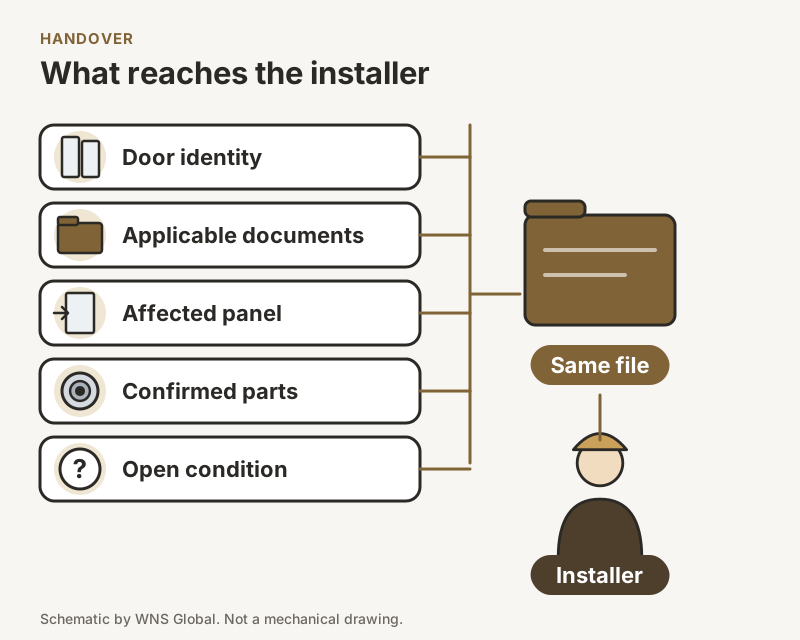
Hand the actual model and applicable instruction set to the qualified installer or service party, alongside the parts references that were confirmed for it.
| Reference | Record to hand over |
|---|---|
| Door identity | Actual model, configuration and generation evidence |
| Applicable documents | Manual and parts drawing revisions confirmed for the door |
| Affected panel | Panel role and relevant assembly reference |
| Confirmed parts | Roller, guide, retention and associated part references |
| Open condition | Damage, missing information and responsible follow-up |
Before you close the file
- The proposed part is linked to the actual named system.
- Associated guide and retention information has not been discarded.
- Installation uses the applicable maker instructions, not this worksheet.
The useful procurement result is a supported parts match. Actual installation, inspection and any adjustment belong with the responsible installer and manufacturer instructions; this guide does not establish a WNS replacement-part compatibility claim.