
From data sheet to locked drawing
Which data must be fixed before a vanity top is cut?
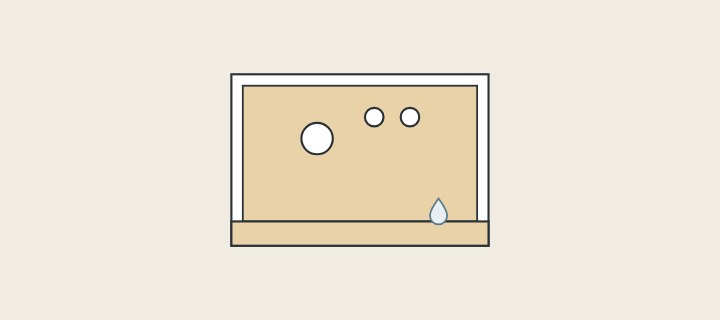
Five sets of data must be fixed: faucet holes, deck thickness at those holes, drain hole, overflow with its drain, and trap position.
Moen’s WS84228 sheet, for example, states three holes of 1-1/8 in minimum diameter, 4 in on center, and a deck between 1/4 in and 1-3/16 in thick.
| Term | What it means here |
|---|---|
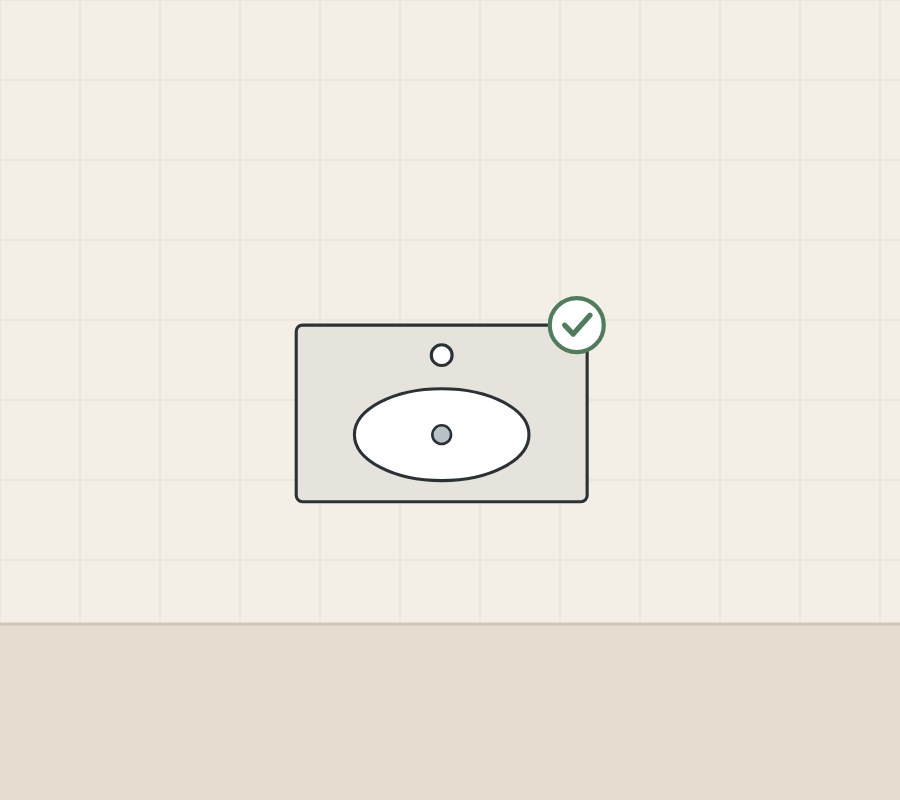
| Single-hole | One deck hole. |
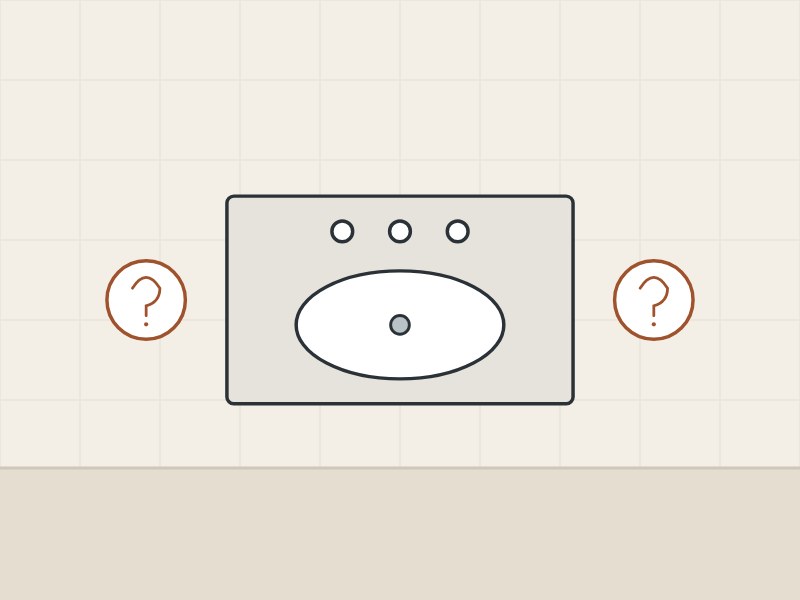
| Centerset | Three holes at 4 in on center, as on Moen’s WS84228. |
| Widespread | Three holes on wider centers: 8 in on Moen’s TS6925. |
| Deck thickness | Top thickness at the hole. |
| Drain hole | Bowl opening for the drain. |
| Overflow | Bowl feature to check the drain against. |
| Waste | The drain fitting in the bowl; makers also call it a drain. |
| Trap | Water seal trap serving the fixture. |
In what order should the interface be settled?
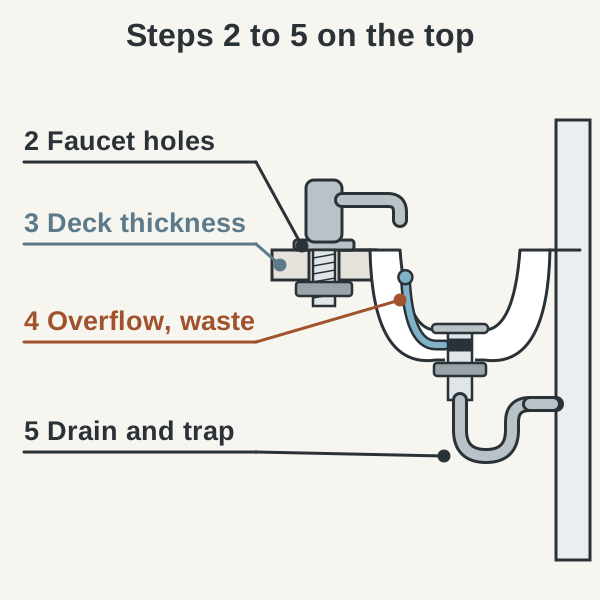
Supplier first, then faucet, deck, drain, trap and remaining holes. This order is the guide’s own.
- Name who supplies the faucet and the drain.
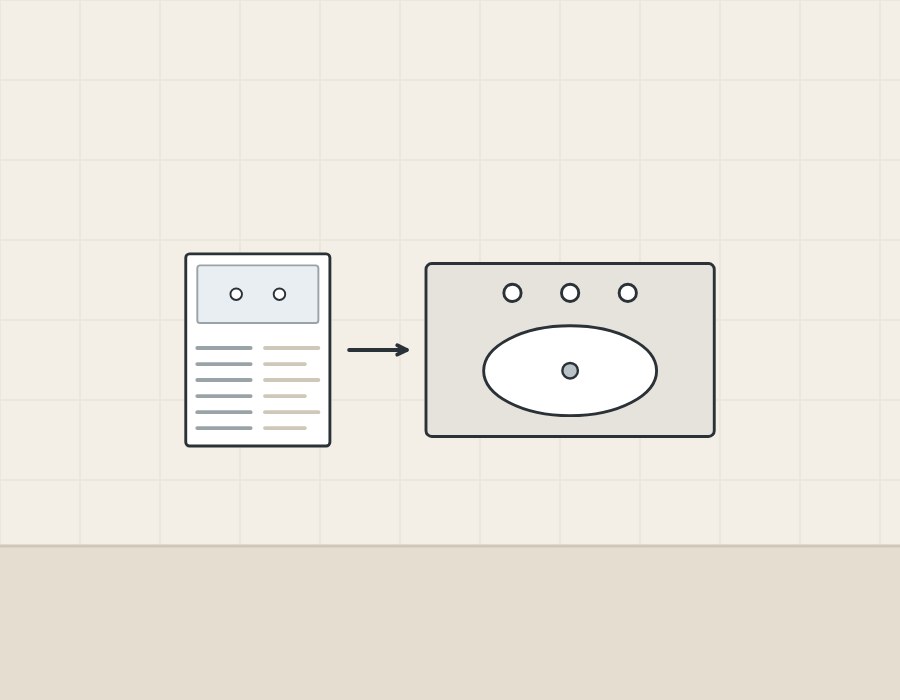
- Fix the faucet model; take hole count, diameter and centers from its sheet.
- Check the top’s thickness at each hole against the sheet.
- Record whether the bowl has an overflow; choose the matching drain.
- Place the drain and trap against the drawers and the wall outlet.
- List every other hole, then lock the drawing.
A sink sheet can bind the fabricator too. Kohler’s K-2356-8 sheet says the countertop manufacturer or cutter must use the cut-out template supplied with the product, or a current one from Kohler.
What hole size and spacing do faucet makers specify?
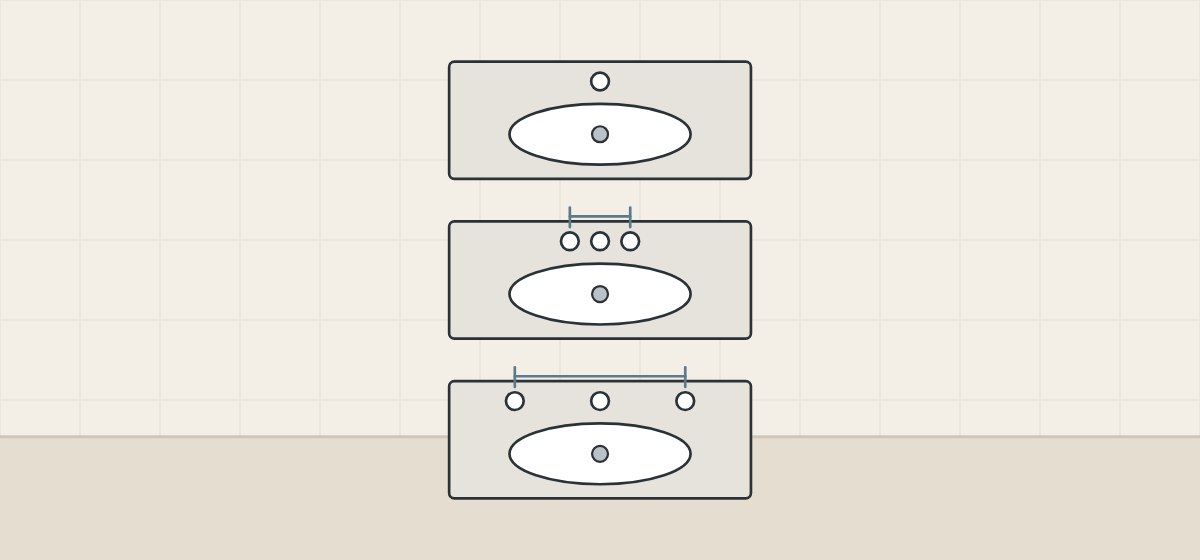
Makers print hole count, spacing and diameter per model. On these five documents the figures are not the same:
| Model | Holes and spacing | Hole diameter |
|---|---|---|
| Delta 3567-MPU-DST, widespread | Three holes, 4 to 16 in centers | 1-1/16 to 1-1/2 in |
| Delta 15748LF, single handle | One or three holes; escutcheon included | 1-1/8 to 1-1/2 in |
| Moen WS84228, centerset | Three holes, 4 in on center | 1-1/8 in minimum |
| Moen TS6925, widespread | Three holes, 8 in centers | 1-1/8 in minimum |
| hansgrohe Rebris, four models | Hole in the mounting surface | 34 to 37 mm |
A sink has its own figures: Kohler’s K-2356-8 sink has 1-3/8 in faucet holes at 8 in spacing.
How thick can the top be at the faucet hole?
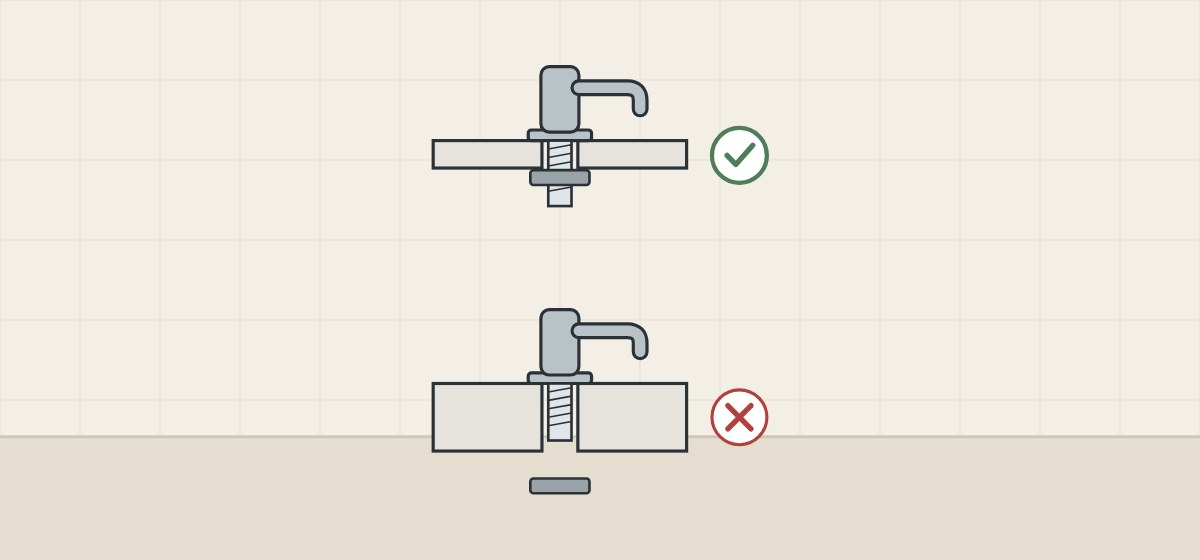
Only as thick as the faucet’s sheet allows. These documents print a maximum, and two of them a minimum:
| Model | Deck thickness on the sheet |
|---|---|
| Delta 3567-MPU-DST | 2-1/4 in maximum |
| Delta 15748LF | 1-3/16 in maximum |
| Moen WS84228 | 1/4 in minimum; 1-3/16 in maximum |
| Moen 6610 | 5/16 in minimum; maximum 1-3/16 in (1234 cartridge version) or 3/4 in (1224 cartridge version) |
| Moen TS6925 | 1-1/4 in maximum; for 1-1/2 to 3 in the sheet names kit 175709, with valves through a 1-1/4 in hole |
| hansgrohe Rebris | 30 mm maximum depth of mounting surface |
The Moen 6610 and WS84228 files each cover two versions; on the 6610 the maximum differs, so the version matters. Where a sheet names no kit for thicker decks, ask the maker, change the faucet or thin the deck at the hole.
Which drain matches a bowl with or without an overflow?
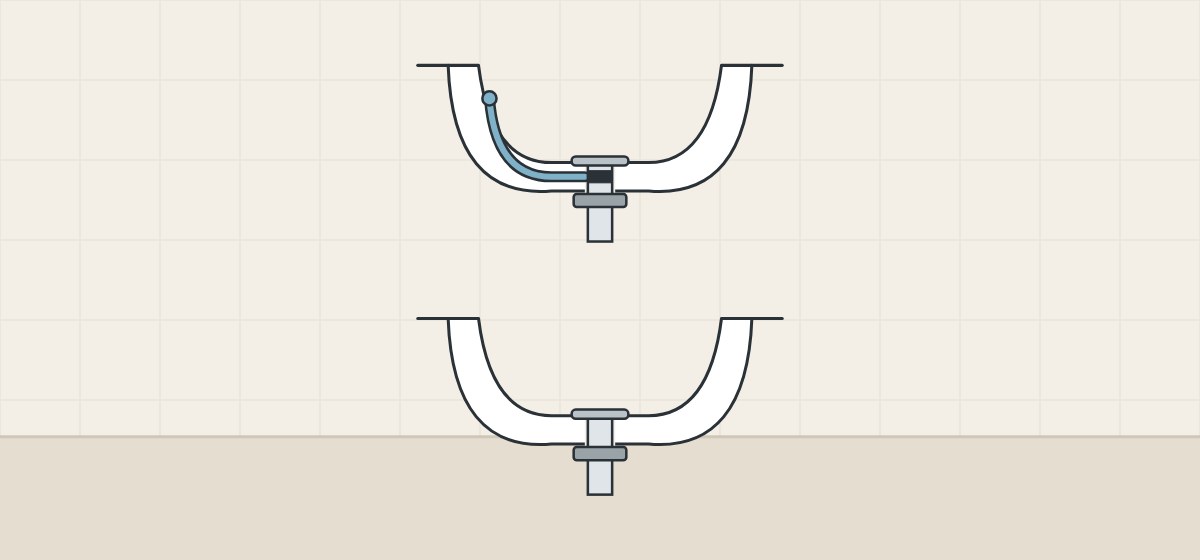
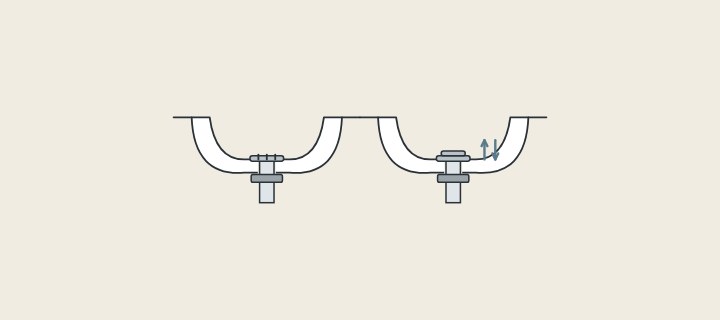
Check the drain against the bowl. Crosswater’s FAQ says a basin with an overflow needs a slotted waste and a basin without one an unslotted drain; it also offers universal drains for either. Kohler’s drain sheets state which they are:
With an overflow
Kohler’s K-7124-A is a pop-up clicker drain with overflow. hansgrohe’s Rebris manual says its drain is intended for a sink with an overflow.
Without an overflow
Kohler’s K-7124 is the clicker drain without overflow. For a sink with no overflow, hansgrohe refers to the sink’s instructions.
Drain hole size
Kohler’s K-2356-8 sink has a 1-3/4 in drain hole. hansgrohe says its drain suits most, but not all, lavatory sinks sold in the United States and Canada.
Lift-rod room
Moen’s WS84228 sheet covers two versions: one recommends at least 2 in to the backsplash for lift-rod operation, the other 2-1/2 in.
- Overflow: yes or no
- Drain model and type
- Drain hole diameter
- Bowl thickness at the drain
- Operation and rod clearance
What does the trap need under the top?
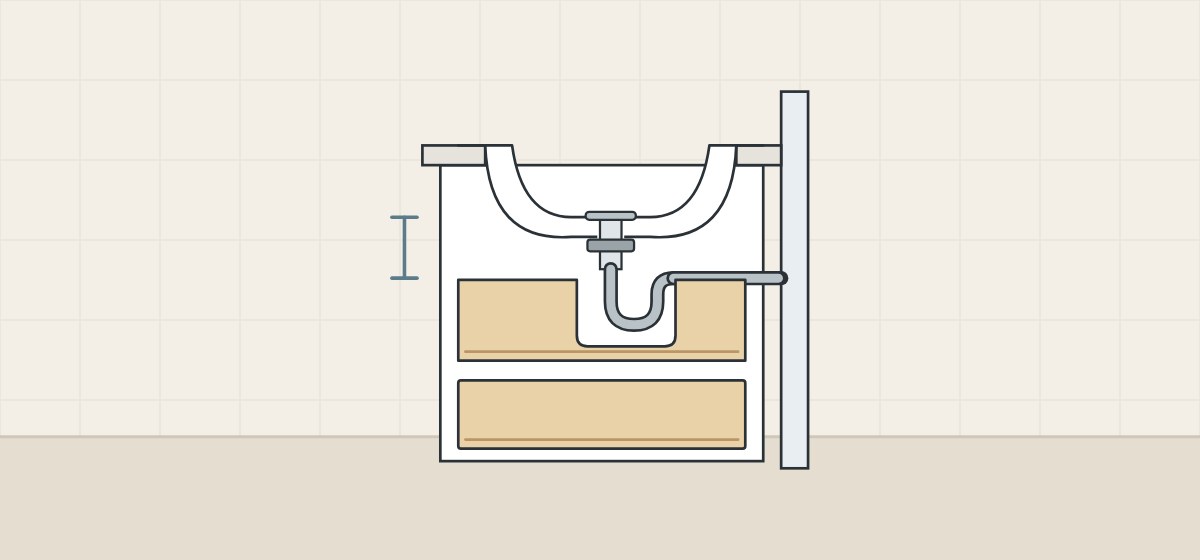
The trap needs height below the drain outlet and room among the drawers. One state rule and one maker show what to check:
A trap for each fixture
Wisconsin’s SPS 382.32 requires each plumbing fixture to be separately trapped by a water seal trap, with listed exceptions.
Seal depth
The same rule sets a liquid seal of 2 to 4 in unless the chapter specifies otherwise. Separately, Geberit’s UK catalogue gives a 50 mm water seal for its space-saving drain for the ONE washbasin; the two are not compared here.
Height and offset
With listed exceptions, Wisconsin limits the vertical distance from the top of the fixture drain outlet to the horizontal center line of the trap outlet to 15 in, and the horizontal distance from the drain outlet to the trap inlet to 15 in.
Room for drawers
Geberit lists that drain for washbasins without visible overflow, for a cabinet without trap cutout, and for a material thickness of 15 to 20 mm near the waste outlet.
These are examples, not general rules; confirm the trap with the local authority. This guide’s own step: draw the trap against the drawers, then move the drain, shorten the drawer or give it a cut-out.
Which standards do the maker sheets name?
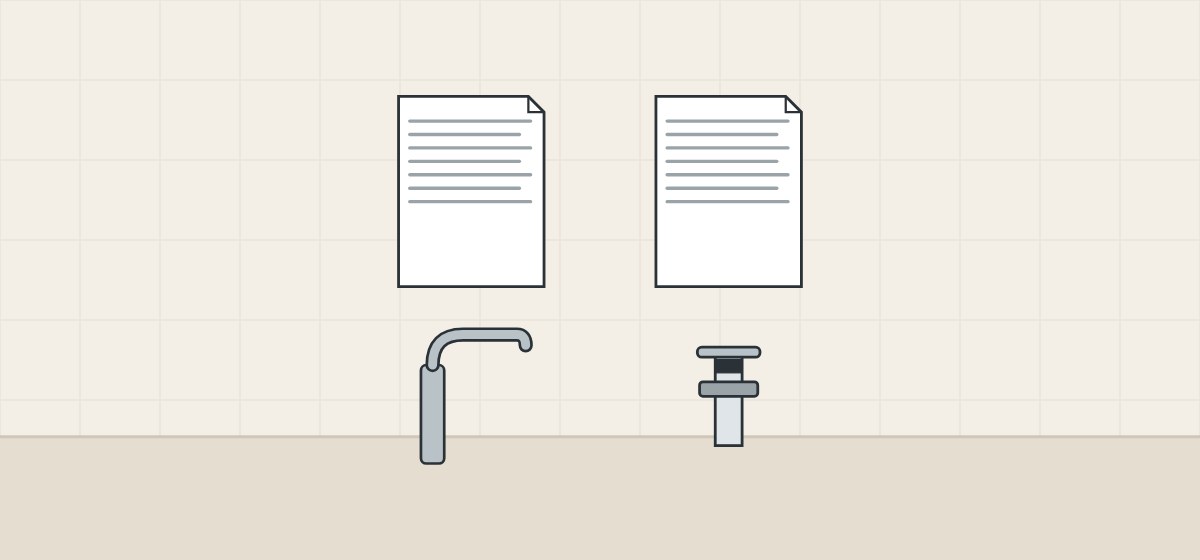
The sheets name standards without an edition year. This guide did not read them.
| Sheet | Standards named |
|---|---|
| Delta 3567-MPU-DST faucet | ASME A112.18.1/CSA B125.1 and ASME A112.18.2/CSA B125.2 |
| Kohler K-7124 drain | ASME A112.18.2/CSA B125.2 |
Who supplies each datum, and when is the drawing locked?
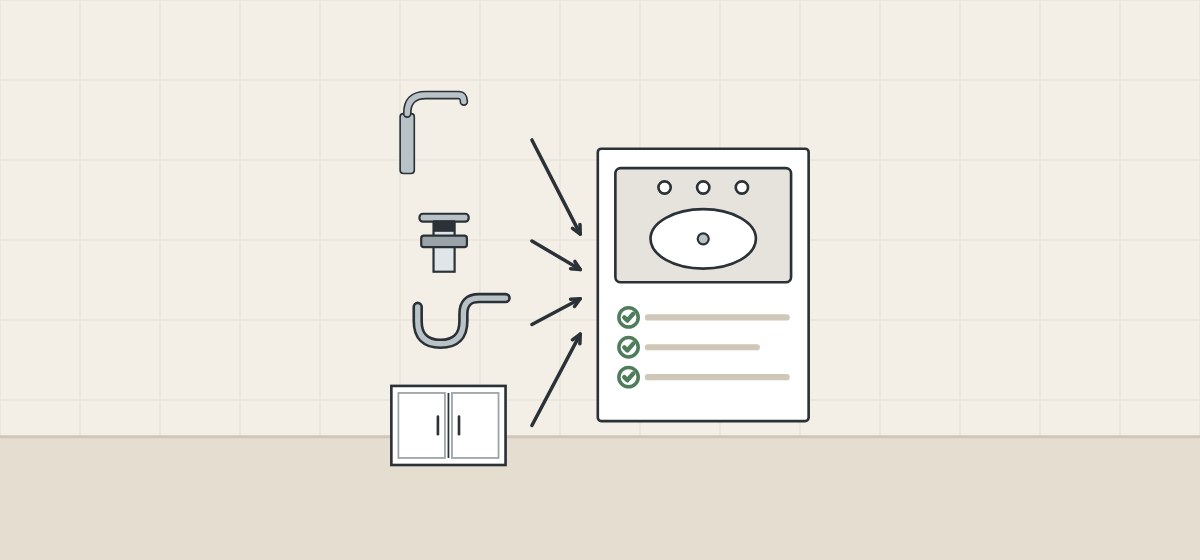
Each datum has one supplier; the drawing is locked when every hole has a source. This is procurement guidance.
- Buyer or plumbing supplier. Faucet and drain models with current sheets.
- Plumbing designer or contractor. Rough-in drawing, trap type and whether an overflow is needed.
- Cabinet supplier. Drawer positions and depths under the bowl.
- Top supplier. Thickness at each hole and at the drain; the combined drawing.
- Hold on a missing item. Without a model and sheet the drawing stays open.
- Lock and sign. Every hole has a diameter, position and source.
- Fit the first top. Mount the real faucet and waste and run water.
Why a late model change can mean a new top
A cut hole fixes diameter, centers and position, and the sheets above differ by model. Delta states on its sheets that it may change specifications and discontinue models without notice. This guide’s rule: a change before cutting means a reissued drawing; a change after cutting means checking the new sheet against the holes already cut, and a new top if they do not match.
What should you send and ask before a quotation?
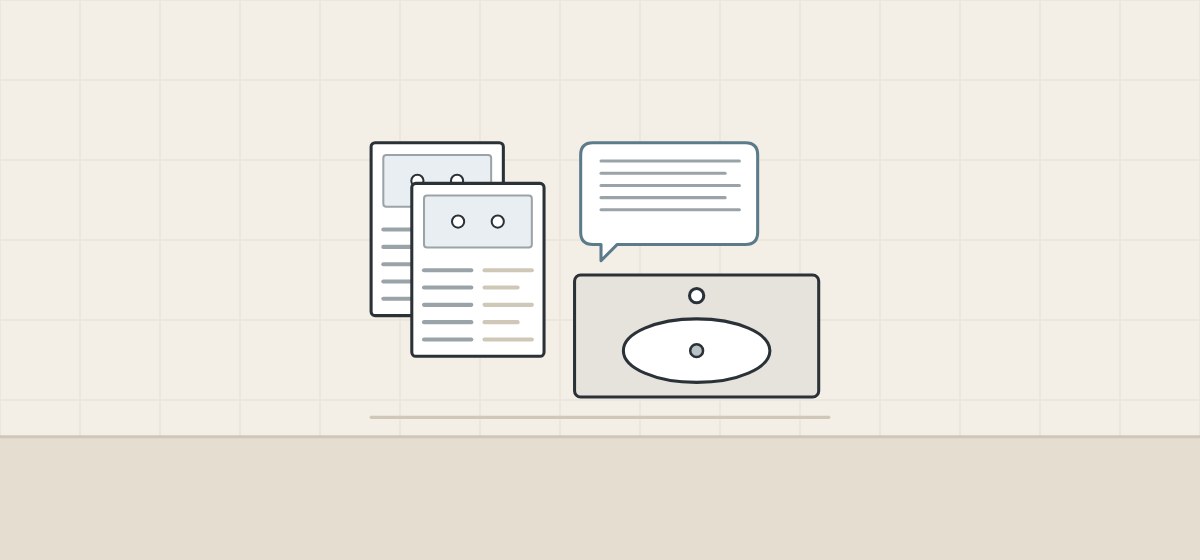
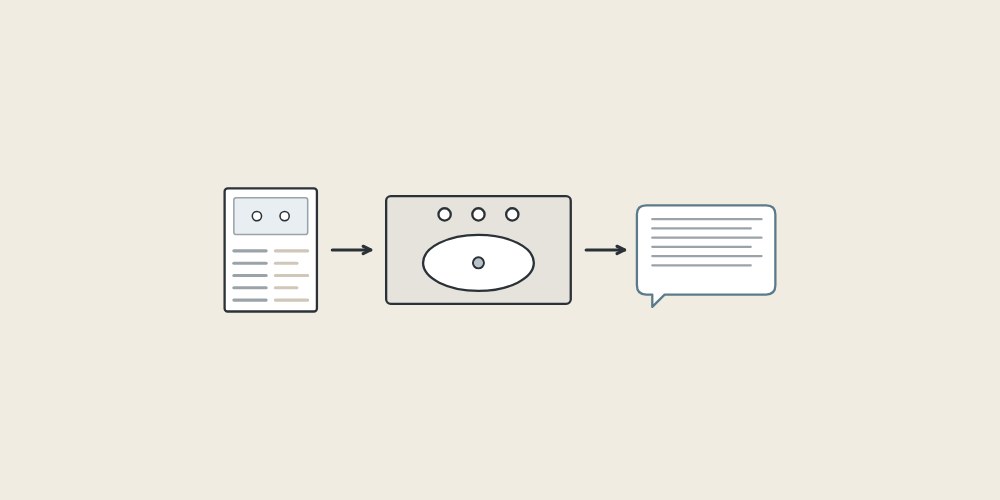
Send the sheets, not a photo: a picture shows the look, not the hole, the deck thickness or the drain.
| Question | Why it matters |
|---|---|
| Which faucet model is the top drawn to? | Hole data are printed per model. |
| How thick is the top at each faucet hole? | Sheets print a maximum. |
| Does the bowl have an overflow? | Crosswater pairs the drain type with it. |
| What is the drain hole diameter? | A supplied drain may not suit. |
| Where does the trap sit against the drawers? | Drawers may need a cut-out. |
| Will the first top be test-fitted? | A paper match is not a fit test. |
Include with your request
- Faucet and drain sheets
- Sink sheet, with any cut-out template
- Plumbing rough-in drawing
- Cabinet drawing with drawers
- List of extra holes, if any
WNS Global confirms any offered top, basin, drilling and commercial terms separately in writing. This guide does not state that WNS Global products have the hole sizes, deck thicknesses, drains, traps or standards listings named above.